
Main Points :
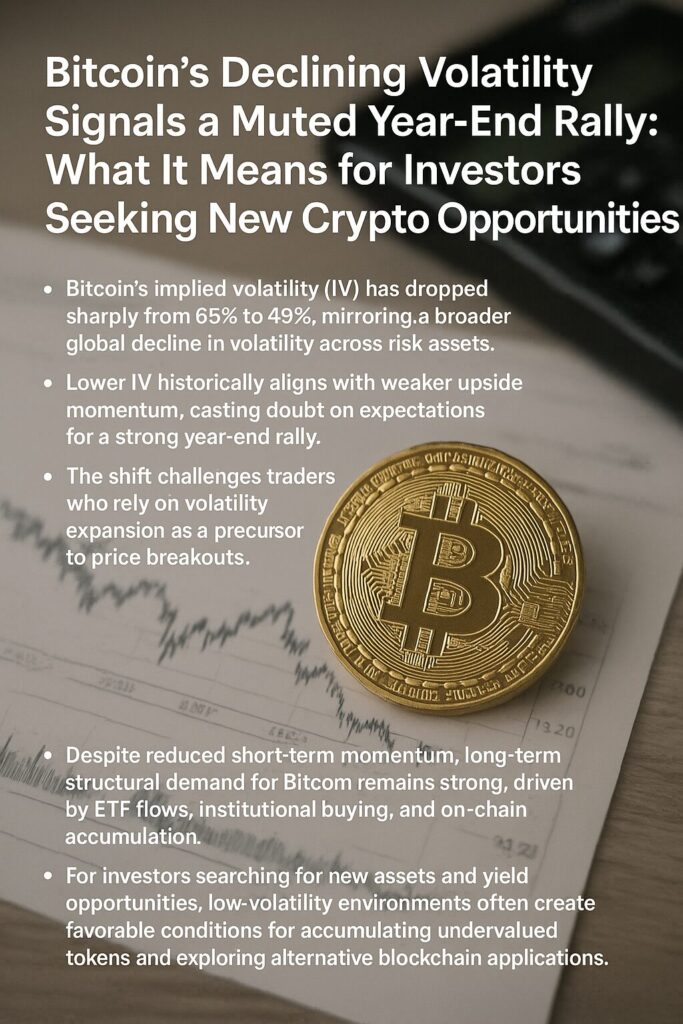
- Bitcoin’s implied volatility (IV) has dropped sharply from 65% to 49%, mirroring a broader global decline in volatility across risk assets.
- Lower IV historically aligns with weaker upside momentum, casting doubt on expectations for a strong year-end rally.
- The shift challenges traders who rely on volatility expansion as a precursor to price breakouts.
- Despite reduced short-term momentum, long-term structural demand for Bitcoin remains strong, driven by ETF flows, institutional buying, and on-chain accumulation.
- For investors searching for new assets and yield opportunities, low-volatility environments often create favorable conditions for accumulating undervalued tokens and exploring alternative blockchain applications.
Introduction: A Market Losing Momentum at the Worst Possible Time
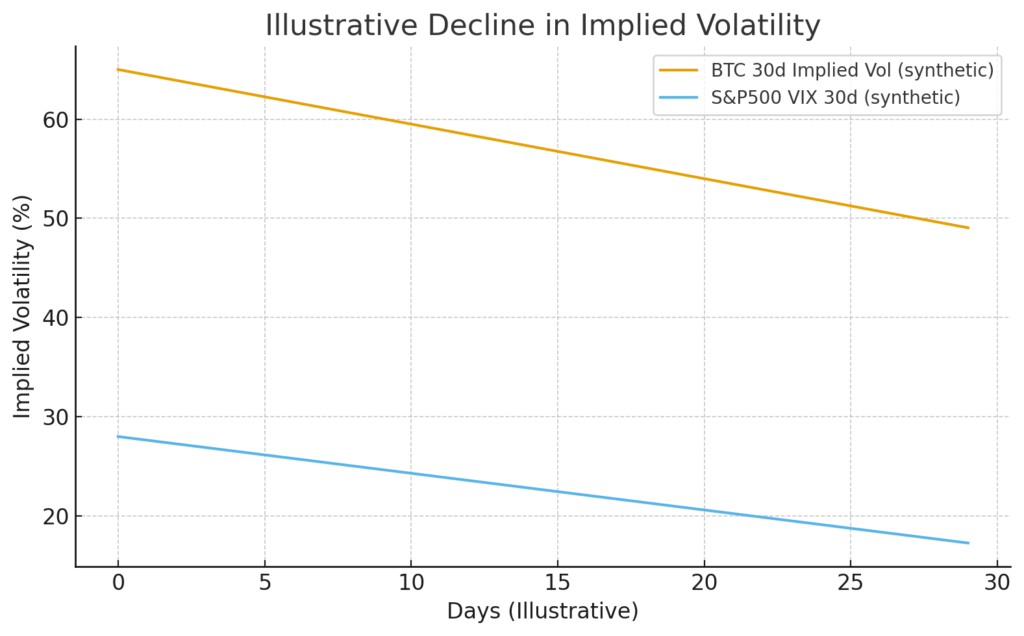
Bitcoin (BTC) enters the final weeks of the year in an unusually calm state. Its implied volatility—an option-driven metric reflecting the market’s expectation of future price movement—has declined markedly, slipping from 65% to 49% within a short period. This decline mirrors the broader reduction in volatility seen in the S&P500’s VIX index, which has fallen from 28% to 17% since late November.
At first glance, stability might appear beneficial for an asset frequently criticized for its extreme price swings. Yet major research firms, including Matrixport, argue that this very decline in volatility undermines the probability of a year-end rally. Historically, Bitcoin’s most explosive upside moves have occurred during periods of increased volatility—often triggered by macro events, liquidity injections, or rapid shifts in investor sentiment.
The new environment poses a dilemma for traders and investors. Bitcoin remains fundamentally strong, with institutional demand rising and digital asset adoption broadening. However, market mechanics indicate that large price moves are becoming less likely in the immediate short term. For investors seeking new crypto assets or yield-generating opportunities, understanding this volatility compression is essential for positioning ahead of 2026.
In this article, we summarize the core findings from the referenced report, integrate updated insights from other market sources, and provide an in-depth interpretation of how today’s volatility landscape shapes tomorrow’s crypto opportunities.
Section 1: Understanding Bitcoin’s Falling Volatility
TradingView data shows that Bitcoin’s 30-day annualized implied volatility—measured via Volmex’s BVIV index—now sits at 49%. This is a significant decline from its peak of 65% reached only weeks earlier, during a brief surge in trading activity.
What does a drop from 65% to 49% mean?
It indicates that expected 30-day price variation has narrowed by approximately 5 percentage points, translating to an estimated ±14% price movement range rather than the earlier ±19% range.
This may seem like a minor adjustment, but for derivatives traders and volatility-based strategies, it represents a structural shift in market expectations. Lower IV typically signals:
- Reduced appetite for leveraged speculation
- Fewer catalysts driving uncertainty
- Stabilizing liquidity conditions
- A stronger underlying sense of equilibrium between buyers and sellers
The S&P500’s VIX index has followed a similar trajectory, falling from 28% to 17%. The parallel movement reinforces the argument that Bitcoin increasingly behaves like a macro-sensitive risk asset, responding to global volatility regimes rather than crypto-specific narratives alone.
Section 2: Why Low Volatility Weakens the Year-End Bullish Outlook
Matrixport’s latest market update states that falling implied volatility “reduces the likelihood of a meaningful upside breakout into year-end.” The report emphasizes that the final major catalyst—the U.S. FOMC meeting—will soon pass. Once that concludes, the market is expected to experience a further decline in volatility heading into the holiday period.
Historically, Bitcoin tends to experience reduced trading volumes in late December as institutional desks close and liquidity conditions thin. Price rallies during such periods often require a surge of volatility—typically triggered by macro shocks or strong risk-on sentiment—but neither seems present at the moment.
Moreover, the relationship between volatility and price has changed. Before November 2024, Bitcoin’s price and implied volatility tended to move together—higher volatility often preceded rallies. But analysts note a gradual decoupling: volatility has fallen while price has remained relatively stable, implying that bullish momentum is weakening.
A low-volatility environment therefore implies:
- Reduced probability of large breakout rallies
- Limited short-term upside for momentum traders
- A consolidation phase rather than an expansion phase
This is not a bearish signal. Rather, it suggests a temporary pause—a “coiling period” in market terms—before the next major macro trigger.
Section 3: Macro Conditions Reinforcing the Decline in Volatility
Several external forces contribute to the ongoing volatility suppression:
1. The U.S. Federal Reserve’s Policy Stabilization
While earlier months were dominated by uncertainty over rate cuts, the market now anticipates a steady policy stance. Confidence reduces volatility.
2. Declining geopolitical tensions
Compared to previous years, risk premiums in oil, global currencies, and equities have contracted. Bitcoin is no longer trading as a crisis hedge but as a risk asset aligned with equities.
3. ETF flows stabilizing
U.S. Bitcoin ETFs saw rapid inflows during early quarters. By late year, inflows became more consistent but less explosive, reducing market turbulence.
4. Reduced liquidations on futures markets
With lower IV, leverage ratios normalize. Massive short or long squeezes become less frequent, constraining breakout potential.
Section 4: Opportunities for Investors in a Low-Volatility Landscape
While the article’s initial findings emphasize muted bullish momentum, investors seeking new crypto assets or emerging revenue opportunities may find the environment ideal for accumulation and research.
Here are the primary opportunities created by low volatility:
1. Accumulation Phases for High-Conviction Assets
Periods of reduced volatility often precede major price expansions. Historically, Bitcoin rallied strongly after prolonged quiet periods—such as in:
- Early 2019
- Mid-2020
- Late-2022
Investors who accumulated during low-IV stretches saw asymmetric upside.
2. Attractive Entry Points for New Altcoins
Lower volatility typically enables:
- stable pricing
- reduced risk of sudden drawdowns
- favorable conditions for evaluating new project fundamentals
Emerging assets that benefit include:
- Layer-2 scalability tokens
- AI-integrated blockchain projects
- Real-world-asset (RWA) tokenization platforms
- Yield-oriented DeFi tokens
3. Increased viability for hedging and structured products
Volatility compression lowers the cost of:
- protective puts
- options-based yield strategies
- delta-neutral farming
- covered calls on BTC and ETH
This expands revenue models for advanced traders and treasury managers.
4. Stronger conditions for institutional participation
Lower volatility reduces regulatory concern and operational risk for:
- payment companies
- fintech custodians
- asset managers
This broadens long-term demand for BTC and high-quality alternative assets.
Section 5: Key Risks Despite the Calm
A low-volatility environment also introduces certain challenges:
1. Complacency leading to sharp unwinding
When markets assume stability, they often misprice risk. A sudden macro shock may cause disproportionately large moves.
2. False breakouts
With thinner liquidity during holidays, even modest trading pressure can trigger misleading price movements.
3. Underperformance of momentum strategies
Traders expecting trending markets may see reduced returns.
4. Reduced mining revenue volatility
While beneficial for miners’ stability, it may also reduce speculative interest in mining-related tokens or hash-rate futures.
Section 6: The Bigger Picture—Long-Term Bullish Drivers Remain Intact
Despite short-term volatility compression, the broader crypto narrative remains remarkably strong. Recent developments across the industry include:
1. Expanding global ETF market
ETFs in Europe, Canada, and Asia have seen record adoption, providing consistent baseline demand.
2. Institutional custody infrastructure maturing
Major banks now integrate:
- tokenization services
- blockchain settlement
- digital asset trading desks
3. Growth in stablecoin settlement volumes
Stablecoins now rival traditional remittance channels in efficiency and cost. As stablecoins integrate across fintech apps, BTC and ETH usage also grows.
4. Increase in on-chain corporate treasury allocations
More companies are allocating to Bitcoin as an inflation hedge and alternative liquidity reserve.
These forces imply that even if a year-end rally does not materialize, long-term structural demand remains robust.
Conclusion: Calm Today, Opportunity Tomorrow
Bitcoin’s falling volatility paints a picture of stability that paradoxically reduces the likelihood of a powerful year-end rally. Yet, for investors seeking new crypto assets or practical blockchain opportunities, this environment may be favorable rather than discouraging.
Low volatility:
- narrows risk
- enables careful accumulation
- supports strategic portfolio building
- introduces new yield-generating mechanisms
In other words, today’s calm may be the early foundation for tomorrow’s expansion. The absence of a year-end rally should not be interpreted as weakness; rather, it signals a maturing market preparing for its next leg of long-term growth.
