
Main Points :
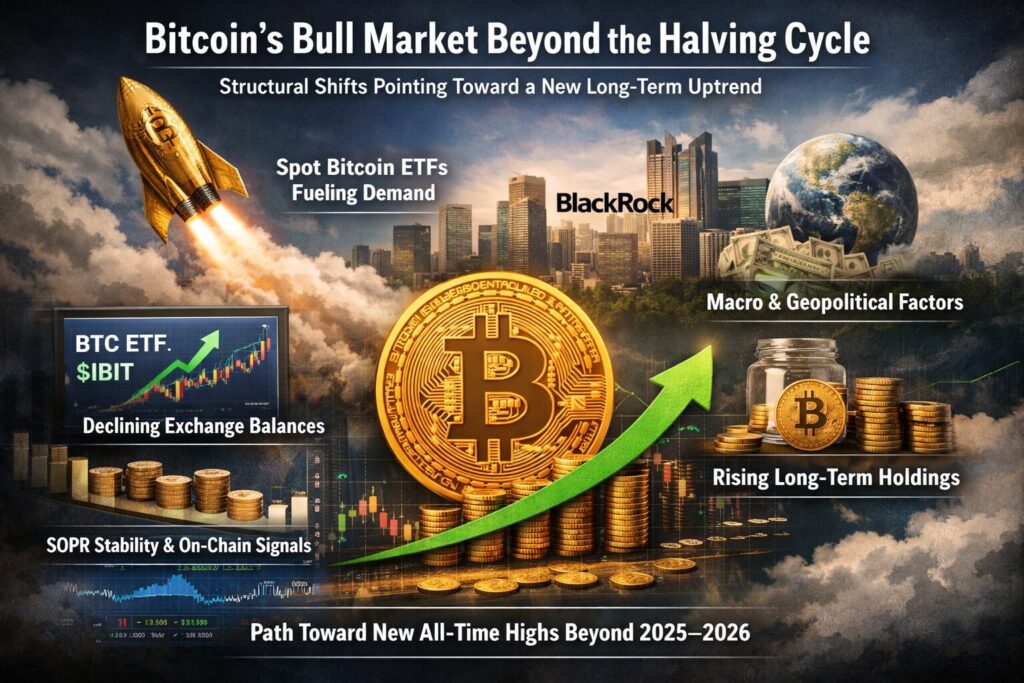
- Bitcoin’s traditional four-year halving cycle is showing signs of structural transformation rather than repetition.
- Institutional inflows via spot Bitcoin ETFs, especially BlackRock’s IBIT, are creating sustained demand independent of miner-driven supply shocks.
- Declining exchange balances indicate reduced sell pressure and growing long-term holding behavior.
- On-chain indicators such as SOPR stability suggest a more mature and less speculative market.
- Macro factors, including monetary easing expectations and geopolitical uncertainty, are reinforcing Bitcoin’s role as a digital store of value.
- Even amid corrections, long-term capital inflows point to the possibility of new all-time highs beyond 2025–2026.
1. Signs of a Structural Shift in the Four-Year Bitcoin Cycle
For more than a decade, Bitcoin’s price behavior has been largely interpreted through the lens of its four-year halving cycle. Each halving event—when Bitcoin’s block reward is cut in half—has historically reduced new supply, triggering bull markets followed by sharp corrections. However, according to a December 17, 2025 report by on-chain analytics firm CryptoQuant, this long-standing pattern may be undergoing a fundamental transformation.
CryptoQuant argues that Bitcoin is gradually transitioning away from a purely halving-dependent market structure toward a more demand-driven model. This shift is significant because it suggests that Bitcoin’s long-term price trajectory may no longer be constrained by the predictable boom-and-bust rhythm that characterized earlier cycles.
From an on-chain perspective, several indicators support this view. Exchange balances have continued to decline, while profit-taking metrics remain stable. Together, these trends imply that Bitcoin holders are behaving less like short-term speculators and more like long-term allocators of capital.
CryptoQuant refers to this potential new phase as the emergence of a “supercycle,” where structural demand from traditional finance dampens extreme volatility and extends bullish conditions beyond the post-halving window.
2. Moving Beyond Halving Dependency: What Has Changed?
The most important change underpinning this structural shift is the nature of Bitcoin demand itself. In previous cycles, demand was dominated by retail investors and crypto-native funds, often driven by momentum and speculation. In contrast, the current cycle is increasingly shaped by institutional capital.
Spot Bitcoin ETFs approved in the United States have opened the door for pension funds, asset managers, endowments, and other conservative capital pools to gain Bitcoin exposure without directly holding the asset. This represents a fundamental evolution in Bitcoin’s market structure.
Unlike retail speculation, institutional allocation tends to be:
- Longer-term in horizon
- Less sensitive to short-term price fluctuations
- Driven by portfolio construction and macro hedging
As a result, Bitcoin demand is becoming steadier and more resilient, reducing reliance on the halving as the sole catalyst for price appreciation.
3. Institutional Demand and the Role of IBIT
One of the clearest examples of this shift is BlackRock’s iShares Bitcoin Trust (IBIT). Since its launch in 2024, IBIT has consistently attracted capital and has become a cornerstone of institutional Bitcoin exposure.
As of late 2025, IBIT’s assets under management (AUM) have reached approximately $68 billion, making it one of the largest Bitcoin investment vehicles in the world. This growth is not merely symbolic; it represents real, persistent demand for physical Bitcoin in the spot market.
Illustrative Growth of IBIT AUM (USD billions)
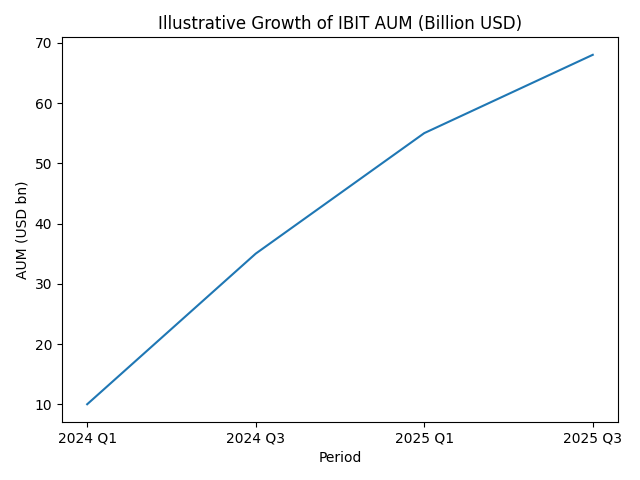
The steady accumulation through IBIT suggests that Bitcoin is increasingly viewed as a strategic asset rather than a speculative trade. This aligns with statements from traditional market strategists such as Tom Lee, who has repeatedly emphasized that “the best years for digital assets are still ahead.”
4. Declining Exchange Balances and Reduced Sell Pressure
On the supply side, CryptoQuant highlights a sharp decline in Bitcoin held on centralized exchanges. In the second half of 2025, exchange balances reportedly fell from approximately 2.4 million BTC to 1.83 million BTC within a relatively short period.
Illustrative Decline in Bitcoin Exchange Balances (Million BTC)
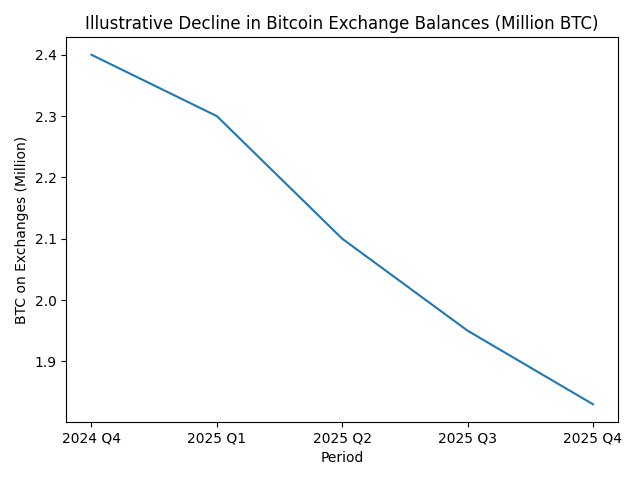
This reduction is critical because Bitcoin stored on exchanges is generally considered more liquid and more likely to be sold. A decline in exchange balances therefore implies:
- Reduced immediate sell pressure
- Increased long-term holding behavior
- Greater confidence among investors
Complementing this trend is the stability of SOPR (Spent Output Profit Ratio), which has hovered around the neutral level of 1. This indicates that investors are neither aggressively realizing profits nor capitulating at losses—another sign of a more balanced and mature market.
5. Macro Environment Strengthening Bitcoin’s Position
Beyond on-chain data, macroeconomic conditions are playing an increasingly important role in Bitcoin’s long-term outlook. Rising geopolitical tensions, concerns about sovereign debt sustainability, and expectations of renewed monetary easing have all contributed to Bitcoin’s growing appeal as a non-sovereign store of value.
Several large asset managers now explicitly compare Bitcoin to gold, positioning it as “digital gold” for the modern financial system. Unlike earlier narratives driven by technological novelty, this framing resonates with institutional investors seeking diversification and inflation hedges.
Grayscale Investments has echoed this view, suggesting that Bitcoin’s historical four-year cycle may no longer apply in its traditional form. According to Grayscale, continued regulatory clarity in the U.S. and expanding demand for alternative assets could sustain capital inflows well into 2026.
6. Can the Bull Market Survive Corrections?
Despite these bullish structural trends, Bitcoin is not immune to volatility. In October 2025, Bitcoin reached a new all-time high of approximately $126,000, before entering a correction phase. Prices subsequently fell by around 30%, stabilizing near $86,000 at the time of writing.
During this correction, roughly $523 million flowed out of BlackRock’s Bitcoin ETF products, reminding investors that institutional capital can still react to short-term market stress.
However, the broader picture remains constructive. University endowments, sovereign wealth funds, and long-term asset allocators have reportedly begun allocating small but meaningful portions of their portfolios to Bitcoin. This type of capital is typically patient and strategic, reinforcing the idea that Bitcoin is transitioning from a speculative instrument to a mainstream asset class.
7. Outlook: Toward 2026 and Beyond
Analysts from firms such as Bitwise have gone as far as predicting new all-time highs in 2026, arguing that the traditional post-halving bear market may fail to materialize this time. While risks remain—particularly from regulatory shocks or global financial crises—the underlying market structure appears stronger than in previous cycles.
The key question moving forward is not whether Bitcoin will experience volatility, but whether it can maintain its upward trajectory without reverting to a prolonged bear market. If institutional demand continues to grow and liquid supply remains constrained, the conditions for a sustained bull market appear firmly in place.
Conclusion
Bitcoin’s market is evolving. What was once a cycle driven primarily by protocol mechanics is becoming a market shaped by institutional capital, macroeconomic forces, and long-term strategic allocation. CryptoQuant’s analysis suggests that Bitcoin may be entering a new era—one where the halving still matters, but no longer defines the entire narrative.
For investors seeking new digital assets, alternative revenue streams, or practical blockchain exposure, this structural shift is critical to understand. Bitcoin’s bull market may not only be continuing—it may be transforming into something fundamentally different.
