Main Points :
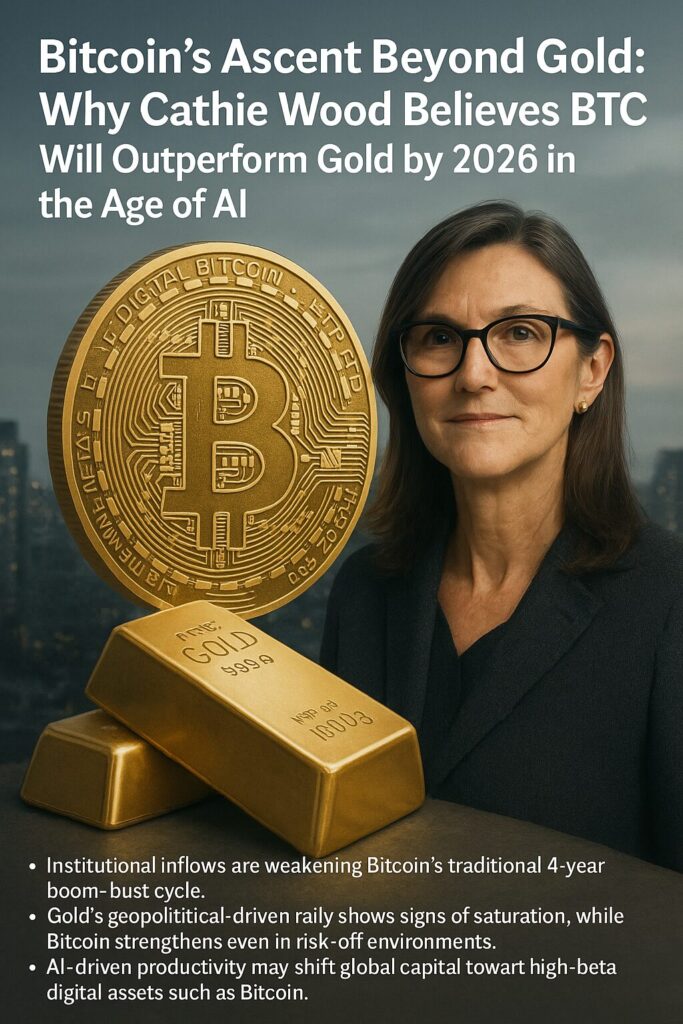
- Institutional inflows are weakening Bitcoin’s traditional 4-year boom–bust cycle.
- Gold’s geopolitical-driven rally shows signs of saturation, while Bitcoin strengthens even in risk-off environments.
- AI-driven productivity may shift global capital toward high-beta digital assets such as Bitcoin.
- By late 2025, BTC price behavior reveals maturing investor psychology and reduced volatility.
- Long-term forecasts point to Bitcoin becoming a superior “store of value” over gold by 2026.
Introduction: A New Financial Paradigm Emerges
When Cathie Wood, CEO of ARK Invest, appeared on FOX Business on December 9, 2025, her message was unmistakable and bold: Bitcoin is no longer bound by the traditional four-year cycle that defined its earlier years. According to Wood, the influx of institutional capital has dramatically changed the dynamics of the Bitcoin market, dampening its historical volatility and creating a structural foundation that could carry the asset far beyond its previous limits.
Most notably, she stated that Bitcoin could outperform gold as early as 2026, marking a historical shift in global financial behavior. Coming from one of the world’s best-known technology-forward investment leaders, this prediction is more than speculation—it reflects deeper macroeconomic patterns involving AI, risk assets, and the modernization of global portfolio allocation.
To understand why this outlook matters, this article synthesizes Wood’s latest remarks, contextual market data, insights from other major analysts, and additional research into institutional behavior and technological acceleration.
1. Bitcoin Versus Gold: Why 2026 Could Be the Turning Point
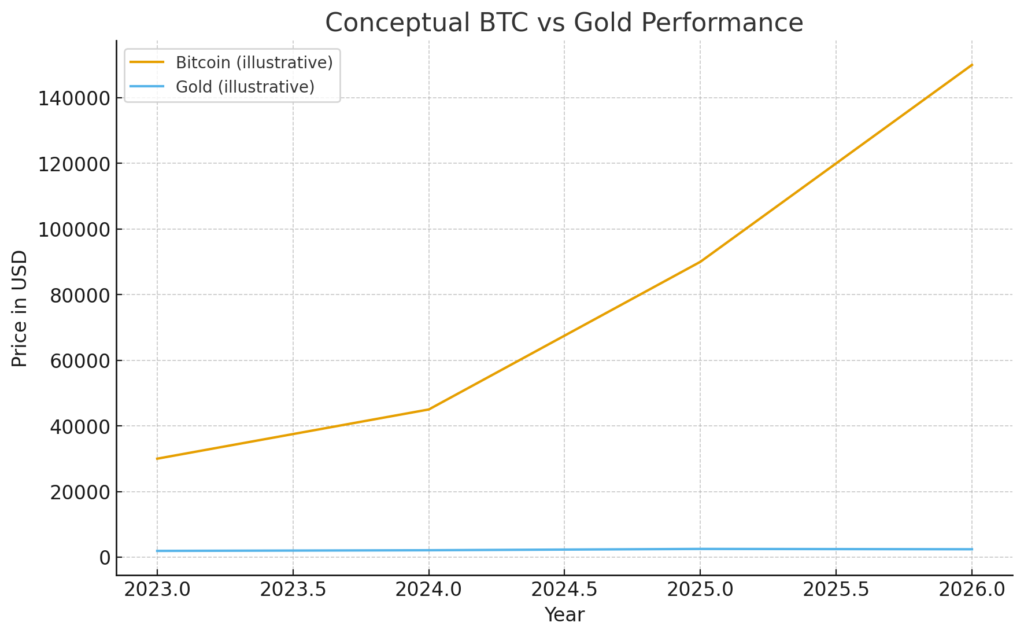
Cathie Wood highlighted a powerful comparison: despite gold rising nearly 60% year-to-date as a hedge during geopolitical instability, Bitcoin has shown an even more persistent upward trajectory—one that Wood describes as “climbing a wall of worry.”
This metaphor reveals the psychological foundation behind modern capital flows. While gold appreciates when fear increases, Bitcoin is increasingly behaving like a structural asset—less influenced by panic and more influenced by long-term adoption.
Gold: A Traditional Safe Haven with Limited Upside
Gold’s surge is largely tied to geopolitical tensions and heightened uncertainty. Historically, gold thrives when fear rises—but its upside tends to flatten once conditions stabilize. The 1980s and 1990s provide examples: during waves of technological innovation, gold stagnated or declined as investors sought new opportunities.
Bitcoin: An Adaptive, Scarce, Global Digital Asset
Bitcoin’s unique qualities—digital scarcity, transportability, transparency, and decentralization—make it increasingly appealing to institutional investors seeking yield, liquidity, and long-term hedging. Bitcoin’s total addressable market (TAM) has grown beyond “digital gold”; it now interacts with AI, cloud infrastructure, cross-border payments, and emerging financial rails.
Because of these structural differences, Wood argues that Bitcoin’s upside potential is far larger than gold’s—especially as AI reconfigures global productivity and capital allocation.
2. The Institutional Era: Why Bitcoin’s Traditional 4-Year Cycle Is Breaking
Bitcoin historically followed a predictable pattern based on halving cycles—strong bull market, followed by a deep retracement. However, Wood and many other analysts now believe that the halving cycle is losing its influence.
Institutional Capital as a Shock Absorber
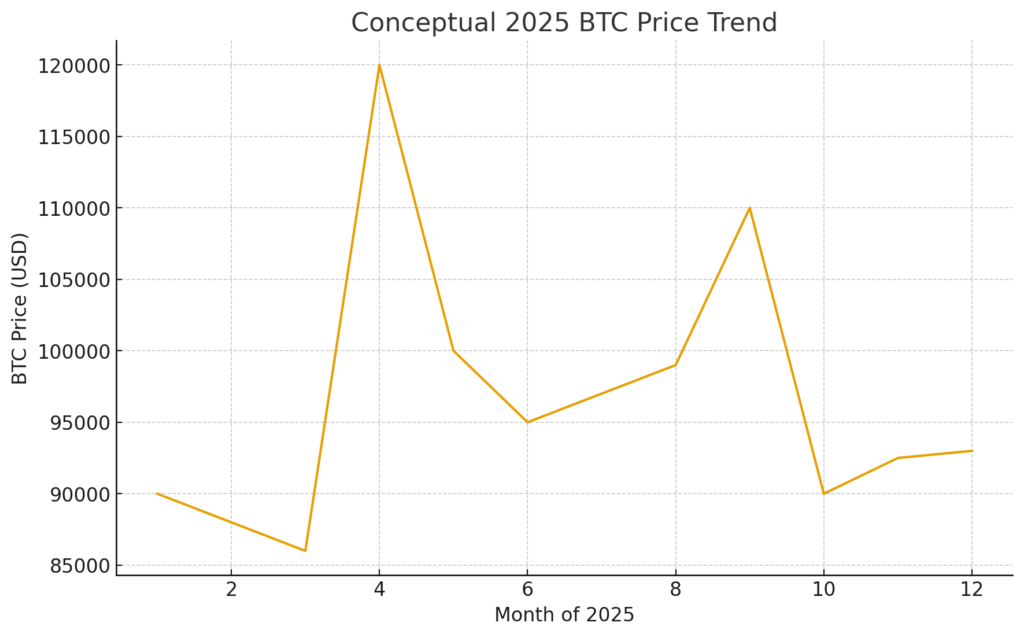
The most direct evidence comes from Bitcoin’s behavior in late 2025. After reaching an all-time high over $126,000, BTC dropped around 30%—yet recovered quickly and stabilized above $80,000. This price resiliency, Wood explains, is the footprint of institutional participation.
Pension funds, asset managers, sovereign funds, insurance companies, and ETF products now hold significant BTC allocations. This creates structural bid pressure and reduces the magnitude of downturns.
Matt Hougan (Bitwise CIO): “2026 Will Be Another Up Year”
Hougan shares Wood’s view. He argues that:
- Halving cycles matter less than before.
- Regulatory clarity is gradually improving in key markets.
- Institutional products (particularly ETFs) have deepened liquidity.
As a result, Bitcoin’s growth may shift from cyclical to secular—a continuous trend of adoption rather than boom-bust speculation.
This maturing market environment increases the probability that Bitcoin behaves more like a high-growth macro asset and less like a volatile commodity.
3. The AI Productivity Boom: How AI Accelerates Capital Toward Bitcoin
Cathie Wood is widely known for linking investment themes across technology sectors, and her analysis of Bitcoin in the AI era is consistent with this approach. According to her, the world is undergoing a “historic productivity revolution” driven by artificial intelligence, robotics, and automation.
During Tech Booms, Risk Assets Outperform
History shows that during major innovation cycles—such as the PC era or the internet boom—capital shifts toward high-growth assets rather than conservative hedges.
Gold tends to underperform during sustained periods of technological optimism. Bitcoin, positioned at the intersection of finance and digital innovation, benefits directly from:
- increasing global digitalization,
- rising demand for programmable assets,
- AI-driven financial automation,
- and new forms of decentralized commerce.
Bitcoin’s Role as the “Primary Digital Store of Value”
Wood argues that Bitcoin is uniquely suited to become the dominant value storage asset within a digital, AI-enhanced economy. Its transparent monetary policy, decentralization, and predictable issuance provide advantages that gold cannot replicate.
By 2026, she expects these macro forces to converge—driving Bitcoin beyond gold in performance, adoption, and market relevance.
4. 2025 Price Behavior: What Market Psychology Reveals
Bitcoin’s price in 2025—trading around $92,500 near year-end after reaching above $126,000 earlier in the year—demonstrated a market increasingly characterized by maturity.
October 2025: The Great Liquidation Event
Following U.S. tariff announcements against China, global markets experienced sharp sell-offs, triggering approximately $19 billion in crypto liquidations. Historically, an event like this would have driven Bitcoin into a steep multi-month bear market.
But instead:
- pessimistic options positioning began to fade by November,
- institutional ETFs absorbed sell pressure,
- and long-term holders continued accumulating.
This signaled a psychological shift: market participants no longer view corrections as existential threats but as cyclical adjustments within a larger structural trend.
End-of-Year Sentiment
Concerns that BTC would fall below $80,000 did not materialize. Instead, the asset recovered, and ETF flows remained steady. This reinforces the thesis that Bitcoin’s long-term support levels are rising due to structural demand—not emotional speculation.
5. Additional Context: What Other Recent Sources Reveal
To enrich the analysis beyond the original Japanese report, here are key external trends (as of late 2025 and early projections for 2026):
1. ETF Inflows Still Increasing
BlackRock, Fidelity, ARK 21Shares, and other ETF sponsors continue reporting:
- rising institutional participation,
- strong AUM growth,
- and deepening liquidity in BTC derivatives.
ETFs reduce frictions in Bitcoin adoption and create a continuous automatic inflow mechanism.
2. Bitcoin as Collateral
Large financial institutions increasingly accept BTC as collateral for loans, derivatives, and structured products. This mirrors the behavior of gold in the early 20th century—before it became a global financial backbone.
3. Corporate Treasury Adoption
More companies allocate part of their treasury into BTC to hedge against inflation and currency devaluation. AI-driven firms, in particular, favor Bitcoin due to its programmability and global liquidity.
4. Gold Faces Structural Limits
Gold is constrained by:
- physical transport challenges,
- limited modern utility,
- regulatory barriers,
- and lower institutional yield opportunities.
Bitcoin faces none of these constraints.
6. Outlook for 2026: Will Bitcoin Truly Surpass Gold?
Given the convergence of:
- institutional inflows,
- AI-driven economic expansion,
- Bitcoin’s rising market liquidity,
- gold’s declining relative momentum,
- and greater regulatory clarity,
Cathie Wood’s prediction appears increasingly plausible. Even conservative analysts acknowledge that BTC is on track to exceed gold in performance and possibly in total investment demand within the coming years.
If Bitcoin reaches between $150,000–$250,000, while gold remains near $2,200–$2,500, the performance gap would widen significantly—cementing Bitcoin’s position as the premier global store-of-value asset of the digital age.
Conclusion: The Digital Store of Value Era
Bitcoin’s evolution from speculative asset to global monetary instrument is accelerating faster than expected. Cathie Wood’s view—that Bitcoin will surpass gold in 2026—is based on structural economic shifts, not hype.
AI, institutional participation, improved liquidity, and a maturing investor base are collectively rewriting the rules of value, risk, and global capital allocation.
The key takeaway for investors seeking new opportunities is clear:
Bitcoin is no longer just a crypto asset—it is becoming the foundational financial instrument of the AI-driven digital economy.