

Main Points :
- Bitcoin has corrected over 40% from its peak but is stabilizing around $71,000
- Institutional adoption—led by Morgan Stanley—is accelerating
- The launch of spot Bitcoin ETFs signals long-term commitment, not speculation
- Key technical support lies between $68,500–$70,000
- Macro risks persist, but institutional capital may absorb selling pressure
- A short-term path toward $80,000–$85,000 is plausible under current conditions
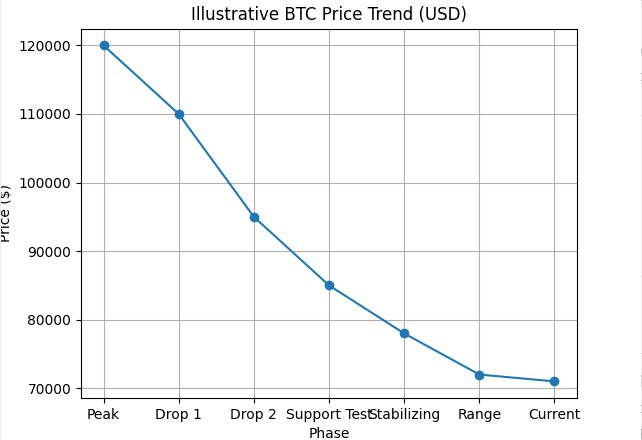
(BTC Price Trend Visualization)
1. A Market Reset: Bitcoin’s 40% Correction in Context
Bitcoin (BTC) is currently trading around $71,000, marking a significant correction of over 40% from its peak in October last year. At first glance, such a drop may appear alarming, particularly for retail investors accustomed to rapid upward momentum. However, when placed in a broader historical and structural context, this correction reflects a natural and even healthy phase in the maturation of the cryptocurrency market.
Unlike previous cycles driven predominantly by speculative retail inflows, the current market environment is undergoing a structural transition. Excessive leverage has been flushed out, short-term speculation has cooled, and price action has entered a consolidation phase. According to analysts at Bloomberg, the “speculative frenzy” that once defined crypto markets has largely dissipated.
This transition is critical. Markets that stabilize after a correction tend to build stronger foundations for sustainable growth. Bitcoin’s current price range suggests that it is forming a base rather than entering a prolonged bearish phase.
2. Institutional Momentum: Morgan Stanley’s Strategic Entry
One of the most important developments reinforcing this structural shift is the entry of major institutional players. Recently, Morgan Stanley launched its first spot Bitcoin ETF, known as $MSBT. On its first day of trading alone, the ETF recorded approximately $34 million in trading volume—an exceptionally strong debut by historical standards.
This event is significant for several reasons:
First, it marks the first time a major U.S. bank has directly issued a spot Bitcoin ETF. Unlike futures-based products, spot ETFs require actual Bitcoin holdings, creating real demand in the underlying market.
Second, institutional participation differs fundamentally from retail speculation. Institutional investors typically operate with longer time horizons, structured risk management frameworks, and strategic asset allocation models. Their entry signals confidence in Bitcoin not merely as a speculative asset, but as a legitimate component of diversified portfolios.
Third, such capital inflows can act as a stabilizing force. As funds flow into ETFs like $MSBT, they can absorb selling pressure, reducing volatility and supporting price floors.
3. Technical Landscape: Key Support and Resistance Levels
From a technical analysis perspective, Bitcoin is currently navigating a critical support zone between $68,500 and $70,000. This range serves as a battleground between buyers and sellers.
If Bitcoin maintains this support level, it suggests that demand is sufficiently strong to prevent further downside. In such a scenario, the market could enter a recovery phase, targeting higher resistance levels.
On the upside, analysts project that Bitcoin could reach $80,000–$85,000 within the next 4 to 6 weeks, provided that institutional inflows continue and macro conditions do not deteriorate significantly.
However, downside risks remain. If Bitcoin closes below $67,000 on a weekly basis, it could trigger a retest of the psychologically significant $60,000 level. Such a move would likely shake market confidence in the short term but could also present accumulation opportunities for long-term investors.
4. Macro Headwinds: Geopolitics and Global Trade Disruptions
Despite the positive momentum from institutional adoption, macroeconomic uncertainties continue to pose risks. Ongoing geopolitical tensions, including conflicts involving Iran, have introduced instability into global trade and financial markets.
These disruptions can have several indirect effects on Bitcoin:
- Increased volatility across asset classes
- Shifts in investor risk appetite
- Currency fluctuations impacting capital flows
Historically, Bitcoin has exhibited dual characteristics—acting both as a risk asset and a hedge, depending on market conditions. In times of extreme uncertainty, it may benefit from its narrative as “digital gold.” However, in broader risk-off environments, it can also experience short-term declines alongside equities.
The current environment reflects this tension. While macro risks persist, they have not been sufficient to derail institutional interest.
5. The Evolution of Bitcoin: From Speculation to Infrastructure
One of the most important takeaways from the current market cycle is the evolving role of Bitcoin within the financial ecosystem.
In earlier cycles, Bitcoin was largely driven by speculative narratives—rapid gains, retail hype, and short-term trading. Today, the narrative is shifting toward infrastructure and integration.
Institutional products like ETFs, custody solutions, and regulated trading platforms are transforming Bitcoin into a foundational asset within the global financial system. This shift has several implications:
- Reduced volatility over time
- Increased correlation with traditional financial markets
- Greater regulatory clarity
- Expanded use cases in portfolio diversification
For investors seeking new income opportunities and blockchain applications, this evolution opens new pathways. Yield strategies, structured products, and hybrid financial models are emerging around Bitcoin and other digital assets.
6. Forward Outlook: The Path to $85,000
Looking ahead, the path toward $85,000 is contingent on several key factors:
1. Sustained Institutional Inflows
Continued investment into ETFs and other institutional vehicles will be crucial in maintaining upward momentum.
2. Technical Stability
Holding the $68,500–$70,000 support zone will reinforce bullish sentiment.
3. Macro Stability
While risks remain, the absence of major shocks will allow the market to focus on fundamentals.
4. Market Psychology
The transition from speculative frenzy to measured optimism is essential for sustainable growth.
If these conditions align, Bitcoin could not only reclaim previous highs but establish new ones, driven by fundamentally different dynamics than in past cycles.
Conclusion
Bitcoin’s recent 40% correction is not a sign of कमज कमज but rather a reflection of a maturing market undergoing structural transformation. The entry of institutional players such as Morgan Stanley represents a pivotal shift from speculative trading to long-term capital allocation.
While risks remain—particularly from macroeconomic factors—the foundation being built today is significantly stronger than in previous cycles. The convergence of institutional adoption, technical stability, and evolving market narratives suggests that Bitcoin’s trajectory remains upward over the medium to long term.
For investors seeking new crypto assets, revenue opportunities, and practical blockchain applications, this phase represents not just a recovery—but a redefinition of what the crypto market can become.
