
Key Points :
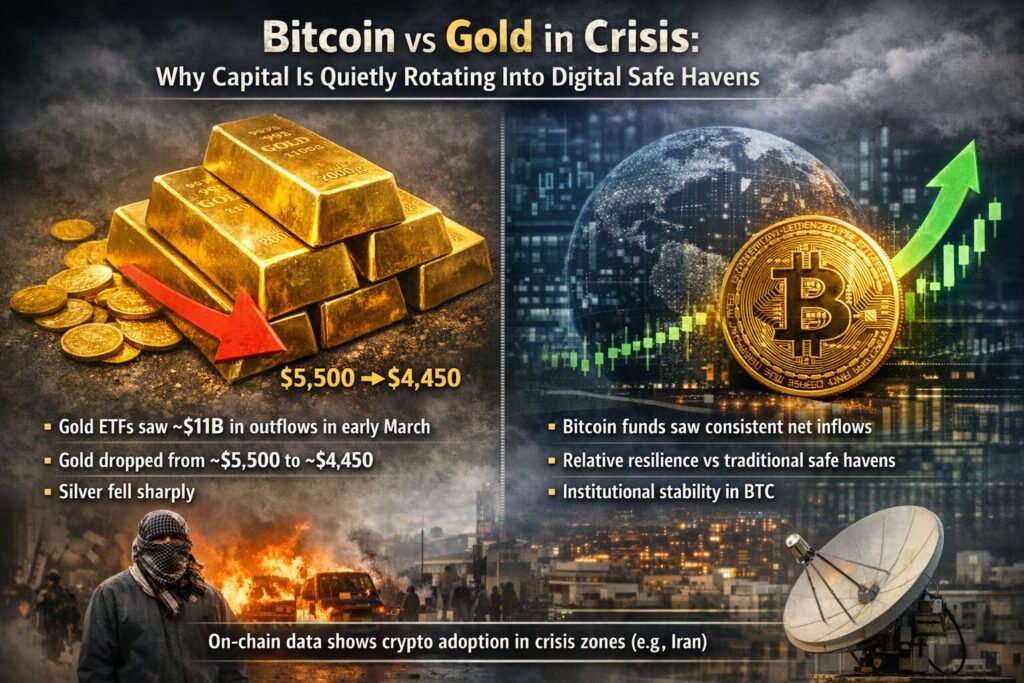
- Gold ETFs saw approximately $11B in outflows in early March
- Bitcoin funds maintained net inflows during geopolitical tension
- Gold dropped from ~$5,500 to ~$4,450, while silver fell sharply
- Bitcoin demonstrated relative resilience vs traditional safe havens
- Institutional positioning shows profit-taking in gold/silver, stability in BTC
- On-chain data suggests real-world crypto adoption in crisis zones (e.g., Iran)
1. A Structural Shift: Bitcoin Begins to Challenge Gold in Crisis Markets
The latest analysis from JPMorgan presents a striking narrative: in a period of geopolitical stress triggered by escalating tensions involving Iran, Bitcoin is no longer behaving like a speculative risk asset alone. Instead, it is beginning to show characteristics traditionally associated with safe-haven assets such as gold.
Historically, gold has been the default hedge during geopolitical instability. However, March 2026 data reveals an unexpected divergence. While gold and silver experienced sharp corrections, Bitcoin maintained relative stability and, more importantly, continued to attract capital inflows.
This shift signals more than a temporary anomaly. It suggests the early stages of a structural transition in how global capital allocates during crises—particularly among institutions.
2. Capital Flows Tell the Real Story
Capital Rotation: Gold vs Bitcoin
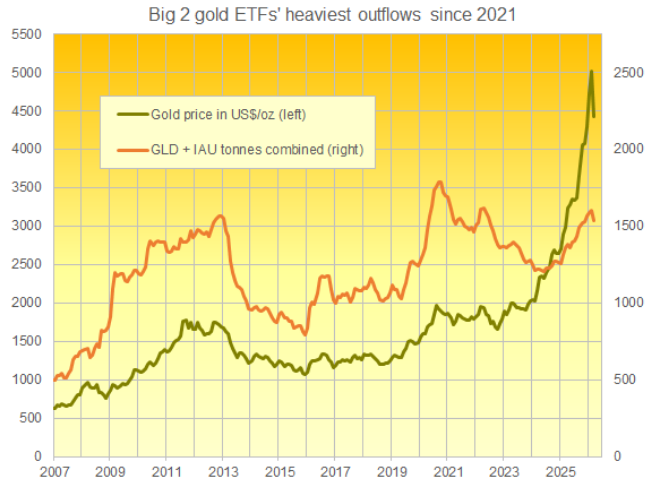
In the first three weeks of March alone, gold ETFs recorded approximately $11 billion in net outflows. This is not a marginal adjustment—it represents a decisive repositioning of capital.
At the same time, Bitcoin-related funds continued to record net inflows, even amid geopolitical uncertainty. This divergence is critical. Traditionally, both gold and Bitcoin would attract inflows during risk-off events. The fact that only Bitcoin did suggests:
- Investors are actively rotating out of gold
- Bitcoin is absorbing part of that displaced capital
Silver mirrored gold’s weakness, with prices falling from approximately $120 to $69, further reinforcing the idea that traditional precious metals were overcrowded trades entering 2026.
3. The Overcrowded Trade Problem in Commodities
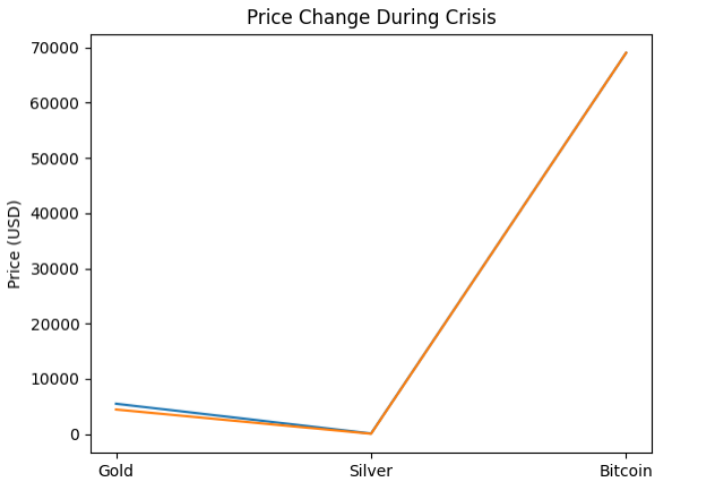
JPMorgan attributes the sharp decline in gold and silver to a classic market dynamic: overcrowded positioning.
From late 2025 into early 2026, institutional investors—including Commodity Trading Advisors (CTAs)—had accumulated significant long positions in gold and silver. These positions became vulnerable when macro conditions shifted:
- Rising interest rates increased the opportunity cost of holding non-yielding assets
- A stronger US dollar reduced the appeal of commodities
- Momentum strategies triggered accelerated profit-taking
As a result, what began as a defensive positioning quickly turned into a cascade of liquidation.
Bitcoin, in contrast, did not exhibit the same crowded positioning profile. Its futures positioning remained relatively stable, suggesting:
- Less leverage-driven exposure
- More diversified holder base
- Reduced susceptibility to forced unwinds
4. Institutional Positioning: Stability vs Liquidation
Futures Positioning
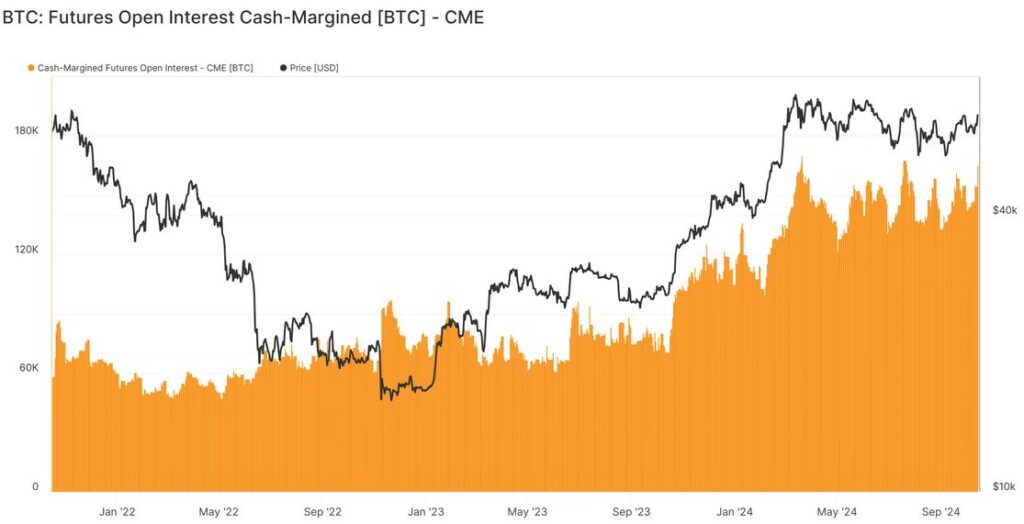
Using data derived from Chicago Mercantile Exchange futures markets, JPMorgan analyzed institutional positioning trends.
The findings:
- Gold and silver positions peaked late 2025 → sharply declined in early 2026
- Bitcoin futures positioning remained relatively stable
This is a crucial signal. It implies that:
- Gold’s decline was position-driven (technical) rather than purely macro-driven
- Bitcoin’s resilience reflects structural demand, not just speculative flows
In other words, Bitcoin is no longer just reacting to liquidity—it is beginning to anchor capital.
5. Bitcoin’s Real-World Utility in Crisis Zones
Crypto Usage Surge in Crisis Regions
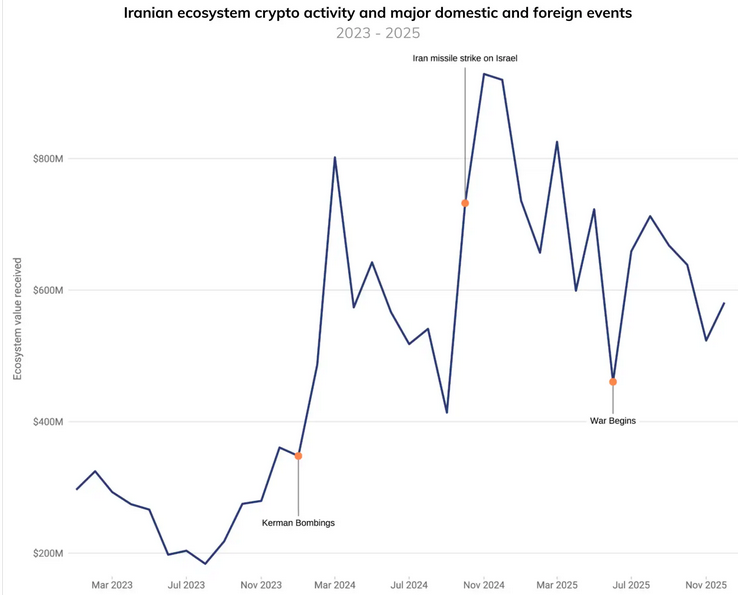
One of the most compelling aspects of this shift is not found in institutional flows—but in real-world behavior.
According to data from Chainalysis:
- Following the outbreak of conflict, crypto usage in Iran surged
- Users moved funds from local exchanges to self-custody wallets
- Cross-border transfers increased via international platforms
This highlights a key advantage Bitcoin has over gold:
| Feature | Gold | Bitcoin |
|---|---|---|
| Portability | Low | High |
| Custody | Physical | Self-custody |
| Transfer speed | Slow | Near-instant |
| Borderless | No | Yes |
In environments where capital controls, banking restrictions, or instability arise, Bitcoin functions not just as an investment—but as financial infrastructure.
6. Liquidity Dynamics: A Quiet but Critical Edge
JPMorgan’s report includes a subtle but powerful observation:
Gold market liquidity has deteriorated to the point where it is now thinner than Bitcoin.
This statement would have been unthinkable just a few years ago.
Liquidity determines:
- Execution efficiency
- Slippage risk
- Institutional scalability
If Bitcoin markets are now deeper than gold in certain contexts, it fundamentally changes how large capital allocators view it.
This is especially relevant for:
- Hedge funds
- Sovereign allocators
- High-frequency trading desks
7. Bitcoin’s Current Market Structure: Between Two Worlds
At the time of the report, Bitcoin was trading around $69,000.
According to QCP Capital:
- Bitcoin is no longer purely a high-beta equity proxy
- But it has not yet fully matured into a true safe-haven asset
This places Bitcoin in a transitional phase:
Meanwhile, derivatives markets show continued demand for downside hedging, indicating that investors are cautious—not euphoric.
8. What This Means for Investors and Builders
For readers seeking:
- New crypto assets
- Yield opportunities
- Practical blockchain applications
This shift carries several implications:
1. Narrative Shift = Opportunity
Markets reprice assets based on narratives. If Bitcoin transitions toward a digital safe haven, its total addressable market expands dramatically.
2. Infrastructure Matters More Than Speculation
The real adoption signal is not ETF flows—it is usage in constrained environments.
Projects that enable:
- Self-custody UX
- Cross-border transfers
- Compliance-friendly on/off ramps
will capture the next wave of growth.
3. Liquidity Is the New Battleground
As institutional capital scales, assets with:
- Deep liquidity
- Transparent markets
- Robust derivatives
will dominate allocation decisions.
Conclusion: The Early Stages of a Monetary Transition
The events of March 2026 may be remembered as a turning point—not because Bitcoin surged, but because gold failed to lead.
Capital did not simply exit risk—it rotated.
From:
- Physical, traditional safe havens
To:
- Digital, programmable, borderless assets
Bitcoin’s resilience during geopolitical stress, combined with real-world usage and improving market structure, suggests that it is evolving into something fundamentally new.
Not just a speculative asset.
Not yet a perfect safe haven.
But increasingly, a core component of the future financial system.
