
Main Points :
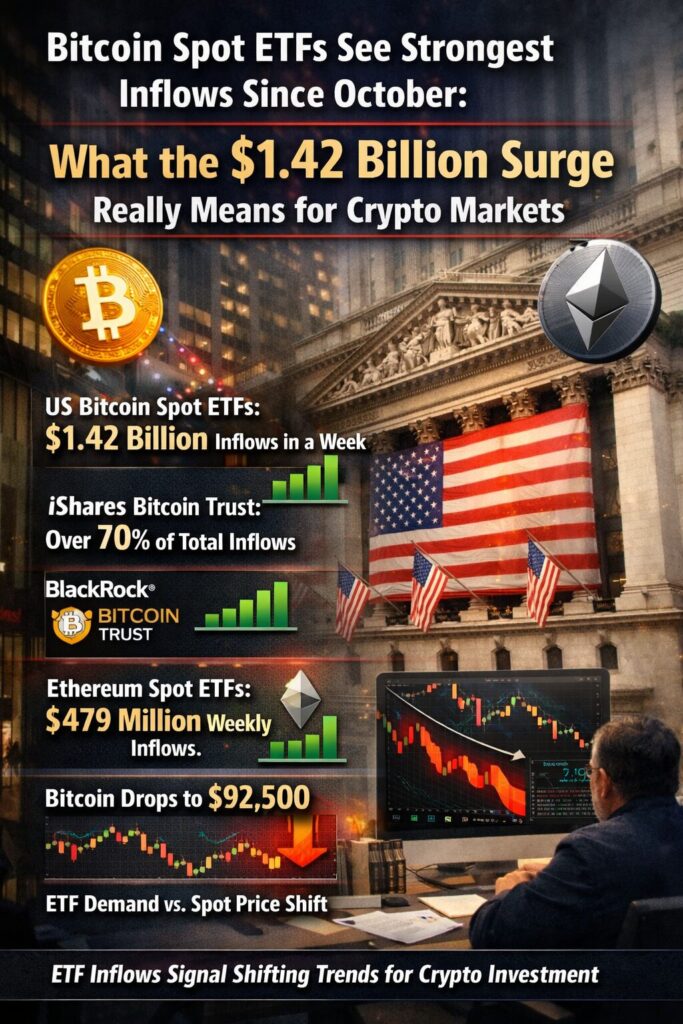
- US-listed Bitcoin spot ETFs recorded $1.42 billion in net inflows in a single week, the strongest since early October.
- BlackRock’s iShares Bitcoin Trust (IBIT) accounted for over 70% of total inflows, highlighting institutional concentration.
- Ethereum spot ETFs also saw renewed momentum with $479 million in weekly inflows.
- Despite ETF inflows, Bitcoin’s price fell toward $92,500, driven by macro risk-off sentiment and derivatives liquidations.
- The divergence between ETF demand and spot price reveals a structural shift in how Bitcoin is accumulated and held.
- For investors seeking new crypto assets and yield opportunities, ETF flows provide a critical signal beyond short-term price action.
Introduction: A Quiet Institutional Accumulation Phase
The cryptocurrency market often captures attention through dramatic price movements. However, some of the most important structural shifts occur quietly—beneath the surface of daily volatility. Last week’s surge in net inflows into US-listed Bitcoin spot ETFs is one such event.
According to data from SoSoValue, Bitcoin spot ETFs recorded $1.42 billion in net inflows over the past week, marking the strongest weekly performance since early October. This occurred despite Bitcoin’s price declining from near $97,000 to the $92,000–93,000 range.
For market participants focused on discovering new digital assets, identifying sustainable yield sources, or understanding real-world blockchain adoption, this divergence between capital inflows and price action deserves close attention.
This article examines what is driving ETF inflows, why price action failed to respond positively, and how this trend reshapes the long-term investment thesis for Bitcoin and Ethereum.
Institutional Demand Returns to the Forefront
Bitcoin Spot ETFs: A Breakdown of the Numbers
[Weekly Net Inflows of US Bitcoin Spot ETFs]
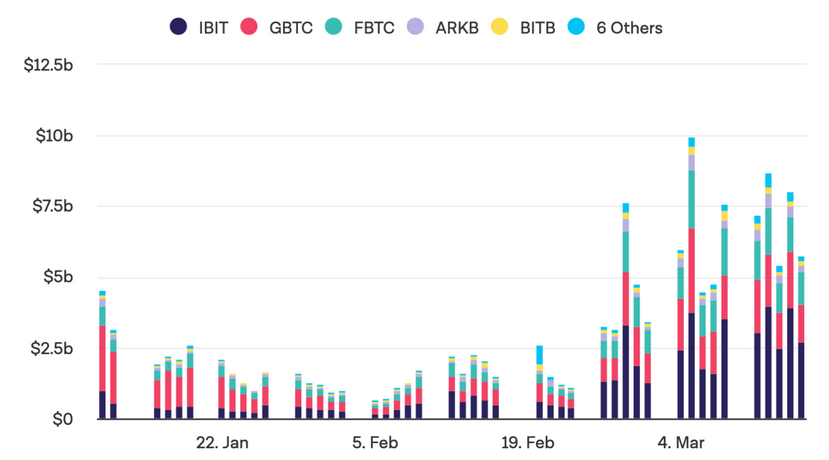
SoSoValue data shows that $1.42 billion flowed into US Bitcoin spot ETFs last week. The majority of this capital was concentrated in a single product:
- BlackRock iShares Bitcoin Trust (IBIT): $1.03 billion
- Other issuers (Fidelity, Ark, Bitwise, etc.): ~$390 million combined
IBIT alone captured more than 70% of total weekly inflows, reinforcing BlackRock’s dominant role as the primary institutional gateway into Bitcoin exposure.
Nick Ruck, Director at LVRG Research, noted that these inflows demonstrate a renewed conviction among institutions viewing Bitcoin as a long-term asset class, rather than a speculative trading instrument.
Ethereum Spot ETFs Join the Momentum
[Weekly Net Inflows of US Ethereum Spot ETFs]
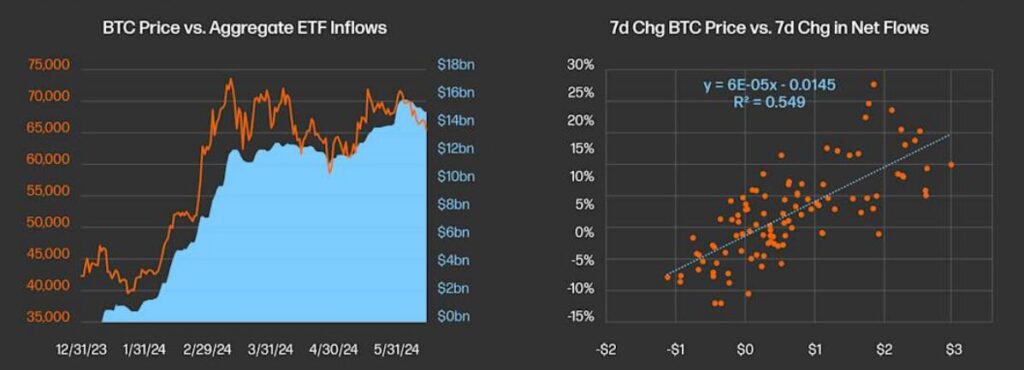
Bitcoin was not alone. Ethereum spot ETFs recorded $479 million in weekly net inflows, their strongest performance since the week ending October 10.
This suggests that institutions are not merely seeking Bitcoin exposure as “digital gold,” but are also positioning for Ethereum’s broader role in:
- Tokenized real-world assets (RWA)
- Stablecoin settlement layers
- On-chain financial infrastructure
- Yield-bearing protocols and staking-related narratives
The synchronized inflows into both BTC and ETH ETFs point to a portfolio-based allocation strategy, rather than isolated speculation.
Why Bitcoin Fell Despite Strong ETF Inflows
Macro Risk-Off Shock: Tariffs and Global Markets
[Bitcoin Price and Liquidation Events]
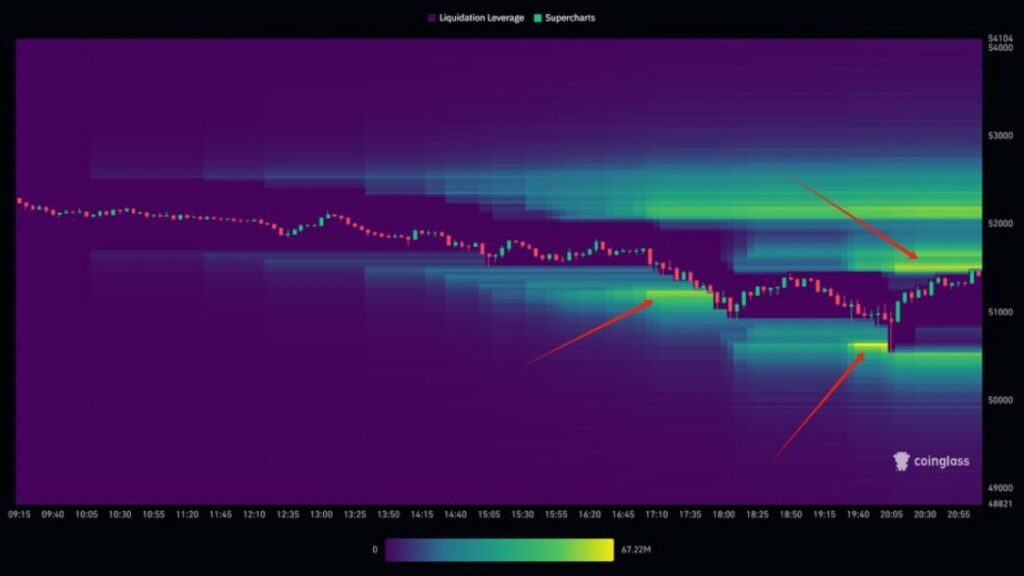
Despite the strong ETF inflows, Bitcoin’s price declined sharply over the weekend. The catalyst was macroeconomic rather than crypto-native.
Former US President Donald Trump announced new tariffs targeting eight European countries, starting at 10% from February 1, with plans to raise them to 25% by June. This announcement triggered a global risk-off move across equities and cryptocurrencies alike.
As capital rotated into traditional safe-haven assets, risk assets—including Bitcoin—came under pressure.
Derivatives-Driven Liquidations
According to Coinglass data, the weekend sell-off resulted in approximately $525 million in long liquidations across the crypto market within a 60-minute window.
Vincent Liu, CIO of Kronos Research, explained:
“Despite strong ETF inflows, Bitcoin’s decline toward $92,000 highlights how derivatives-driven the market remains. Over-leveraged long positions built on shallow liquidity collapsed rapidly, triggering forced liquidations.”
This underscores a key structural reality: ETF demand and derivatives positioning operate on different time horizons.
Structural Decoupling: ETFs vs. Leveraged Traders
The recent price action reveals a growing decoupling between:
- Institutional spot accumulation via ETFs
- Short-term speculative leverage in futures and perpetuals
ETF inflows represent unlevered, custody-grade capital, often held by pension funds, asset managers, and long-only strategies. These investors are largely insensitive to short-term volatility.
In contrast, derivatives traders amplify price swings through leverage, stop-loss cascades, and liquidation engines.
This divergence explains why Bitcoin can experience record ETF inflows while simultaneously undergoing sharp price corrections.
What This Means for Long-Term Investors
ETFs as a Structural Demand Floor
While ETFs do not guarantee price appreciation, they establish a persistent bid in the market. Each inflow represents Bitcoin removed from liquid circulation and placed into long-term custody.
Over time, this reduces available supply, especially when combined with:
- Bitcoin halving cycles
- Long-term holder accumulation
- Reduced miner sell pressure
For investors seeking durable crypto exposure rather than short-term trading profits, ETF flows may be a more reliable signal than daily price charts.
Implications for Yield-Seeking and Blockchain-Focused Investors
For readers interested in the practical use of blockchain and new revenue models, ETF inflows also have second-order effects:
- Liquidity Stability
Institutional capital stabilizes core assets like BTC and ETH, providing a base layer for DeFi, tokenization, and payment rails. - Expansion of Regulated On-Ramps
ETFs normalize crypto exposure within traditional portfolios, accelerating adoption of compliant custody, settlement, and reporting infrastructure. - Capital Rotation Opportunities
Historically, sustained BTC inflows precede capital rotation into:- Layer 2 ecosystems
- Infrastructure tokens
- RWA and yield-bearing protocols
Ethereum’s Strategic Positioning Beyond Price
Ethereum’s ETF inflows deserve special attention. Unlike Bitcoin, Ethereum offers:
- Native yield through staking
- A settlement layer for tokenized assets
- Programmable compliance mechanisms
Institutional interest in ETH suggests anticipation of on-chain financial infrastructure growth, not just speculative price appreciation.
Risks to Monitor Going Forward
Despite the positive ETF narrative, several risks remain:
- Macro shocks (interest rates, geopolitics, trade policies)
- Regulatory shifts affecting ETF structures or custody rules
- Liquidity mismatches between spot and derivatives markets
Investors should treat ETF inflows as a long-term signal, not a guarantee against volatility.
Conclusion: A Signal Hidden Beneath the Noise
The $1.42 billion weekly inflow into Bitcoin spot ETFs is not merely a headline statistic—it is evidence of a structural transformation in crypto markets.
While leveraged traders continue to drive short-term volatility, institutions are steadily accumulating exposure through regulated, transparent vehicles. This dual-track market structure may persist, creating sharp corrections alongside long-term accumulation.
For those seeking new crypto assets, sustainable yield, or practical blockchain applications, the key takeaway is clear:
Follow the capital, not the candles.
ETF inflows represent conviction capital—and conviction, over time, reshapes markets.
