

Key Takeaways :
- Bitcoin has corrected nearly 30% from its all-time high, yet large holders known as “sharks” continue to accumulate aggressively.
- On-chain data shows that wallets holding 100–1,000 BTC are buying at the fastest pace since 2013.
- Historically, sharp increases in shark accumulation have preceded major upside moves within 6–12 months.
- Some technical analysts warn of a deeper drawdown, potentially toward $35,000, citing failed channel breakouts.
- Institutional players such as Grayscale Investments and Bitwise Asset Management argue that the traditional four-year Bitcoin cycle is breaking down.
- The divergence between on-chain accumulation and technical pessimism defines the current market regime.
1. Bitcoin’s 30% Correction: Panic or Opportunity?
Bitcoin (BTC) recently experienced a sharp correction of nearly 30% from its historical peak, falling from approximately $98,000 to the $87,900–$88,000 range. Such drawdowns, while psychologically painful for retail participants, are not unusual in Bitcoin’s historical bull markets.
What stands out in the current cycle is not the price decline itself, but who is buying during the correction.
On-chain data reveals that large investors—often referred to as “Bitcoin sharks”—are not retreating. Instead, they are accelerating their accumulation.
These sharks are defined as wallet addresses holding between 100 BTC and 1,000 BTC, a category that typically includes early adopters, crypto-native funds, proprietary trading desks, and some institutional allocators.
2. Who Are the “Bitcoin Sharks”?
The term “shark” occupies a middle ground in Bitcoin’s holder taxonomy:
- Shrimps: <1 BTC
- Crabs / Fish: 1–100 BTC
- Sharks: 100–1,000 BTC
- Whales: 1,000+ BTC
Unlike whales—whose activity can sometimes be distorted by custodial wallets or exchange cold storage—sharks often represent active capital with high conviction.
According to data from Glassnode, this cohort has been accumulating Bitcoin at the fastest pace observed since 2013, even as prices moved lower.
【Net Position Change of Bitcoin Shark Wallets】
(Line graph showing cumulative BTC accumulation by 100–1,000 BTC wallets)
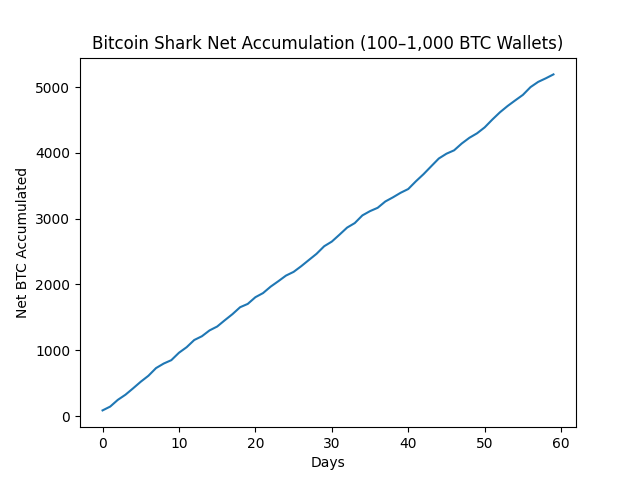
This behavior strongly suggests that sharks view the current correction not as the start of a bear market, but as a strategic accumulation zone.
3. Accumulation During Decline: A Repeating Historical Pattern
Historically, aggressive shark accumulation has often preceded significant upside moves:
- 2016–2017 Cycle: Shark accumulation accelerated before BTC rallied over 1,600% within a year.
- 2020–2021 Cycle: Similar patterns emerged before BTC surged from ~$10,000 to ~$69,000.
- 2024 Mid-Cycle Rally: Accumulation increased before BTC climbed from ~$54,000 to over $116,000.
In several of these cases, Bitcoin appreciated over 160% within 12 months following strong accumulation phases.
This historical context explains why many long-term investors interpret the current data as structurally bullish, even amid short-term volatility.
4. Why Sharks Are Buying: Structural Drivers Beyond Price
The motivations behind shark accumulation today differ meaningfully from earlier cycles.
4.1 Institutional Infrastructure Is Now Mature
Unlike previous bull markets, Bitcoin today operates within a far more developed institutional framework:
- Spot Bitcoin ETFs in the U.S.
- Prime brokerage access for crypto assets
- Regulated custodians and insurance products
- Improved derivatives and hedging instruments
This infrastructure lowers operational risk and encourages systematic accumulation strategies, especially during drawdowns.
4.2 Bitcoin as a Treasury and Collateral Asset
For many sophisticated investors, Bitcoin is no longer just a speculative asset. It is increasingly treated as:
- A long-term treasury reserve
- Collateral for leverage and yield strategies
- A hedge against fiat debasement
This changes the time horizon of buyers, making them less sensitive to short-term price swings.
5. The Bearish Counterargument: Is a $35,000 Bitcoin Possible?
Despite the bullish on-chain signals, not all analysts are convinced.
Technical analyst Lofty argues that Bitcoin failed to hold the upper boundary of its ascending channel, forming what he describes as a “perfect bull trap.”
【Comparison of 2021 and 2026 Price Structures】
(Overlay chart showing double-top-like formations)
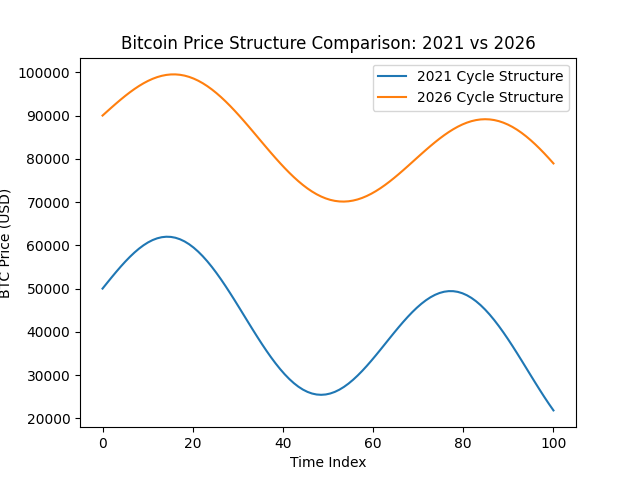
Drawing parallels to 2021, Lofty suggests Bitcoin could retrace as low as $35,000 in February, echoing the multi-month decline that followed the 2021 double top.
From a purely technical perspective, this scenario cannot be dismissed outright—especially if macro conditions tighten or risk appetite deteriorates.
6. Is the Four-Year Bitcoin Cycle Breaking Down?
While cycle-based analysts warn of downside risk, major institutional players increasingly argue that Bitcoin’s four-year cycle model is becoming obsolete.
Grayscale Investments has publicly stated that:
- Institutional adoption has altered Bitcoin’s supply-demand dynamics.
- ETF flows dampen post-halving boom-and-bust cycles.
- Long-term price discovery is becoming smoother and more persistent.
Similarly, Bitwise Asset Management has described 2026 as a likely “year of expansion” for Bitcoin, not contraction.
These perspectives suggest that while volatility remains, structural demand may now overpower traditional cyclical drawdowns.
7. Reconciling the Contradiction: On-Chain vs. Charts
The current market presents a rare divergence:
- On-chain data: Strong accumulation, long-term conviction.
- Technical charts: Short-term vulnerability, potential downside.
For sophisticated investors, this is not a contradiction but a multi-timeframe reality.
Short-term traders may face turbulence, while long-term capital positions itself quietly during uncertainty.
8. Implications for Investors Seeking the Next Opportunity
For readers interested in new crypto assets, revenue opportunities, or blockchain applications, several lessons emerge:
- Follow Smart Capital, Not Noise
On-chain accumulation by sharks often precedes major structural moves. - Volatility Is a Feature, Not a Bug
Corrections enable strategic entry for long-term positions. - Bitcoin’s Role Is Expanding
Beyond price appreciation, BTC now underpins collateralized finance, structured products, and treasury strategies. - Risk Management Still Matters
Even bullish scenarios must account for drawdowns and leverage risk.
Conclusion: Accumulation as a Signal, Not a Guarantee
Bitcoin’s current correction has exposed a clear divide between fear-driven narratives and data-driven behavior.
While price action alone may suggest uncertainty, on-chain evidence shows that some of the most informed participants in the market are buying aggressively.
Whether Bitcoin experiences further downside or begins its next ascent, one thing is clear:
Bitcoin sharks are positioning for a future they believe is higher, not lower.
For investors focused on the long game, this accumulation phase may one day be remembered not as a warning—but as an invitation.
