
Key Points :
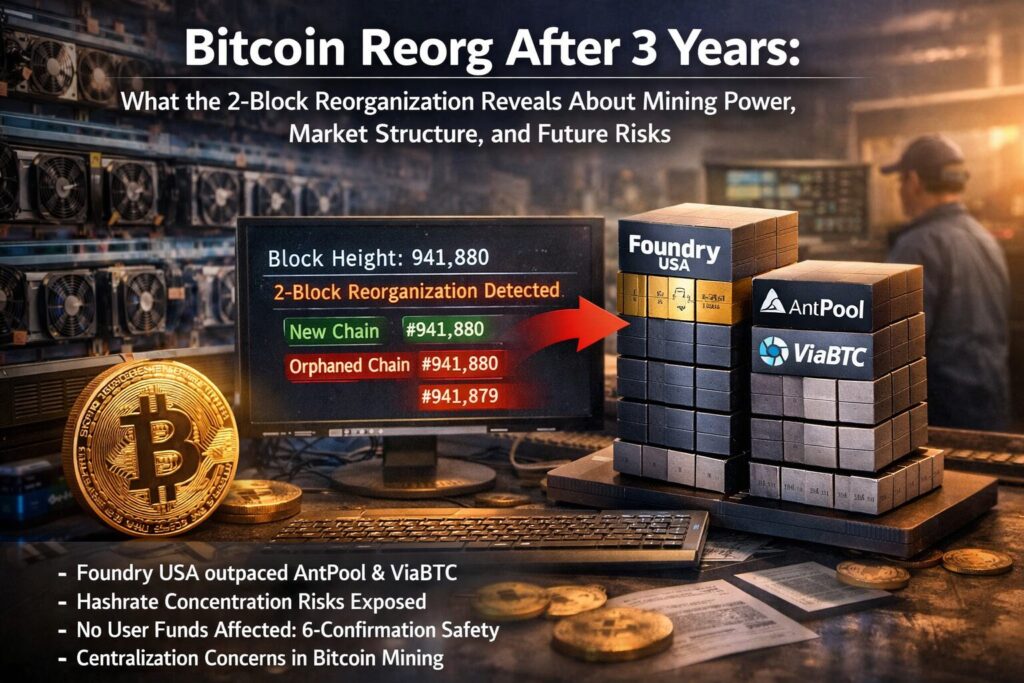
- A rare 2-block reorganization (reorg) occurred at Bitcoin block height 941,880
- Foundry USA outcompeted AntPool and ViaBTC, replacing their blocks
- The event highlights hashrate concentration risks in Bitcoin mining
- No user funds were affected due to standard 6-confirmation safety rules
- The reorg demonstrates both Bitcoin’s resilience and emerging structural centralization
1. The Event: A Rare 2-Block Reorganization Explained
On March 23, 2026, the Bitcoin network experienced a rare and technically significant event: a 2-block chain reorganization, also known as a “reorg,” at block height 941,880.
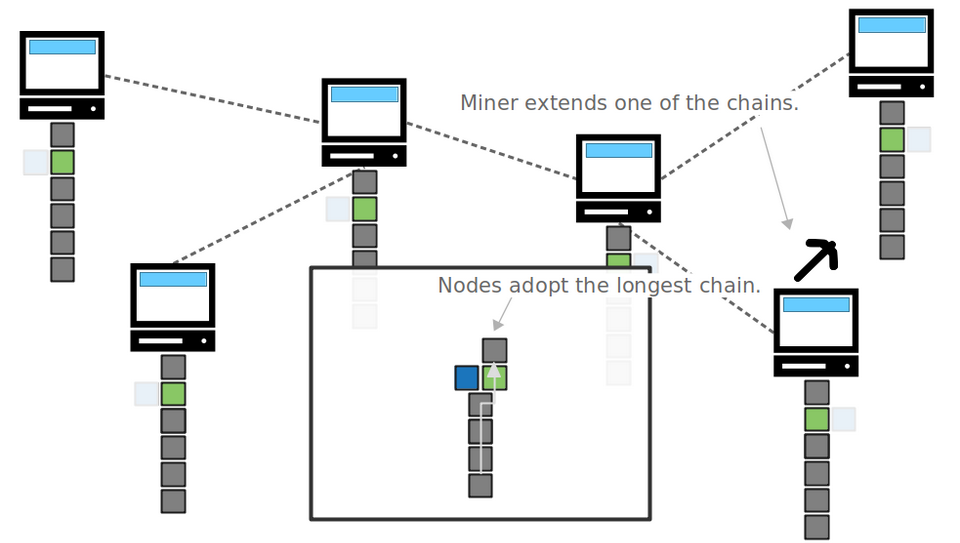
In simple terms, a blockchain reorganization occurs when two competing versions of the blockchain temporarily exist, and the network ultimately selects the chain with the highest cumulative proof-of-work—the so-called longest chain.
In this specific case, two mining pools—AntPool and ViaBTC—initially produced consecutive blocks (941,881 and 941,882), forming a temporary chain. However, at nearly the same time, Foundry USA mined an alternative chain that extended further—producing seven consecutive blocks (941,879 to 941,885).
Because Foundry’s chain had more accumulated work, the network adopted it as the valid chain, effectively discarding the blocks mined by AntPool and ViaBTC. These discarded blocks became what are known as orphan blocks.
[Blockchain Reorganization Mechanism]
2. Why This Event Is Rare—and Important
According to Bitcoin analyst ajtowns, a 2-block reorganization is an extremely rare occurrence—happening roughly once every ~150,000 blocks, or approximately once every few years.
The last similar event occurred in May 2023. That means this 2026 reorg reinforces a key point:
Bitcoin’s consensus mechanism is working exactly as designed—even under rare edge cases.
However, rarity does not diminish importance. In fact, it amplifies it.
This event provides a real-world stress test of the Bitcoin protocol’s ability to resolve competing chains without human intervention.
3. Mining Competition and the Rise of Foundry USA
The most notable takeaway from this event is not just that a reorg occurred—but who won it.
Foundry USA demonstrated a significant competitive edge by:
- Mining 7 consecutive blocks
- Overpowering two major pools simultaneously
- Establishing dominance in a real-time mining race
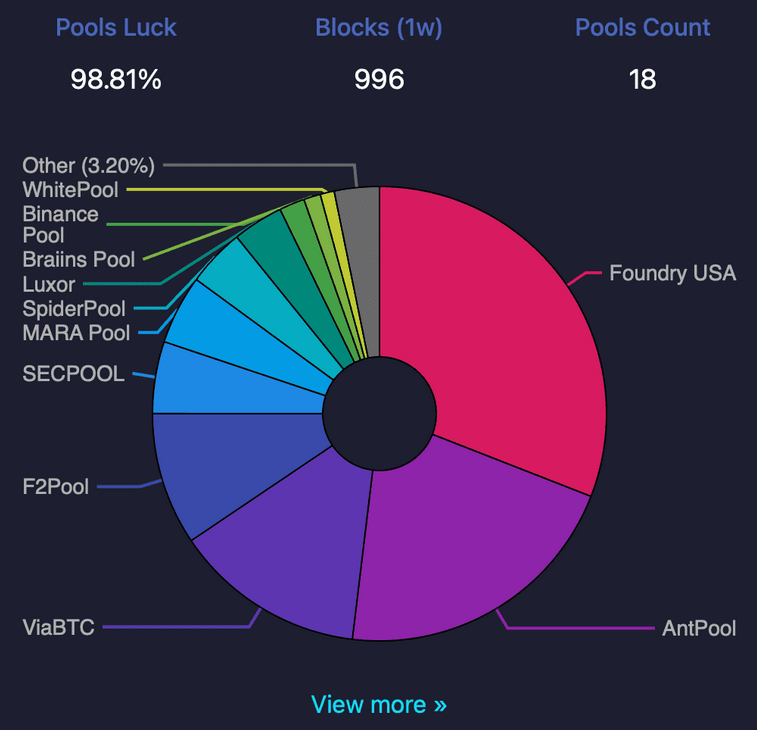
This outcome strongly suggests that Foundry USA controls a substantial share of global Bitcoin hashrate.
[Mining Pool Hashrate Distribution]
4. Hashrate Concentration: A Growing Structural Concern
This leads us to a deeper and more strategic issue: hashrate centralization.
Bitcoin is designed to be decentralized, but in practice:
- Mining has consolidated into large industrial pools
- Economies of scale favor dominant players
- Access to cheap energy and infrastructure creates barriers to entry
The fact that a single entity (Foundry USA) could override blocks from multiple competitors raises concerns such as:
- Potential influence over transaction ordering
- Increased risk of coordinated behavior
- Theoretical vulnerability to 51% attacks, if concentration increases further
While there is no indication of malicious behavior in this case, the structural trend is clear.
5. Why Users Were Not Affected
Despite the technical complexity of the event, end users were not impacted.
This is due to one of Bitcoin’s most important operational safeguards:
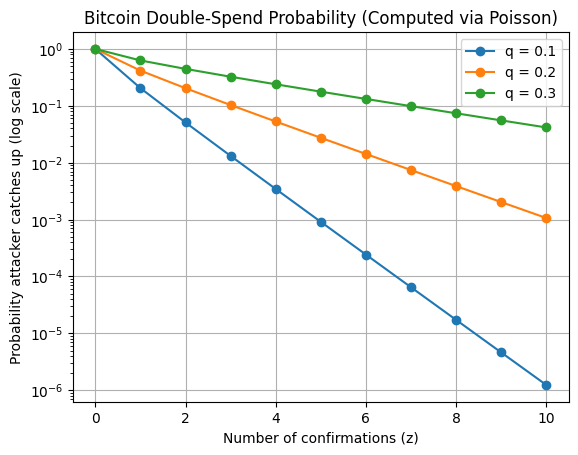
Transactions are considered final only after 6 confirmations
Since the reorganization affected only 2 blocks, it did not reach the threshold where exchanges or payment processors would consider transactions final.
This highlights an important operational lesson:
- Finality in blockchain is probabilistic, not absolute
- Safety margins (like 6 confirmations) exist precisely for rare events like this
6. Bitcoin’s Self-Healing Mechanism in Action
Rather than being a flaw, this reorganization demonstrates Bitcoin’s self-correcting nature.
Key design principles at work:
- Proof-of-Work competition ensures fairness
- Longest chain rule resolves conflicts automatically
- No central authority required
This is one of the most powerful aspects of Bitcoin:
Even when forks occur, the system converges back to a single truth without coordination.
7. Market Implications: What This Means for Investors and Builders
This event is not just a technical curiosity—it carries market implications.
For Investors
- Large mining pools are becoming increasingly influential
- Monitoring hashrate distribution is becoming as important as price charts
- Structural centralization could impact long-term risk profiles
For Builders (Wallets, Exchanges, Protocols)
- Must design systems assuming temporary chain instability
- Should enforce confirmation thresholds dynamically
- Need robust reorg-handling logic
For New Opportunities
- Decentralized mining initiatives may gain renewed interest
- Alternative consensus models (PoS, hybrid) may see increased attention
- Infrastructure tools for reorg monitoring could become valuable
[Confirmation Safety vs Risk Curve]
8. Broader Trends: Institutional Mining and Industrialization
Zooming out, this event fits into a broader trend:
Industrialization of Bitcoin Mining
- Large-scale data centers dominate mining
- Institutional capital is deeply involved
- Publicly traded mining companies are expanding
Geopolitical Factors
- Mining is increasingly tied to energy policy
- Regions with surplus energy (e.g., North America) dominate
Regulatory Overhang
- Governments may scrutinize mining concentration
- ESG narratives continue to shape mining strategies
9. Conclusion: Strength and Fragility in the Same System
The March 2026 Bitcoin reorganization presents a paradox:
- On one hand, it proves the robustness of Bitcoin’s design
- On the other, it exposes evolving centralization risks
This dual reality defines the next phase of Bitcoin’s evolution.
Bitcoin is not static—it is a living system shaped by incentives, competition, and scale.
For investors, builders, and regulators alike, the lesson is clear:
- Monitor not just price—but structure
- Understand not just technology—but power distribution
- Recognize that resilience and risk can coexist
