
Main Points :
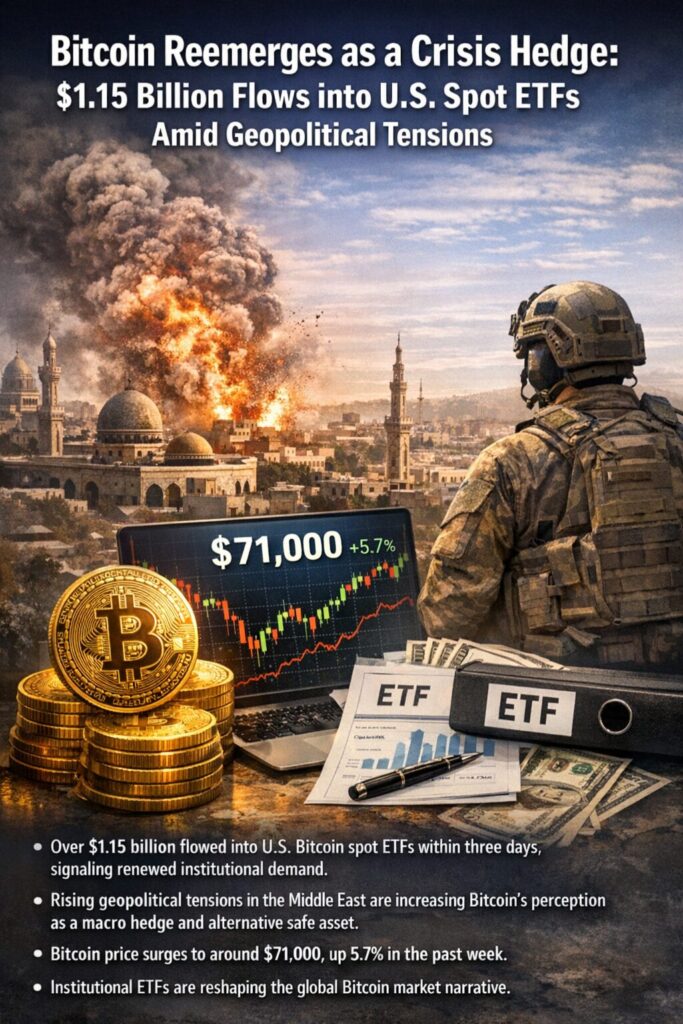
- Over $1.15 billion flowed into U.S. Bitcoin spot ETFs within three days, signaling renewed institutional demand.
- Rising geopolitical tensions in the Middle East are increasing Bitcoin’s perception as a macro hedge and alternative safe asset.
- Bitcoin price has climbed to around $71,000, gaining 5.7% week-on-week.
- Institutional investment vehicles such as ETFs are reshaping how Bitcoin integrates into global capital markets.
- The narrative of Bitcoin may be shifting again—from risk asset to geopolitical hedge.
1. A Surge of Capital into Bitcoin Spot ETFs
In early March 2026, Bitcoin once again captured the attention of global investors as U.S. spot Bitcoin exchange-traded funds (ETFs) recorded net inflows exceeding $1.15 billion between March 2 and March 4. The rapid influx of capital highlights the growing importance of institutional investment channels in shaping the cryptocurrency market.
The data, compiled by digital asset analytics platform SoSoValue, shows that after several weeks of net outflows during February, capital flows into Bitcoin ETFs abruptly reversed direction. The shift coincided with escalating geopolitical tensions in the Middle East, particularly surrounding Iran.
Investors appear to be repositioning their portfolios in response to uncertainty in traditional financial markets. While Bitcoin has often been categorized as a speculative or high-risk asset, the latest capital flows suggest that some market participants are increasingly viewing it as a macro hedge against geopolitical instability.
The resurgence of ETF inflows also reflects how the structure of the Bitcoin market has evolved. In previous cycles, inflows into cryptocurrency exchanges primarily came from retail traders. Today, however, ETFs allow pension funds, hedge funds, and asset managers to allocate to Bitcoin through regulated financial instruments.
This structural shift is significant because it expands Bitcoin’s investor base beyond the crypto-native community and integrates the asset more deeply into the global financial system.
Weekly Net Flows into U.S. Bitcoin Spot ETFs
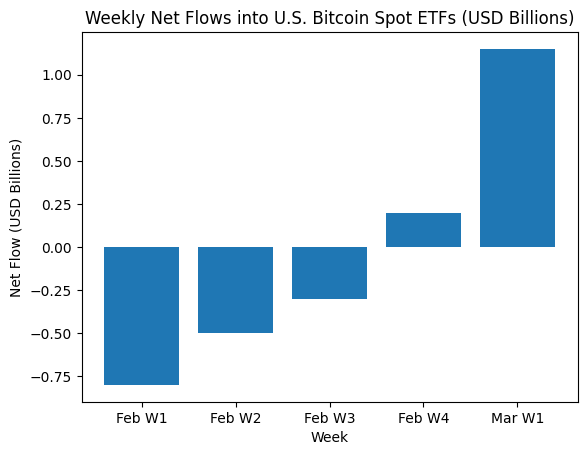
The chart illustrates how ETF flows turned sharply positive in early March after several weeks of withdrawals.
2. Geopolitical Tensions and the Return of the “Safe Haven” Narrative
One of the most intriguing aspects of the recent market movement is the renewed debate over Bitcoin’s role as a safe-haven asset.
Historically, assets such as gold and U.S. Treasury bonds have served as hedges during geopolitical crises. Bitcoin, by contrast, has often behaved like a high-beta technology asset, moving in tandem with equities during periods of risk-on sentiment.
However, recent developments suggest the narrative may be evolving.
The escalation of tensions involving Iran has heightened fears of broader instability in the Middle East. In addition to military concerns, investors are worried about energy market disruptions and potential inflationary shocks driven by rising oil prices.
In such an environment, investors typically seek assets that are resistant to political interference and monetary debasement.
Bitcoin’s unique characteristics—such as its fixed supply, decentralized network, and independence from national monetary policy—make it an attractive hedge for some investors.
Unlike gold, Bitcoin can be transferred globally within minutes and stored digitally without reliance on traditional custodians. These attributes are increasingly relevant in an era where capital controls, sanctions, and geopolitical fragmentation are becoming more common.
Bitcoin Price Reaction After Geopolitical Escalation
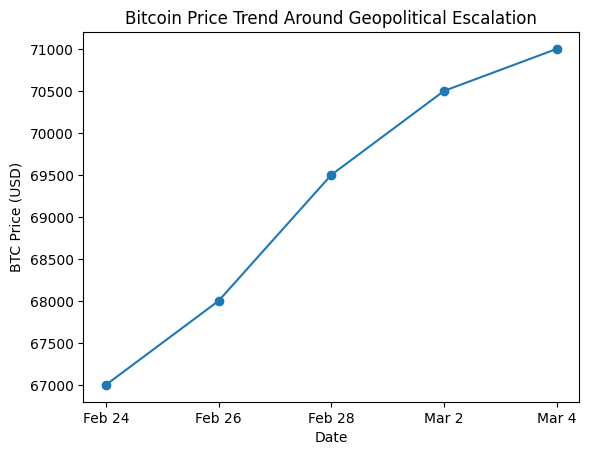
The chart illustrates the upward price trend following geopolitical escalation in late February.
3. Bitcoin Price Climbs to $71,000
According to data from crypto market aggregator CoinGecko, Bitcoin was trading at approximately $71,000 at the time of writing, representing a 5.7% increase compared with the previous week.
Although Bitcoin remains below its historical peak levels, the steady climb is noteworthy given the turbulent macroeconomic backdrop.
During recent weeks, global equity markets have experienced increased volatility as investors reassess growth prospects and geopolitical risks. Despite this instability, Bitcoin’s price movement has been relatively stable compared with traditional risk assets.
This relative resilience has not gone unnoticed by institutional investors.
Several analysts have pointed out that the cryptocurrency’s performance during geopolitical crises may reinforce the argument that Bitcoin functions as a digital macro hedge.
The perception shift is important because narratives play a powerful role in financial markets. If Bitcoin increasingly becomes associated with capital preservation rather than speculation, it could attract an entirely new class of investors.
4. Institutional Voices on Bitcoin’s Changing Role
Industry experts are beginning to discuss Bitcoin’s evolving role in global finance.
Nic Puckrin, co-founder of crypto analysis platform Coin Bureau and a former analyst at Goldman Sachs, noted that the return of capital to Bitcoin ETFs during volatile equity markets is particularly noteworthy.
According to Puckrin, the market behavior suggests that some investors may already be treating Bitcoin as a hedge against geopolitical risk.
In comments reported by financial media outlets, he observed that if Bitcoin continues to remain stable while other asset classes fluctuate dramatically, the cryptocurrency could gradually reclaim its reputation as a safe asset.
This perspective aligns with a broader trend observed over the past several years.
Large asset managers and institutional investors increasingly treat Bitcoin as part of a diversified portfolio strategy, rather than purely a speculative instrument.
5. The Institutionalization of Bitcoin Through ETFs
The introduction of spot Bitcoin ETFs in the United States marked a major milestone for the cryptocurrency industry.
Before ETFs, many institutional investors faced regulatory or operational barriers when attempting to gain exposure to Bitcoin. Custody risks, compliance requirements, and accounting complexities limited participation.
ETFs solved many of these issues by providing exposure to Bitcoin through a familiar financial instrument traded on regulated exchanges.
As a result, capital allocation decisions involving Bitcoin are increasingly being made alongside traditional assets such as equities, commodities, and bonds.
This institutionalization has several important implications:
- Greater market liquidity
- Improved price discovery
- Increased correlation with macroeconomic factors
At the same time, ETF flows have become a powerful indicator of market sentiment.
Large inflows often signal institutional accumulation, while outflows can indicate broader risk aversion.
The latest $1.15 billion inflow therefore represents more than just a short-term trading event—it may signal renewed institutional confidence in Bitcoin’s macro role.
Bitcoin’s Role in the Modern Portfolio
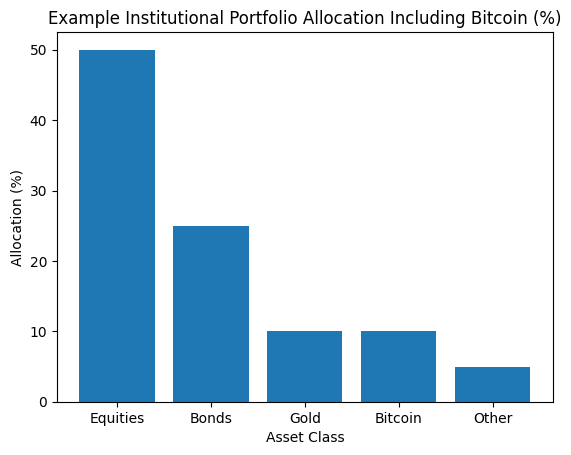
The chart shows how Bitcoin is increasingly considered alongside traditional hedging assets.
6. Implications for Crypto Investors and Builders
For investors searching for the next wave of cryptocurrency opportunities, the current developments carry several implications.
First, the increasing institutional adoption of Bitcoin strengthens the overall legitimacy of the digital asset industry. As Bitcoin becomes integrated into global financial markets, it may serve as a gateway asset that brings new capital into the broader crypto ecosystem.
Second, the rise of ETFs suggests that regulated financial infrastructure will continue to shape crypto markets.
Projects that integrate with traditional finance—such as tokenized assets, decentralized finance infrastructure, and blockchain settlement layers—may benefit from this trend.
Third, geopolitical uncertainty is likely to remain a key driver of crypto market cycles.
In a world characterized by increasing geopolitical fragmentation, assets that operate outside traditional financial systems may gain strategic importance.
Bitcoin’s decentralized architecture positions it uniquely within this emerging financial landscape.
Conclusion
The recent $1.15 billion inflow into U.S. spot Bitcoin ETFs highlights a potentially significant shift in how investors perceive the cryptocurrency.
While Bitcoin has often been classified as a speculative asset, current geopolitical tensions and macroeconomic uncertainty are prompting a reassessment of its role.
If Bitcoin continues to demonstrate resilience during periods of global instability, it may gradually establish itself as a digital safe haven alongside gold and other traditional hedges.
For investors and blockchain builders alike, this transition carries profound implications.
Bitcoin’s growing institutional adoption could serve as the foundation for the next phase of crypto market expansion—one where digital assets become deeply embedded within the architecture of the global financial system.
