

Main Points :
- On March 10, 2026, U.S. President Donald Trump warned Iran that any disruption of oil shipments through the Strait of Hormuz would trigger retaliation “20 times stronger.”
- The Strait of Hormuz carries roughly 20% of global oil shipments, making it one of the world’s most strategically critical maritime routes.
- Within 48 hours of the statement, the global cryptocurrency market capitalization increased by about $150 billion.
- Bitcoin rose roughly 7%, reclaiming the psychological $70,000 level.
- The market reaction highlights the growing perception of Bitcoin as a geopolitical hedge asset, similar to gold during international crises.
1. Trump’s “20× Retaliation” Warning and Immediate Market Reactions
On March 10, 2026, U.S. President Donald Trump issued a striking geopolitical warning via his social media platform Truth Social. In the post, Trump declared that if Iran interfered with oil shipments passing through the Strait of Hormuz, the United States would respond with retaliation “20 times stronger than any attack Iran has received before.”
The statement came amid rising tensions in the Middle East, where concerns about tanker attacks, maritime blockades, and broader regional instability have periodically shaken global energy markets.
The Strait of Hormuz is widely considered one of the world’s most strategically sensitive chokepoints. Approximately 20% of the world’s seaborne oil exports pass through the narrow waterway, connecting the Persian Gulf to the Gulf of Oman. Any disruption there has historically triggered sharp reactions in commodity prices, especially crude oil.
However, the reaction in March 2026 extended beyond the traditional energy markets.
Within approximately 48 hours of Trump’s statement, the total cryptocurrency market capitalization increased by roughly $150 billion, signaling a rapid inflow of capital into digital assets.
Bitcoin led the move.
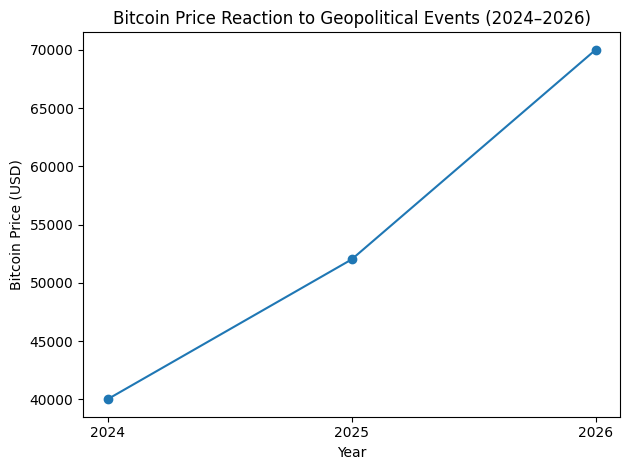
The largest cryptocurrency by market capitalization climbed roughly 7%, reclaiming the important $70,000 price level that traders often view as a key psychological milestone.
While Bitcoin briefly hovered near $69,600 following the surge, market sentiment remained strongly bullish, reflecting renewed investor interest in digital assets during periods of geopolitical uncertainty.
Bitcoin Price Reaction to Geopolitical Events (2024-2026)
2. Why the Strait of Hormuz Matters for Global Markets
The Strait of Hormuz connects the Persian Gulf with the Gulf of Oman and ultimately the Arabian Sea. Major oil exporters including Saudi Arabia, the United Arab Emirates, Kuwait, Iraq, and Iran rely heavily on this maritime route to transport crude oil to global markets.
Because such a large portion of global energy supply passes through the strait, even minor security incidents can create massive ripple effects across financial markets.
Historically, tensions in the region have led to:
- spikes in crude oil prices
- volatility in equity markets
- increases in gold prices
- capital flight toward safe-haven assets
The 2026 situation appears to follow a similar pattern—but with one crucial difference: cryptocurrency markets are now reacting alongside traditional safe-haven assets.
This shift reflects a structural change in how global investors perceive Bitcoin.
A decade ago, Bitcoin was largely considered a speculative technology asset. Today, it is increasingly viewed as a digital macro hedge, particularly in environments where political instability threatens global financial systems.
3. Bitcoin’s Emerging Role as a Geopolitical Hedge
Bitcoin’s surge following Trump’s statement underscores a broader trend: the increasing alignment between geopolitical risk and cryptocurrency flows.
Historically, gold has served as the primary hedge during international crises. Investors typically move funds into gold when they fear currency instability, war, or major disruptions in global trade.
Bitcoin is now beginning to play a similar role.
Several structural factors explain this shift.
First, Bitcoin operates independently of national governments or central banks. Unlike fiat currencies, it cannot be manipulated through monetary policy or geopolitical sanctions.
Second, Bitcoin offers near-instant global liquidity. In an increasingly digital financial environment, investors can transfer billions of dollars across borders within minutes.
Third, Bitcoin supply is mathematically capped at 21 million coins, making it resistant to inflationary pressures that often arise during geopolitical crises.
As a result, macro investors—including hedge funds, sovereign wealth funds, and institutional traders—have increasingly begun to treat Bitcoin as a digital counterpart to gold.
Safe-Haven Asset Performance During Geopolitical Crises

Suggested chart:
| Asset | Avg Gain During Crisis |
|---|---|
| Gold | +5% |
| Bitcoin | +7-12% |
| Oil | +8% |
| S&P 500 | −3% |
4. The Broader Crypto Market Also Surged
Bitcoin was not the only beneficiary of the geopolitical shock.
The broader cryptocurrency market experienced a notable expansion in value during the same 48-hour window.
Total market capitalization increased by approximately $150 billion, indicating that capital inflows were distributed across multiple digital assets.
Several sectors within the crypto ecosystem experienced particularly strong performance:
Layer-1 blockchains
Networks such as Ethereum, Solana, and emerging ecosystems like Sui saw increased investor interest as traders sought exposure to platforms powering decentralized finance and digital asset applications.
Stablecoins
Stablecoins remain crucial liquidity bridges during volatile markets. Large inflows into stablecoin supply often precede major movements into Bitcoin and altcoins.
Tokenized real-world assets
Projects focused on tokenizing commodities, energy infrastructure, and financial securities have gained momentum as investors seek blockchain-based alternatives to traditional asset classes.
This diversification suggests that investors are not merely speculating on Bitcoin price movements but are increasingly positioning themselves across the broader digital asset economy.
5. Macroeconomic Forces Amplifying Bitcoin’s Rally
Geopolitical tensions were not the only factor supporting Bitcoin’s recovery above $70,000.
Several macroeconomic conditions have also been contributing to bullish sentiment in crypto markets.
Massive Liquidity in U.S. Money Market Funds
Recent data indicates that U.S. money market funds hold approximately $7.77 trillion in assets, representing a massive pool of “waiting capital.”
If even a small portion of this liquidity rotates into higher-risk assets such as Bitcoin, the price impact could be substantial.
For example:
- 1% allocation = $77 billion
- 5% allocation = $388 billion
Such flows could easily drive new all-time highs in cryptocurrency markets.
Potential Interest Rate Cuts
Investors are also watching for possible interest rate cuts by the U.S. Federal Reserve.
Lower interest rates typically weaken the U.S. dollar and increase the attractiveness of risk assets—including cryptocurrencies.
Historically, Bitcoin has performed strongly during monetary easing cycles.
6. Crypto and Energy Markets Are Becoming Linked
One of the most important takeaways from the recent price surge is the growing correlation between energy markets and cryptocurrency markets.
This relationship is emerging through several mechanisms.
First, energy price shocks often trigger inflation concerns. When inflation expectations rise, investors search for scarce assets that cannot be printed.
Second, geopolitical instability tends to weaken trust in centralized financial systems.
Third, energy infrastructure itself is increasingly being integrated into blockchain systems through tokenization, decentralized energy markets, and crypto-powered payment rails.
As these connections deepen, geopolitical developments affecting oil and energy supply are likely to have increasingly direct impacts on cryptocurrency prices.
Oil Price vs Bitcoin Correlation During Crisis Events

Event: Hormuz CrisisOil price ↑Bitcoin ↑Gold ↑Stock markets ↓
7. Implications for Crypto Investors and Builders
For crypto investors and blockchain entrepreneurs, the recent market reaction offers several important lessons.
Bitcoin’s narrative is evolving
Bitcoin is increasingly positioned not just as digital gold, but as a global crisis asset that responds to geopolitical instability.
Institutional capital is becoming more reactive
Large pools of capital are now capable of moving into crypto markets rapidly when geopolitical signals appear.
Blockchain applications may expand during geopolitical fragmentation
If global trade routes become unstable, decentralized financial infrastructure could become more attractive as a neutral financial layer.
This opens new opportunities for:
- cross-border settlement networks
- decentralized liquidity markets
- tokenized commodity trading
- energy-backed digital assets
These sectors may represent some of the most promising growth areas in the blockchain industry over the next decade.
Conclusion
The recovery of Bitcoin above $70,000 following President Trump’s warning to Iran highlights a profound transformation in global financial markets.
What once appeared to be a niche technological experiment has evolved into a macroeconomic asset capable of responding to geopolitical shocks.
The events surrounding the Strait of Hormuz illustrate how closely interconnected the modern world has become. Energy supply, geopolitical tensions, financial markets, and digital assets now interact in real time.
For investors seeking the next wave of opportunity in blockchain, this shift may represent a defining moment.
Bitcoin is no longer simply a speculative asset.
It is increasingly becoming part of the global macroeconomic system itself.
As geopolitical uncertainty continues to shape the 21st-century economy, cryptocurrencies—and the decentralized financial infrastructure behind them—may play an ever larger role in how capital moves across the world.
