

Key Takeaways :
- Bitcoin rebounded above $87,000 after a sharp sell-off, outperforming U.S. equities in the short term.
- Despite the bounce, analysts warn that the market structure remains fragile, with downside risks still dominant.
- Heavy long-position liquidations in derivatives markets suggest weak conviction among leveraged traders.
- Macro uncertainty, especially delayed monetary easing by the Federal Reserve, continues to pressure risk assets.
- Altcoins such as BNB, XRP, and SUI showed relative strength, hinting at selective capital rotation rather than broad risk-on sentiment.
- For long-term investors, Bitcoin’s fixed supply narrative remains intact, but short-term volatility is likely far from over.
A Short-Term Rebound in a Fragile Market
Bitcoin staged a modest recovery on December 16, stabilizing during early U.S. trading hours and climbing roughly 3% from the previous session’s lows to reclaim the $87,000 level. The rebound followed a sharp sell-off that rattled the crypto market a day earlier, triggering panic across spot and derivatives markets alike.
This price action offered temporary relief to traders who had watched Bitcoin tumble from recent highs above $94,000. Yet, beneath the surface, the market’s structure remains tense. Volatility has not subsided meaningfully, and liquidity conditions suggest that the rebound may be more corrective than the start of a renewed uptrend.
Ethereum lagged Bitcoin during the recovery, rising only about 1.4%, while several major altcoins—including BNB, XRP, and SUI—posted gains between 3% and 6%. This divergence points to a market that is selectively reallocating capital rather than embracing broad-based optimism.
Crypto-Related Stocks Join the Bounce
Crypto-linked equities also rebounded modestly after the previous day’s steep declines. Strategy, a prominent Bitcoin treasury company, and retail brokerage Robinhood both gained roughly 3% to 4%. Meanwhile, Circle—the issuer of USD Coin (USDC), the $78 billion stablecoin—surged nearly 9%, highlighting continued investor interest in infrastructure and payment-focused crypto businesses.
What stood out on December 16 was crypto’s relative outperformance compared to traditional equities. U.S. stock markets traded lower overall, with the S&P 500 down about 0.5% and the Nasdaq slipping roughly 0.3%. This divergence suggests that crypto markets, at least temporarily, decoupled from broader risk-off sentiment in equities.
However, such decoupling has historically been short-lived, particularly when macroeconomic uncertainty remains unresolved.
Macro Pressure: Weak Jobs Data, No Immediate Relief
Adding to the complexity was the release of delayed U.S. employment data. November figures showed the unemployment rate jumping to 4.6%, the highest level in four years. Ordinarily, such data might strengthen expectations for monetary easing.
Yet, markets remain skeptical. The probability of a Federal Reserve rate cut in January stands at only around 24%, reflecting persistent concerns about inflation and the Fed’s reluctance to pivot prematurely. For crypto markets, this creates a challenging environment: liquidity remains constrained, and risk appetite is easily shaken by negative surprises.
Temporary Relief or a Pause Before Another Drop?
While the rebound suggested that selling pressure had eased in the short term, several analysts caution that Bitcoin may not have seen its final low. Samer Hasn, Senior Market Analyst at XS.com, described the recent rally from November’s $80,000 lows to early December as a “corrective move” rather than a sustainable trend reversal.
According to Hasn, the current market remains structurally weak. In a market note released on December 16, he pointed to derivatives data as confirmation. Over the past two days alone, approximately $750 million worth of long positions were liquidated, with about $250 million tied directly to Bitcoin futures.
Such large-scale liquidations indicate that many traders were either exiting positions ahead of macro data releases or being forced out by margin calls. Both scenarios reinforce the idea that confidence among leveraged participants is fragile.
“Without a positive macro catalyst to reset sentiment, Bitcoin remains exposed to sharp downside risks,” Hasn warned. “A move below $80,000 should no longer be viewed as a tail risk but as a realistic near-term scenario.”
Derivatives Markets Signal Stress
The derivatives market often acts as an early warning system for crypto price movements, and recent data suggests mounting stress. Elevated funding rate volatility, declining open interest following liquidations, and increased use of short-dated options all point to defensive positioning.
Title: Bitcoin Price vs. Long Position Liquidations (Last 30 Days)
Description: A dual-axis chart showing Bitcoin’s price movement alongside daily liquidation volumes, highlighting spikes during sharp sell-offs.
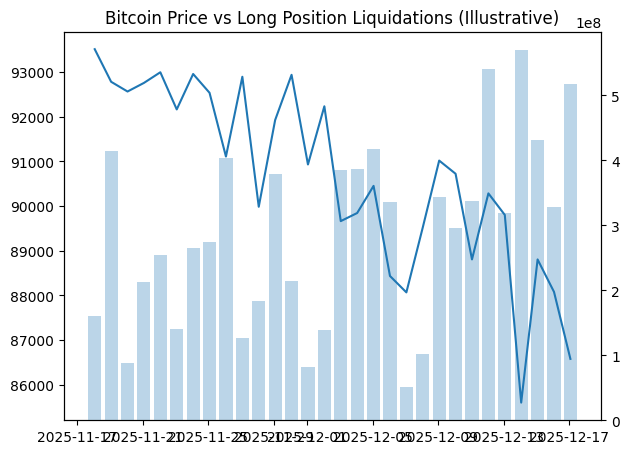
This chart would visually underscore how leveraged excess has been flushed out repeatedly, yet without establishing a clear base of strong spot demand.
Competing Narratives: Liquidity Tightness vs. Bitcoin’s Long-Term Role
David Hernandez, a crypto investment specialist at 21Shares, framed the situation as a clash between short-term macro headwinds and Bitcoin’s long-term investment thesis.
In the near term, tightening financial conditions and delayed monetary easing are forcing traders to reassess risk. This reassessment often results in immediate selling pressure, particularly when key technical support levels are tested.
However, Hernandez emphasized that underlying economic tensions continue to support Bitcoin’s longer-term appeal.
“As the Federal Reserve struggles to control inflation without tipping the economy into recession, assets with finite supply become increasingly relevant,” he said. “Bitcoin’s role as a hedge against monetary debasement remains intact.”
This dual narrative helps explain why long-term holders appear less reactive than short-term traders, even as volatility intensifies.
Altcoins: Selective Strength, Not a Full Rotation
The relative outperformance of BNB, XRP, and SUI deserves attention. Rather than signaling a broad altcoin season, the moves suggest selective positioning based on specific narratives:
- BNB: Continued ecosystem usage and exchange-related demand.
- XRP: Ongoing speculation around regulatory clarity and cross-border payment use cases.
- SUI: Interest driven by developer activity and Layer-1 competition dynamics.
Title: Relative Performance of BTC vs. Major Altcoins
Description: Indexed performance chart (base = 100) comparing BTC, ETH, BNB, XRP, and SUI over the past two weeks.
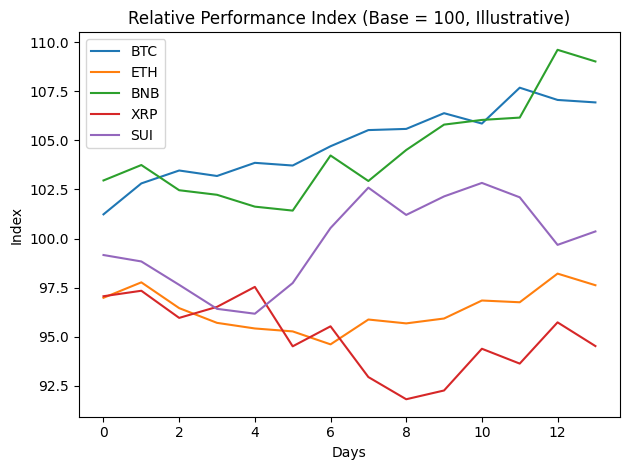
This chart would illustrate that while Bitcoin sets the tone, capital is rotating tactically rather than chasing speculative momentum across the board.
What This Means for Investors and Builders
For investors seeking new crypto assets or income opportunities, the current environment demands caution and selectivity. Short-term trading remains hazardous due to unstable liquidity and macro uncertainty. Risk management—through position sizing, hedging, or reduced leverage—is essential.
For builders and operators focused on practical blockchain use, the resilience of infrastructure players like Circle highlights a key theme: utility-driven crypto businesses may weather volatility better than purely speculative assets.
Conclusion: Volatility First, Conviction Later
Bitcoin’s rebound above $87,000 provides temporary relief, but it does not resolve the market’s underlying fragility. With derivatives markets signaling stress and macro conditions offering little immediate support, the risk of a move below $80,000 remains tangible.
Yet, the broader narrative has not collapsed. Bitcoin’s fixed supply, growing institutional familiarity, and role within a strained global financial system continue to attract long-term capital. For now, the market appears caught between fear-driven deleveraging and conviction-driven accumulation.
The coming weeks will likely determine which force prevails.
