
Main Points :
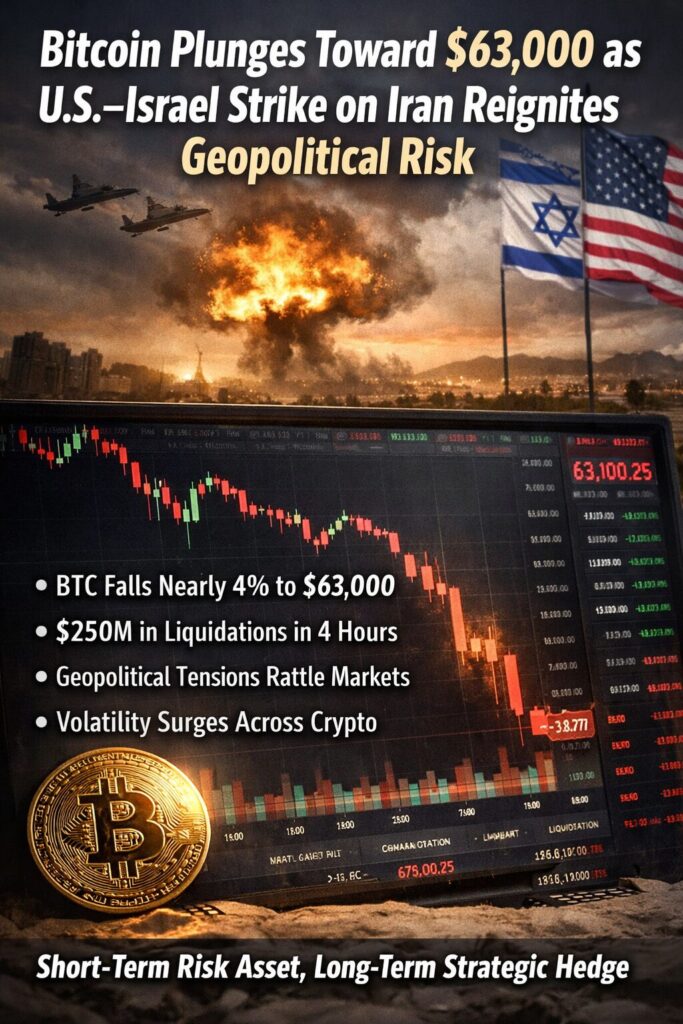
- Bitcoin fell nearly 4% in a single day after the United States and Israel announced military operations targeting Iran’s nuclear infrastructure.
- BTC tested the $63,000 level as crypto markets reacted ahead of traditional financial markets.
- Over $250 million in liquidations occurred within four hours, highlighting leverage risk.
- Geopolitical shocks are increasingly shaping short-term crypto price action.
- Institutional positioning, derivatives leverage, and macro hedging dynamics are amplifying volatility.
- The event underscores Bitcoin’s dual identity: risk asset in the short term, strategic hedge in the long term.
1. Immediate Market Reaction: Bitcoin Tests $63,000
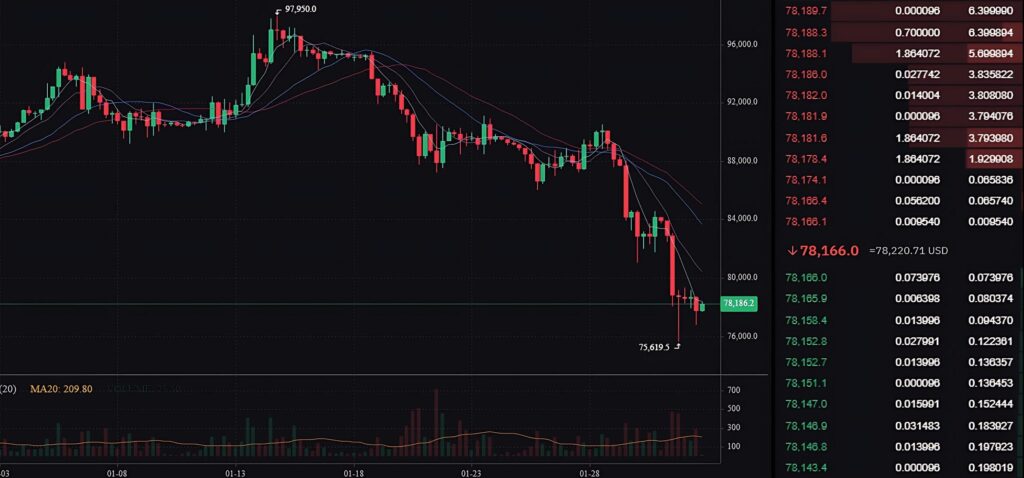
Bitcoin (BTC) experienced a sharp decline on Saturday following the announcement that the United States and Israel had launched military operations against Iran, reportedly targeting nuclear infrastructure facilities. Within hours of the announcement, BTC’s daily losses approached 4%, and prices briefly tested the $63,000 level.
The reaction was swift and decisive. Unlike traditional equity markets, which were closed at the time of the announcement, cryptocurrency markets operate 24/7. As a result, crypto became the first asset class to price in the renewed geopolitical risk. This phenomenon has increasingly positioned Bitcoin as a real-time barometer of global uncertainty.
According to derivatives data aggregators, more than $250 million in leveraged positions were liquidated within a four-hour window. The liquidation heatmap revealed a cascade effect: as prices broke below key technical support zones, long positions were forcibly closed, accelerating downward momentum.
This episode once again demonstrated the reflexive nature of crypto markets—where leverage, liquidity, and sentiment interact at high speed.
2. Political Escalation and Strategic Messaging
The geopolitical catalyst was a video address by U.S. President Donald Trump, who emphasized that the joint U.S.–Israel operation focused on Iran’s nuclear infrastructure. He also made direct remarks to the Iranian public, urging them to “take control” of their government once military objectives were achieved.
Such rhetoric marked a significant escalation in tone. Markets interpreted the announcement not merely as a limited strike but as a potential expansion of regional conflict.
This is not the first time geopolitical conflict involving Iran has affected crypto markets. In 2025, Iranian offensives led to abrupt volatility across risk assets, including equities, commodities, and digital assets. Each episode reinforces a growing pattern: crypto markets now respond to geopolitical developments with the same immediacy as oil futures or currency pairs.
However, the depth of crypto’s reaction is often amplified by leverage. Unlike traditional markets, where margin requirements are tightly regulated, crypto derivatives allow high leverage, creating vulnerability to cascading liquidations during unexpected news events.
3. Why Crypto Reacts Before Traditional Markets
One of the most important dynamics in this event was timing. U.S. stock futures had not yet opened for trading when Bitcoin began its descent. As a result, crypto effectively functioned as the “first responder” asset class.
This first-mover behavior stems from three factors:
- 24/7 Trading Structure – Crypto never closes.
- Global Retail Participation – Traders across time zones react instantly.
- High Leverage in Derivatives Markets – Amplifies both upside and downside.
In recent years, Bitcoin has exhibited characteristics of both a risk-on technology asset and a macro hedge. During acute geopolitical shocks, the initial reaction often mirrors equities: investors de-risk and reduce exposure. Yet over longer horizons, capital sometimes rotates back into Bitcoin as a hedge against systemic uncertainty.
This duality makes Bitcoin uniquely sensitive to short-term fear while remaining attractive in strategic allocation frameworks.
4. Liquidations and the Leverage Trap
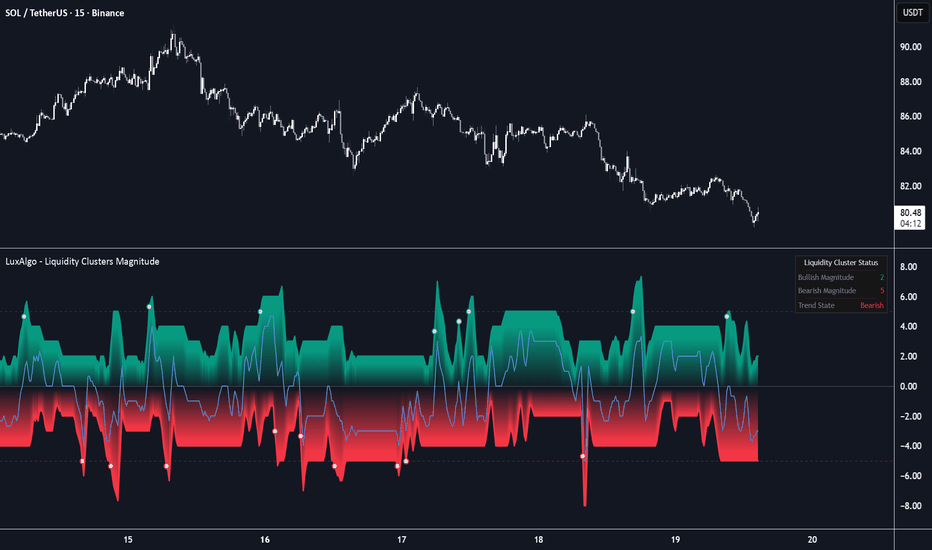
More than $250 million in liquidations within four hours signals excessive leverage buildup prior to the event. Funding rates in perpetual futures markets had been elevated, indicating crowded long positioning.
When BTC dropped toward $63,000, stop-loss orders triggered automatically. As leveraged long positions were liquidated, forced selling added to the downward pressure.
This “liquidation cascade” mechanism is increasingly central to crypto volatility. It transforms geopolitical headlines into mechanical price accelerators.
For investors seeking new income opportunities or yield strategies, this dynamic presents both risk and opportunity:
- Volatility increases options premiums.
- Funding rate imbalances create arbitrage openings.
- Liquidation clusters offer short-term tactical entry points.
However, exploiting these opportunities requires disciplined risk management and real-time monitoring tools.
5. Broader Macro Context: Oil, the Dollar, and Safe-Haven Flows
Geopolitical tensions involving Iran frequently impact oil markets. Historically, rising Middle East tensions correlate with oil price spikes, stronger U.S. dollar demand, and equity volatility.
Bitcoin’s behavior during such episodes has evolved. In earlier cycles, BTC often fell alongside equities and remained depressed. In more recent years, however, drawdowns tend to be sharp but shorter-lived.
Institutional participation has changed the structure of crypto markets. Hedge funds, asset managers, and ETF flows increasingly treat Bitcoin as part of broader macro portfolios. When geopolitical stress increases, portfolio managers may temporarily reduce exposure to high-beta assets, including BTC.
Yet if conflict escalates and currency instability rises, Bitcoin may re-emerge as a capital preservation alternative—particularly in regions directly affected by sanctions or capital controls.
This pattern reinforces Bitcoin’s complex macro identity.
6. Structural Implications for Investors Seeking Opportunity
For readers searching for new crypto assets or revenue streams, this episode highlights several practical considerations:
A. Volatility as a Revenue Engine
High-volatility periods expand derivatives spreads and funding differentials. Structured strategies—delta-neutral hedging, basis trades, options selling—become more attractive.
B. Real-Time Risk Monitoring
On-chain analytics, liquidation heatmaps, and funding rate dashboards are no longer optional tools; they are essential infrastructure.
C. Cross-Asset Awareness
Crypto does not exist in isolation. Oil futures, Treasury yields, and geopolitical headlines directly impact BTC flows.
D. Capital Allocation Discipline
Short-term panic can generate long-term entry points—but only for investors who manage leverage prudently.
7. Technical Outlook: Why $63,000 Matters
The $63,000 level represents a significant technical zone. It previously acted as consolidation support during earlier market cycles. A sustained breakdown below this level could open the path toward deeper retracement zones around $60,000.
Conversely, a rapid rebound from $63,000 would signal resilient spot demand and limited structural damage.
The coming days will reveal whether this event was a temporary leverage flush or the beginning of broader risk repricing.
8. The Evolution of Bitcoin in a Geopolitical World
The most profound takeaway is structural rather than tactical. Bitcoin is no longer an isolated speculative instrument. It has become embedded within the global macro system.
Geopolitical conflict now influences:
- Short-term volatility
- Derivatives positioning
- ETF flows
- Institutional asset allocation
At the same time, Bitcoin’s censorship-resistant properties remain relevant in environments of political instability.
This dual role—risk asset and strategic hedge—creates recurring cycles of sharp corrections followed by renewed adoption.
Conclusion: Shock, Leverage, and Strategic Positioning
Bitcoin’s drop toward $63,000 following U.S.–Israel military action against Iran underscores the increasing integration of crypto markets into global macro dynamics. The immediate reaction—nearly 4% down with $250 million in liquidations—demonstrates how leverage magnifies geopolitical shocks.
Yet beyond the volatility lies a deeper narrative. Bitcoin now acts as both a speculative risk asset and a strategic hedge against systemic instability. For investors seeking the next income opportunity or blockchain-driven revenue model, the lesson is not to avoid volatility—but to understand its mechanics.
Periods of geopolitical stress reveal structural weaknesses in overleveraged markets. They also create windows for disciplined capital deployment.
Whether Bitcoin stabilizes above $63,000 or retests lower levels, one fact remains clear: crypto has entered the geopolitical era. Understanding this transformation is essential for anyone serious about practical blockchain investment and long-term digital asset strategy.
