Key Points :
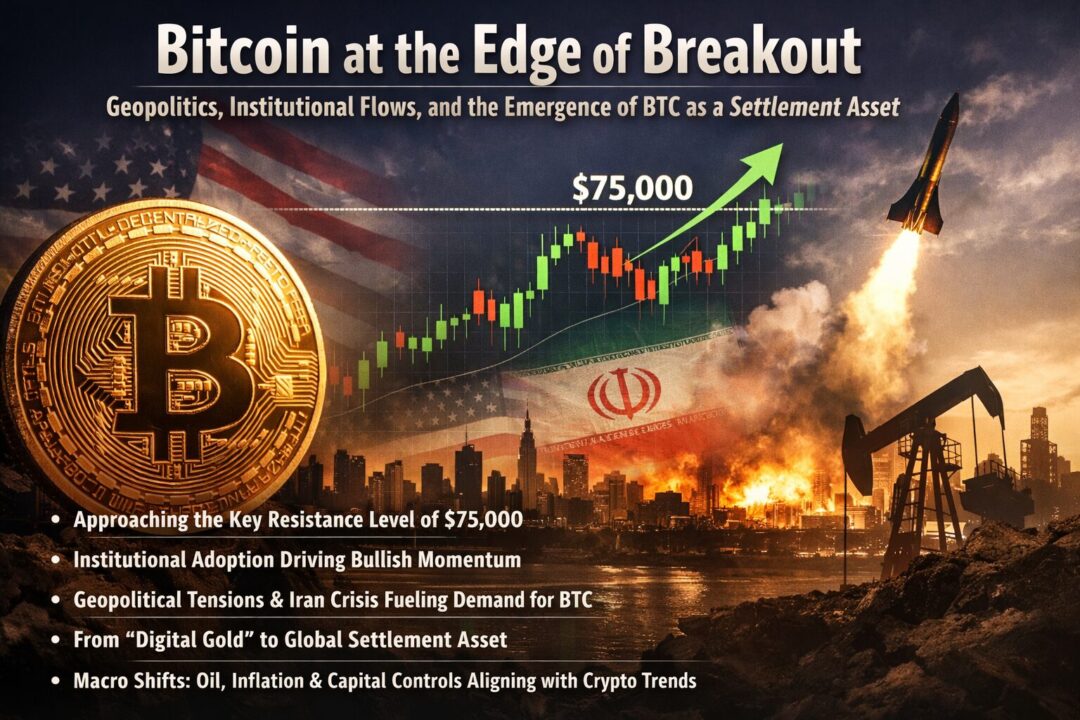
- Bitcoin is approaching the critical $75,000 resistance level, signaling a potential breakout phase
- Institutional adoption and derivatives market structure support upward momentum
- Geopolitical tensions—especially involving Iran and oil trade—are introducing real-world BTC utility
- Ethereum futures outperforming Bitcoin hints at broader crypto market expansion
- Bitcoin is evolving from “digital gold” into a functional global settlement asset
BTC Price Near Resistance (Visual Chart)
The Breakout Threshold: Why $75,000 Matters
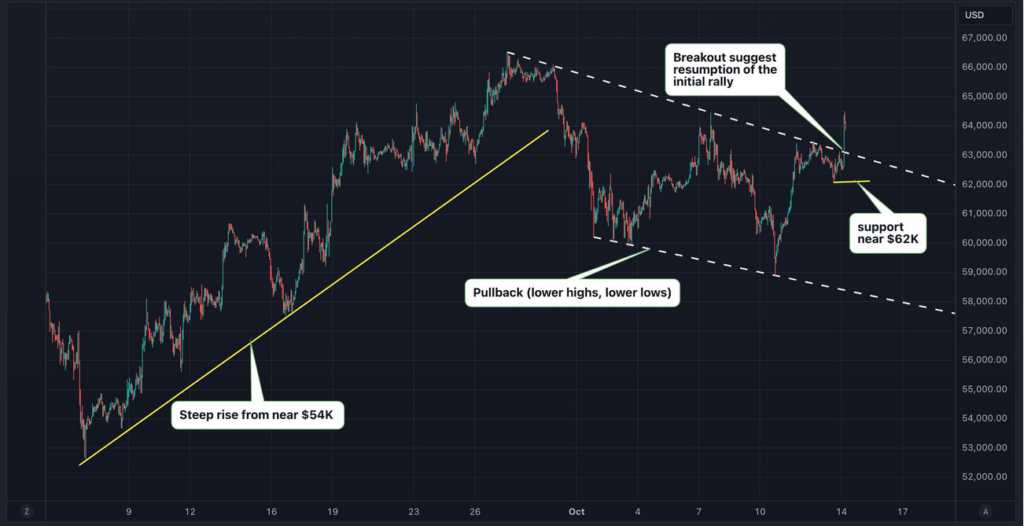
Bitcoin is once again approaching a psychologically and technically critical level: $75,000. For months, this range has acted as a ceiling, rejecting upward momentum and reinforcing a consolidation structure. However, the current market environment appears fundamentally different from previous attempts.
Unlike earlier rallies driven primarily by retail enthusiasm, this cycle is increasingly defined by institutional participation, macroeconomic shifts, and evolving geopolitical dynamics. These factors are converging to create a structural foundation that could support a sustained breakout rather than a temporary spike.
The recent price action reflects this tension. Following geopolitical shocks—such as the breakdown of nuclear negotiations between the United States and Iran—Bitcoin briefly dropped from approximately $73,000 before rapidly recovering. This resilience is notable. It suggests that underlying demand is not only strong but also diversified across different types of market participants.
From a technical standpoint, repeated tests of resistance tend to weaken it. The more frequently Bitcoin approaches the $75,000 level without significant rejection, the higher the probability that it will eventually break through. This phenomenon is well understood in traditional markets and is now clearly visible in crypto price behavior.
Derivatives Market Structure (Futures Premium)
Derivatives Signal Confidence: Institutional Positioning Builds
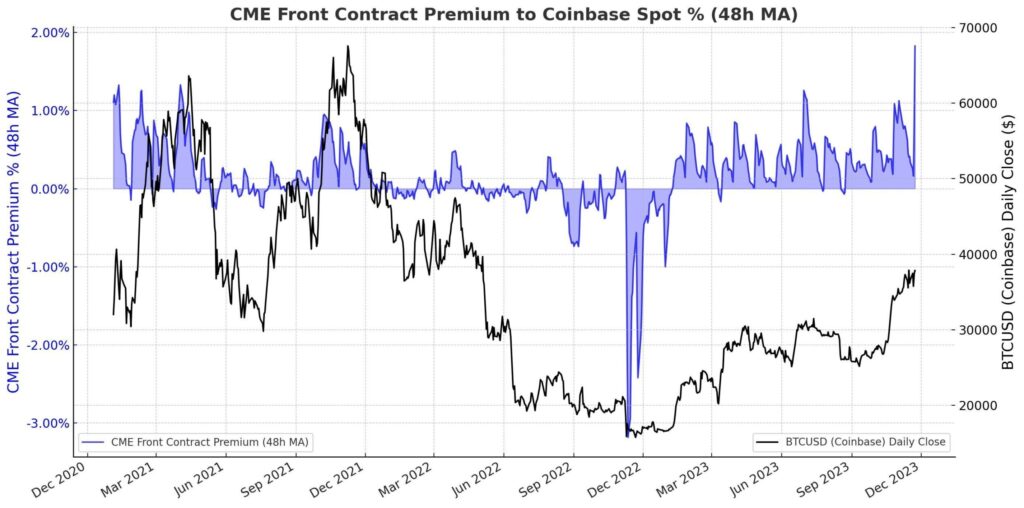
One of the clearest indicators supporting a bullish outlook is the behavior of the derivatives market. Futures premiums on the Chicago Mercantile Exchange (CME) have risen to approximately 7%, indicating strong demand for leveraged long exposure.
In traditional financial terms, this reflects a state of “contango,” where future prices exceed spot prices. While excessive contango can signal overheating, moderate levels—such as the current 7%—often indicate healthy optimism rather than speculative excess.
Even more intriguing is the relationship between Ethereum and Bitcoin futures. Ethereum futures are now trading at a premium relative to Bitcoin futures for the first time since mid-March. This shift suggests that capital is rotating within the crypto ecosystem, not exiting it.
Such internal rotation is typically a bullish signal. It implies that investors are expanding their exposure across multiple assets rather than reducing risk. In previous cycles, similar patterns have preceded broader market rallies, where Bitcoin leads initially, followed by Ethereum and then smaller altcoins.
For investors seeking new opportunities, this dynamic is critical. It indicates that while Bitcoin remains the anchor asset, the next phase of growth may be distributed across the broader crypto landscape.
Strait of Hormuz & Oil Flow Map
Geopolitics Meets Bitcoin: From Store of Value to Settlement Layer
Perhaps the most compelling development highlighted in recent analysis is the intersection of geopolitics and Bitcoin utility.
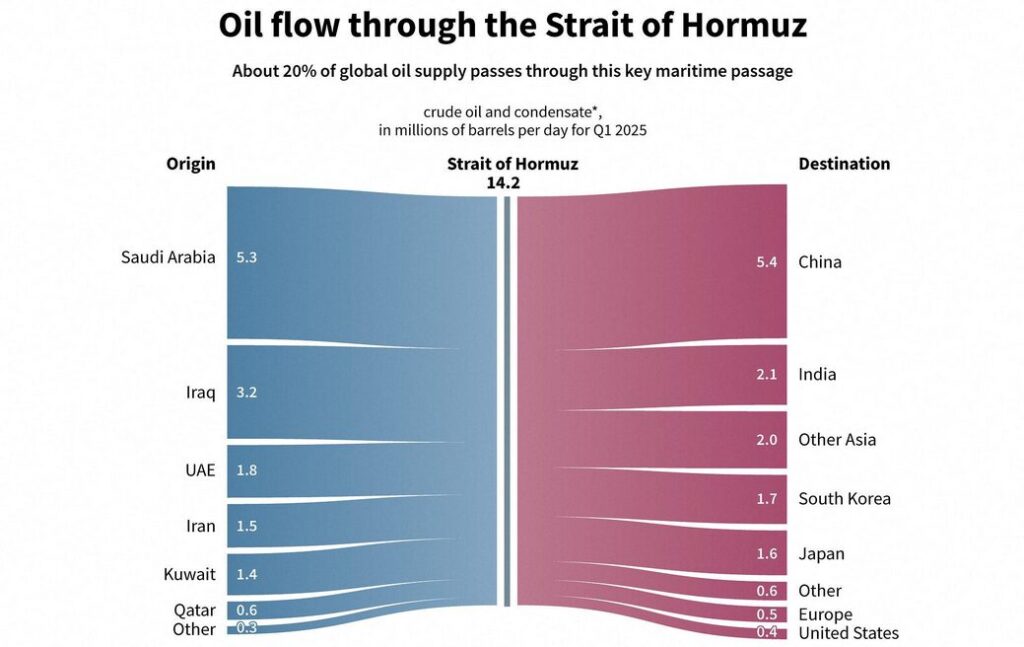
A proposal from an Iranian oil-related organization suggests imposing a $1 per barrel transit fee on oil shipments passing through the Strait of Hormuz. What makes this proposal extraordinary is not the fee itself, but the accepted payment methods: Chinese yuan or Bitcoin.
To understand the magnitude of this proposal, consider the scale of oil flow through the Strait of Hormuz—approximately 7.3 billion barrels annually. At $1 per barrel, this would generate $7.3 billion in annual fees.
Converted into Bitcoin at current price levels, this equates to demand for roughly 100,000 BTC per year.
Even if the proposal remains theoretical, its implications are profound. It signals a shift in how Bitcoin is perceived—not merely as a speculative asset or hedge against inflation, but as a viable medium for international settlement.
In a world increasingly fragmented by geopolitical tensions, traditional financial rails—dominated by the U.S. dollar—are becoming less universally accessible. Sanctions, currency controls, and political conflicts are driving countries and organizations to explore alternative systems.
Bitcoin, with its decentralized architecture and borderless nature, is uniquely positioned to fill this gap.
Bitcoin’s Identity Shift: Digital Gold Is No Longer Enough
For years, Bitcoin has been described as “digital gold.” This narrative has been useful but incomplete.
Gold functions primarily as a store of value. It is rarely used in day-to-day transactions, particularly at scale. Bitcoin, however, is beginning to demonstrate capabilities that extend far beyond this role.
The potential use of Bitcoin in oil transit payments represents a fundamental shift. It introduces the concept of Bitcoin as a “settlement asset”—a neutral, censorship-resistant medium for transferring value between parties that may not trust each other or the existing financial system.
This evolution aligns with broader trends in the crypto industry. Stablecoins, decentralized finance (DeFi), and tokenized assets are all contributing to the emergence of a parallel financial infrastructure.
Bitcoin’s role within this system may ultimately resemble that of a base layer—analogous to a reserve asset that underpins more complex financial instruments.
Market Implications: What Comes Next?
If current trends continue, several key developments are likely:
First, a successful breakout above $75,000 could trigger a wave of momentum-driven buying. This would include both retail investors and algorithmic trading systems that respond to technical signals.
Second, increased institutional participation will likely bring greater liquidity and stability to the market. While volatility will remain a defining feature of crypto, its nature may evolve as the market matures.
Third, geopolitical adoption—whether through oil trade or other mechanisms—could introduce entirely new sources of demand. Unlike speculative demand, this type of usage is tied to real economic activity, making it potentially more durable.
Finally, the relationship between Bitcoin and other crypto assets will continue to evolve. Ethereum’s recent strength suggests that the market is entering a phase of expansion rather than contraction.
Conclusion: A Structural Shift, Not Just a Price Move
Bitcoin’s approach toward $75,000 is not merely a technical event—it is a reflection of deeper structural changes within the global financial system.
Institutional adoption, derivatives market dynamics, and geopolitical developments are converging to redefine Bitcoin’s role. What was once viewed as a niche asset is now emerging as a critical component of a new financial architecture.
For investors, the implications are clear. This is not simply about identifying the next price target. It is about understanding the broader transformation taking place—and positioning accordingly.