
Key Points :
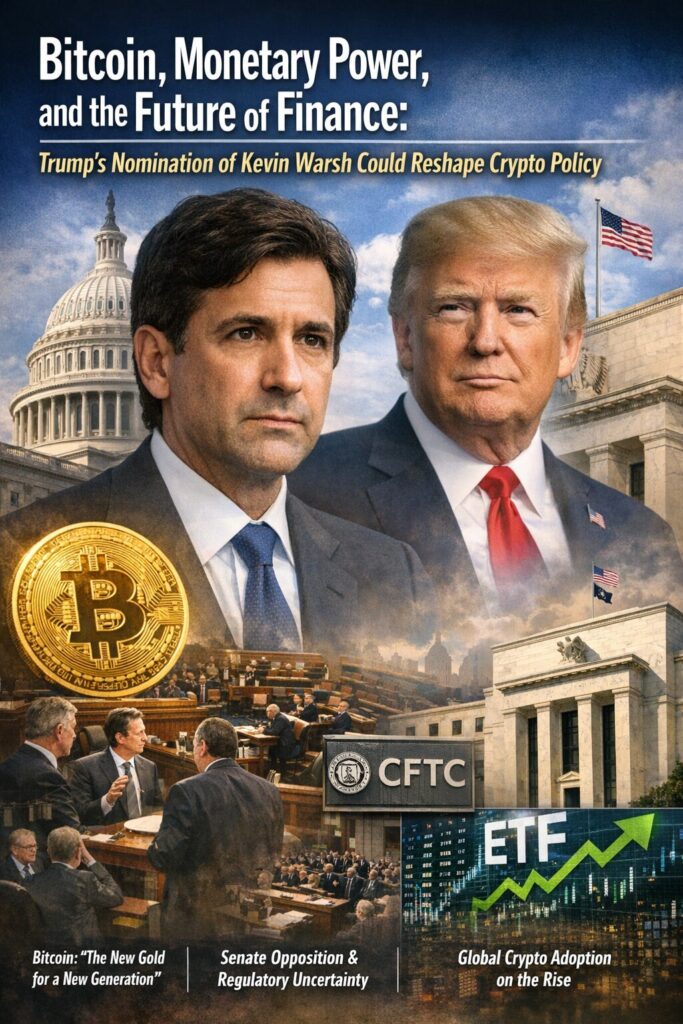
- Former Federal Reserve Governor Kevin Warsh, a known supporter of Bitcoin, has been formally nominated by President Donald Trump to become the next Federal Reserve Chair.
- Warsh has previously described Bitcoin as “the new gold for younger generations.”
- His nomination could signal a shift in U.S. monetary policy toward greater recognition of digital assets.
- Political opposition in the Senate may delay or complicate confirmation.
- Meanwhile, regulatory leadership gaps at the Commodity Futures Trading Commission (CFTC) could influence how cryptocurrencies are supervised in the near future.
- The broader global context shows increasing institutional adoption of Bitcoin, rising ETF inflows, and growing interest in blockchain-based financial infrastructure.
1. A Bitcoin-Friendly Candidate for the World’s Most Powerful Central Bank
The United States Federal Reserve is widely considered the most influential central bank in the global financial system. Its decisions affect not only U.S. interest rates and inflation but also global liquidity conditions, asset prices, and international capital flows. For this reason, any change in leadership at the Federal Reserve is closely watched by investors, policymakers, and markets worldwide.
In a move that has quickly attracted attention across financial and cryptocurrency circles, U.S. President Donald Trump has formally submitted the nomination of Kevin Warsh to the Senate as the next Chair of the Federal Reserve. If confirmed, Warsh would succeed the current Chair, Jerome Powell, whose term is scheduled to end on May 15.
According to the official White House notification, the nomination would grant Warsh two roles simultaneously: a four-year term as Federal Reserve Chair and a fourteen-year term as a member of the Federal Reserve Board of Governors.
While changes in Federal Reserve leadership are always significant, this nomination carries a unique dimension: Warsh has repeatedly expressed relatively favorable views toward Bitcoin and the broader cryptocurrency ecosystem.
For digital-asset investors and entrepreneurs, the possibility that a Bitcoin-friendly policymaker could lead the world’s most powerful central bank represents a potential turning point.
2. Kevin Warsh: From Financial Crisis Policymaker to Crypto-Era Thinker
Kevin Warsh is not new to central banking. He served as a Federal Reserve Governor from 2006 to 2011, spanning both the George W. Bush and Barack Obama administrations.
During this period, he was involved in policymaking during one of the most dramatic events in modern financial history: the 2008 global financial crisis.
After leaving the Federal Reserve, Warsh joined the Hoover Institution at Stanford University as a senior fellow, where he has continued to write and speak about monetary policy, global finance, and technological change in financial systems.
In recent years, his public commentary has included several notable statements about Bitcoin and digital assets.
One of his most widely cited remarks came during a 2021 interview with CNBC, where he argued:
“If Bitcoin didn’t exist, gold would probably be much higher today. For people under 40, Bitcoin is the new gold.”
This statement captured an important generational shift in investor behavior. While older investors traditionally view gold as a hedge against inflation and monetary instability, younger investors increasingly see Bitcoin fulfilling a similar role.
Warsh has also suggested that cryptocurrencies can serve as signals about the health of monetary policy.
In a 2025 interview, he stated that digital assets could help bring discipline to markets by revealing where the global financial system requires adjustment.
3. Bitcoin as a Signal of Monetary Policy Confidence
Perhaps the most intriguing aspect of Warsh’s perspective is his view of Bitcoin not merely as a speculative asset, but as a measurement tool for economic confidence.
He once reflected on a conversation in 2011 when venture capitalist Marc Andreessen showed him the original Bitcoin white paper.
Warsh later commented that he wished he had understood more clearly at that time how transformative the technology might become.
According to Warsh, Bitcoin can function as a “market test” of policy credibility.
When trust in government policy weakens, alternative stores of value such as gold—or increasingly Bitcoin—may gain traction.
This interpretation aligns with a broader trend observed in recent years: Bitcoin’s price often rises during periods of macroeconomic uncertainty, including inflation concerns, geopolitical instability, or financial-system stress.
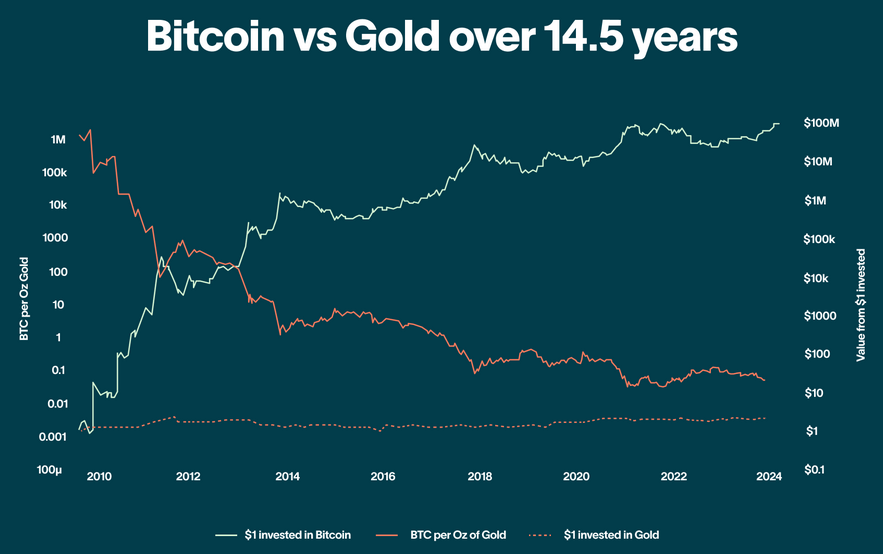
Illustrative market trends showing Bitcoin adoption and performance relative to traditional assets.
4. Political Resistance and the Question of Federal Reserve Independence
Despite enthusiasm from some corners of the crypto community, Warsh’s nomination is unlikely to proceed without political controversy.
Federal Reserve independence has long been considered a cornerstone of the U.S. economic system. Central bankers are expected to make policy decisions based on economic data rather than political pressure.
Democratic leaders in the Senate have already expressed concerns.
Senate Majority Leader Chuck Schumer criticized the nomination earlier this year, arguing that the move could undermine the independence of the Federal Reserve.
Schumer stated that Warsh must demonstrate clearly that he will protect the central bank from political influence.
Without such assurances, he argued, the Senate should not approve the nomination.
These tensions highlight a deeper debate in the United States: how to balance democratic accountability, financial stability, and central bank autonomy.
5. The Broader Regulatory Landscape: CFTC and Crypto Market Structure
The nomination also comes at a time when the regulatory framework for cryptocurrencies in the United States remains in flux.
One notable gap involves leadership at the Commodity Futures Trading Commission (CFTC).
As of now, the agency is operating with fewer commissioners than usual. Typically composed of five commissioners, the CFTC currently relies heavily on its chair to manage regulatory operations.
If pending market-structure legislation passes in Congress, the CFTC could gain significantly expanded authority over cryptocurrency markets.
This would likely include oversight of:
- Digital asset derivatives
- Spot crypto market integrity
- Stablecoin-related trading infrastructure
- Cross-border digital asset exchanges
Such regulatory clarity could significantly impact the growth of blockchain-based financial systems.
6. Global Crypto Adoption Continues to Accelerate
While the political debate in Washington unfolds, the broader cryptocurrency ecosystem continues to expand rapidly.
Several recent developments illustrate the accelerating institutionalization of digital assets:
- Bitcoin ETFs in the United States have attracted tens of billions of dollars in inflows.
- Major financial institutions are building digital asset custody services.
- Payment networks are experimenting with stablecoin-based settlements.
- Governments worldwide are exploring central bank digital currencies (CBDCs).
Meanwhile, emerging blockchain platforms are experimenting with new applications in:
- decentralized finance (DeFi)
- tokenized real-world assets
- global remittances
- decentralized identity systems
For entrepreneurs and investors seeking the next generation of blockchain opportunities, these developments represent an expanding frontier.
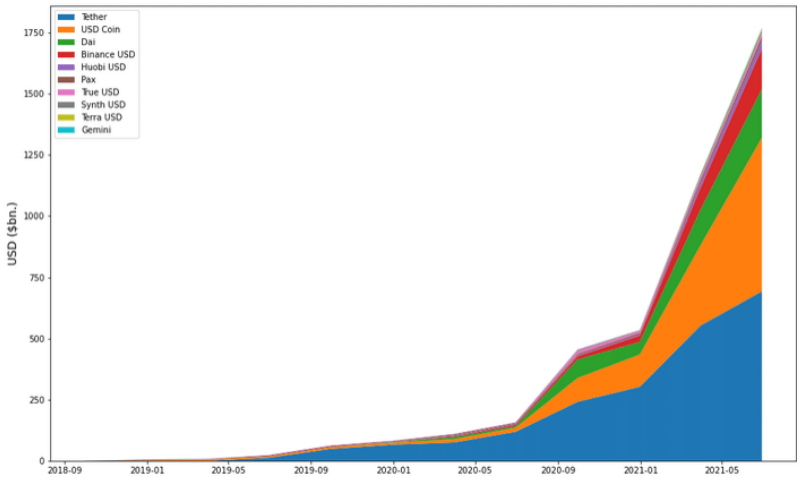
Global expansion of cryptocurrency markets and institutional adoption.
7. What This Could Mean for the Future of Bitcoin
If Kevin Warsh is ultimately confirmed as Federal Reserve Chair, the symbolic implications for the cryptocurrency industry could be profound.
For over a decade, Bitcoin existed largely outside the traditional financial system. Central banks and regulators often treated it with skepticism or outright hostility.
Today, the situation is evolving.
Bitcoin is increasingly discussed alongside gold, sovereign bonds, and other macroeconomic assets.
A Federal Reserve chair who openly acknowledges Bitcoin’s potential role in the financial system could encourage a more nuanced policy environment.
This does not necessarily mean the Federal Reserve would actively promote cryptocurrencies.
However, it could lead to:
- greater policy dialogue about digital assets
- clearer regulatory frameworks
- increased institutional participation
- integration of blockchain infrastructure into financial markets
Conclusion
The nomination of Kevin Warsh to lead the Federal Reserve represents more than a routine political appointment. It reflects a moment when the worlds of traditional finance and digital assets are beginning to converge.
Warsh’s past remarks suggest he views Bitcoin not simply as a speculative asset but as a technological innovation capable of reshaping financial markets.
Whether or not his nomination ultimately succeeds, the debate itself underscores a growing reality: cryptocurrencies are no longer peripheral to global finance.
They are becoming part of the conversation about monetary policy, financial stability, and the future of the global economic system.
For investors, entrepreneurs, and developers exploring new opportunities in blockchain technology, this shift could mark the beginning of a new chapter—one where digital assets move closer to the core of the world’s financial architecture.
