

Main Points :
- Bitcoin mining difficulty jumped approximately 14.7% to 144.4T after recovering from a weather-driven hash rate dip.
- The prior adjustment saw a sharp decline from 141.67T to 125.86T, reflecting temporary disruption.
- The recent rebound confirms that winter storms—not structural mining weakness—caused the earlier drop.
- Hash rate resilience reinforces Bitcoin’s long-term network security.
- AI diversification among miners exists, but core Bitcoin mining economics remain intact.
- Rapid multi-trillion difficulty swings today contrast sharply with Bitcoin’s early 11-year climb to 15T.
- Institutional infrastructure growth and ASIC efficiency improvements support long-term bullish fundamentals.
The 14.7% Difficulty Shock: What Just Happened?
Bitcoin’s mining difficulty increased to 144.4 trillion (T), marking a substantial 14.7% adjustment upward from 125.86T. This sharp rebound follows a previous downward adjustment when severe winter storms in the United States temporarily disrupted mining operations, especially in energy-dense regions such as Texas.
Bitcoin’s protocol adjusts mining difficulty approximately every two weeks to maintain its target block time of roughly 10 minutes. When hash rate declines—whether due to regulatory crackdowns, power outages, or environmental disruptions—the difficulty decreases. When computational power returns, difficulty increases accordingly.
In this case, the earlier drop was not structural. It was environmental.
The network’s ability to recover quickly demonstrates one of Bitcoin’s most underestimated strengths: automatic, algorithmic self-stabilization.
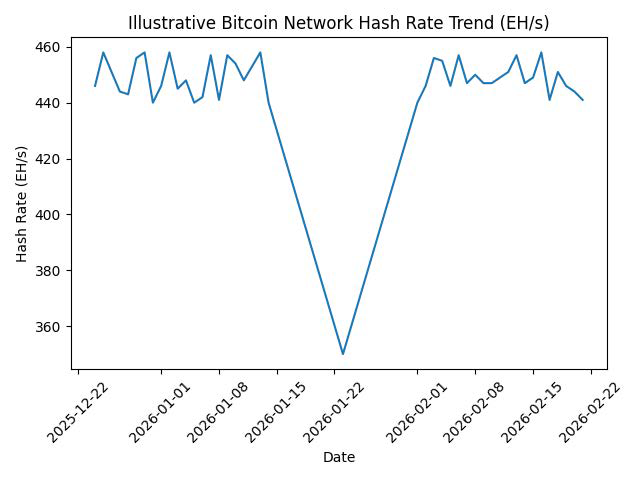
This chart illustrates the temporary dip and subsequent recovery in network hash rate.
Hash Rate Recovery: A Sign of Structural Strength
Hash rate represents the total computational power securing the Bitcoin network. It is measured in exahashes per second (EH/s) and reflects both the number of mining machines online and their processing efficiency.
During the winter storm, hash rate temporarily declined as miners in affected regions curtailed operations to preserve grid stability. However, once conditions normalized, mining operations rapidly resumed.
The current rebound signals:
- No mass miner capitulation
- No systemic hardware failure
- No widespread operational shutdown
- No quantum computing threat
- No fundamental profitability collapse
The quick recovery also contradicts speculative narratives suggesting that miners were exiting Bitcoin mining en masse to pivot into artificial intelligence (AI) data center infrastructure.
While some large mining companies have diversified revenue streams into AI hosting and HPC (high-performance computing), the hash rate recovery confirms that Bitcoin mining remains a core, economically viable activity.
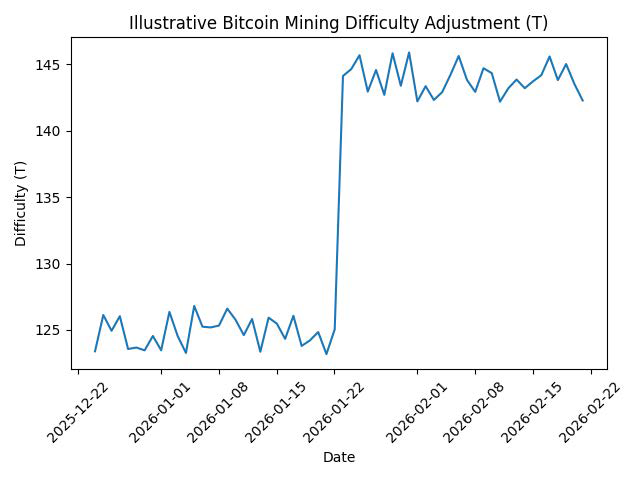
This chart shows the previous difficulty drop and the current sharp rebound.
Why Difficulty Matters for Investors
For investors seeking new crypto assets or income strategies, difficulty metrics offer insight into miner behavior and network security.
When difficulty rises:
- Mining competition intensifies
- The cost of producing 1 BTC increases
- Security strengthens
- Miner breakeven prices may rise
As of current market conditions, if Bitcoin trades at approximately $65,000–$70,000, and mining difficulty increases significantly, the estimated all-in production cost for efficient operators may approach $40,000–$50,000 depending on energy pricing and ASIC efficiency.
This dynamic has two implications:
- It creates a rising “security floor” beneath Bitcoin’s valuation.
- It increases long-term supply discipline.
Higher production costs historically correlate with stronger long-term price support.
A Historical Perspective: From 15T in 11 Years to 15T in Weeks
It took nearly 11 years after Bitcoin’s 2009 launch for mining difficulty to reach 15T.
Today, difficulty fluctuates by more than 15T within a single adjustment cycle.
This illustrates:
- Exponential growth in mining hardware efficiency
- Industrialization of mining
- Institutional capital entry
- Advanced ASIC innovation
- Energy arbitrage at global scale
Bitcoin mining has evolved from hobbyist GPUs to industrial-scale facilities operating immersion-cooled ASIC clusters optimized for joule efficiency.
This industrialization signals maturation—not fragility.
The AI Diversification Narrative: Reality vs Speculation
Some analysts speculated that declining hash rate was due to miners abandoning Bitcoin for AI workloads.
Marty Bent of Ten31 commented that such narratives were exaggerated. The primary driver of hash rate decline was weather, not strategic retreat.
That said, the AI pivot narrative contains partial truth:
- Some miners lease infrastructure for AI training clusters.
- GPU-based facilities can repurpose for machine learning.
- Data center operators seek diversified revenue streams.
However, Bitcoin mining ASICs are not interchangeable with AI GPUs. Their hardware specialization ensures continued network commitment.
The recovery confirms that Bitcoin’s base layer remains economically compelling.
Macro Context: Energy Markets and Institutional Positioning
Beyond weather effects, the difficulty adjustment occurs within broader macro trends:
- U.S. energy grid flexibility markets now integrate mining curtailment programs.
- Institutional ETFs continue accumulating Bitcoin exposure.
- Long-term holders maintain historically high supply percentages.
- Halving-cycle supply compression continues to tighten issuance.
Bitcoin’s next structural challenge is not environmental—it is macro-liquidity driven.
If global liquidity expands, high difficulty levels amplify bullish cycles.
If liquidity tightens, miner margins compress—but network security persists.
Implications for Yield and Strategy Seekers
For readers searching for next-generation revenue opportunities, several strategic considerations emerge:
- Mining Equity Plays
Publicly traded mining companies benefit from difficulty-driven scarcity dynamics. - Infrastructure Tokens
Projects focused on decentralized compute or energy coordination may gain relevance. - Layer-2 Scaling Solutions
As base layer security strengthens, Lightning and sidechain ecosystems become more viable. - Energy Arbitrage Investments
Bitcoin mining increasingly monetizes stranded or renewable energy. - ASIC Efficiency Innovation
Hardware innovation cycles can outperform spot BTC during certain phases.
Difficulty growth signals economic seriousness. Weak networks do not sustain trillion-scale computational arms races.
Network Resilience and the Security Premium
Bitcoin’s security budget consists of block rewards plus transaction fees.
Higher difficulty means greater aggregate investment into securing the chain.
For institutional investors, this creates a “security premium” narrative:
- Capital secures capital.
- Hash power becomes geopolitical infrastructure.
- Mining decentralization mitigates systemic risk.
This dynamic strengthens Bitcoin’s thesis as a sovereign-grade monetary network.
Conclusion: Weather Was Temporary. Network Strength Is Structural.
The nearly 15% surge in mining difficulty marks more than a technical adjustment. It confirms:
- Environmental disruptions were temporary.
- Miner commitment remains strong.
- Hash rate resilience is intact.
- Structural network growth continues.
Bitcoin’s mining difficulty now swings by magnitudes that once required a decade to achieve.
For long-term capital allocators, this signals maturation.
For entrepreneurs, it signals infrastructure opportunity.
For investors, it reinforces the core thesis:
Bitcoin is not weakening—it is industrializing.
