

Key Takeaways :
- Bitcoin’s mining difficulty reached a new all-time high at the final adjustment of 2025, signaling unprecedented competition among miners.
- The next difficulty adjustment in January 2026 is expected to push the threshold even higher, reinforcing network security and decentralization.
- Rising difficulty reflects increasing capital intensity in mining, reshaping profitability and industry structure.
- Bitcoin’s dynamic difficulty adjustment mechanism plays a critical role in protecting price stability, supply integrity, and resistance to centralization.
- For investors and blockchain practitioners, mining metrics provide valuable signals about network health, long-term value, and emerging business opportunities.
Bitcoin Mining Difficulty Breaks Records at the End of 2025
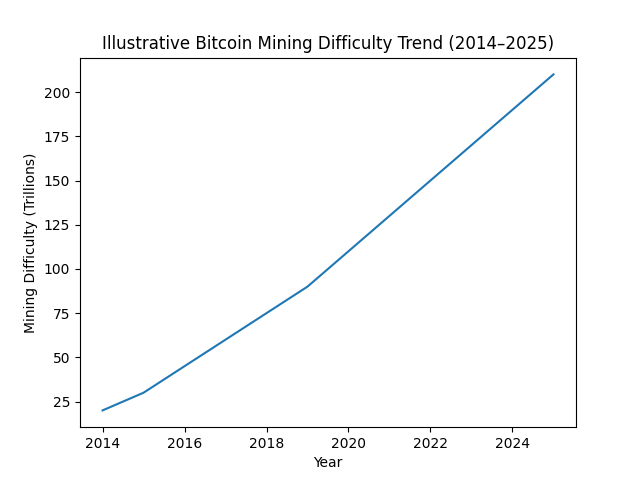
Bitcoin’s mining difficulty, a metric representing the computational effort required to add a new block to the blockchain, increased slightly during the final adjustment of 2025, reaching a record 148.2 trillion. This milestone underscores how competitive and capital-intensive Bitcoin mining has become as the network continues to mature.
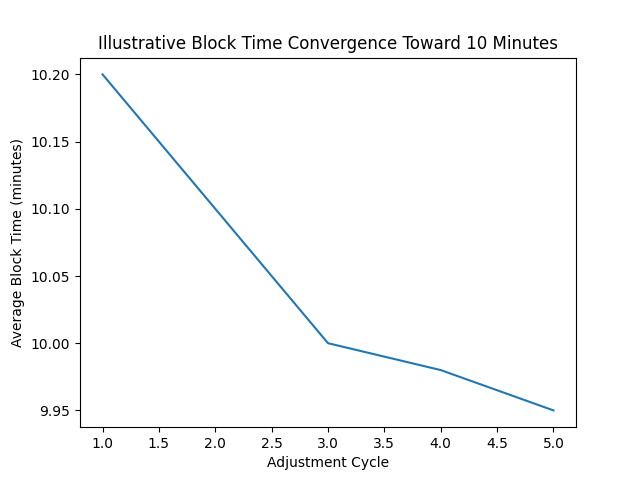
According to CoinWarz data, the next difficulty adjustment is projected to occur on January 8, 2026, at block height 931,392, potentially raising difficulty to approximately 149 trillion. At the time of writing, the average block time stands at around 9.95 minutes, slightly faster than the protocol’s target of 10 minutes. This deviation strongly suggests another upward adjustment is imminent.
Bitcoin’s protocol automatically corrects such imbalances. When blocks are produced too quickly, the system responds by increasing mining difficulty, ensuring long-term stability and predictability.
Illustrative Bitcoin Mining Difficulty Trend (2014–2025)
Why Mining Difficulty Keeps Rising
Mining difficulty reached multiple highs throughout 2025. During September, when Bitcoin’s price was trending upward, the network recorded two sharp difficulty increases as miners rapidly deployed new hardware to capitalize on higher profitability. However, a historic market downturn in October disrupted price momentum without reversing the long-term difficulty trend.
This divergence highlights a crucial reality: mining difficulty does not directly follow short-term price fluctuations. Instead, it reflects aggregate computational power committed to securing the network. Even during price corrections, large-scale mining operators often continue expanding, driven by long-term expectations rather than short-term volatility.
For miners, rising difficulty translates into higher operational costs. More powerful hardware, greater energy consumption, and sophisticated infrastructure are required simply to maintain existing output levels. Bitcoin mining has effectively become a capital-intensive industrial activity, favoring operators with access to cheap electricity, advanced chips, and long-term financing.
Difficulty Adjustment as a Guardian of Decentralization
Bitcoin’s mining difficulty adjusts every 2,016 blocks, roughly once every two weeks. This mechanism ensures blocks are neither produced too quickly nor too slowly, preserving the network’s rhythm and reliability.
More importantly, difficulty adjustment prevents any single entity from dominating the network by suddenly deploying massive computational resources. Without this safeguard, large miners could rapidly gain disproportionate influence, undermining decentralization.
This is where Bitcoin’s design distinguishes itself from many other blockchain systems. Rather than relying on governance committees or discretionary interventions, Bitcoin enforces balance through mathematical self-regulation embedded in the protocol.
Illustrative Block Time Convergence Toward 10 Minutes
51% Attacks, Selling Pressure, and Price Integrity
A commonly cited threat to blockchain networks is the so-called 51% attack, which occurs when a single miner or coordinated group controls the majority of the network’s computing power. In such a scenario, attackers could reorganize transactions, double-spend coins, and undermine trust in the system.
Even without a direct attack, excessive concentration of mining power creates economic risks. A dominant miner could consistently win block rewards and sell large volumes of Bitcoin on the market, exerting sustained downward pressure on price.
Bitcoin’s difficulty adjustment mechanism mitigates these risks by making it increasingly expensive to gain dominance. As more hash power enters the network, difficulty rises, neutralizing the advantage of scale and protecting both network integrity and price stability.
Rising Hashrate Signals Long-Term Confidence
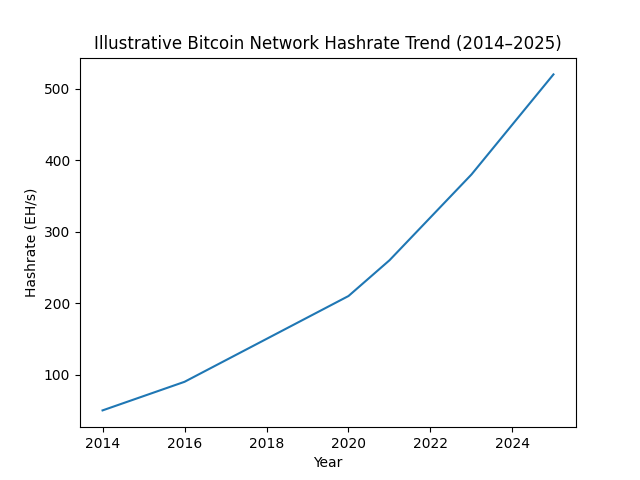
Closely related to mining difficulty is the network’s hashrate, which measures total computational power securing the blockchain. Throughout 2025, Bitcoin’s hashrate continued climbing, reflecting sustained investment in mining infrastructure despite market volatility.
A rising hashrate is often interpreted as a signal of long-term confidence. Mining operators are committing capital today in anticipation of future rewards, betting on Bitcoin’s relevance, scarcity, and resilience.
Illustrative Bitcoin Network Hashrate Trend (2014–2025)
Implications for Investors and Blockchain Practitioners
For investors seeking new digital assets or revenue opportunities, mining metrics provide insights that price charts alone cannot offer. Rising difficulty and hashrate suggest a strengthening security model and long-term conviction among industry participants.
For blockchain practitioners, Bitcoin’s difficulty adjustment offers a masterclass in protocol-level economic design. It demonstrates how incentives, cryptography, and automation can replace centralized oversight while maintaining system stability at global scale.
Emerging projects in infrastructure, energy optimization, mining hardware, and financial derivatives increasingly build around these dynamics. Bitcoin mining is no longer just about block rewards—it is an ecosystem supporting energy markets, data centers, and financial innovation.
Conclusion: Difficulty as a Feature, Not a Flaw
Bitcoin’s record-breaking mining difficulty at the end of 2025 is not a warning sign—it is a confirmation of the network’s robustness. The anticipated increase in January 2026 reinforces the idea that Bitcoin continues to function exactly as designed, adapting automatically to changes in participation and computational power.
By dynamically adjusting difficulty, Bitcoin preserves decentralization, secures its monetary policy, and protects price integrity. For those exploring new crypto assets, income streams, or practical blockchain applications, mining difficulty is not just a technical metric—it is a window into Bitcoin’s enduring value proposition.
