
Main Points :
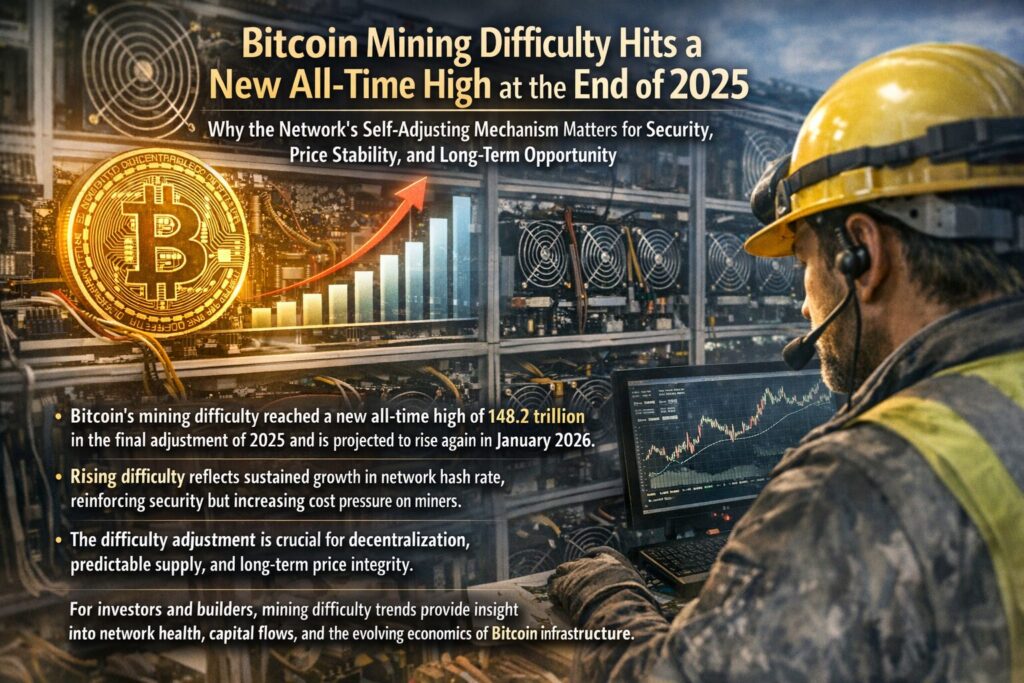
- Bitcoin’s mining difficulty reached a new all-time high of 148.2 trillion in the final adjustment of 2025 and is projected to rise again in January 2026.
- Rising difficulty reflects sustained growth in network hash rate, reinforcing security but increasing cost pressure on miners.
- The difficulty adjustment mechanism is not merely technical; it is central to Bitcoin’s decentralization, predictable supply schedule, and long-term price integrity.
- For investors and builders, mining difficulty trends provide insight into network health, capital flows, and the evolving economics of Bitcoin infrastructure.
Introduction: Why Mining Difficulty Still Matters in 2026
Bitcoin’s mining difficulty is often treated as a niche technical metric, discussed mainly among miners and protocol engineers. Yet as Bitcoin matures into a globally relevant financial and settlement network, mining difficulty has become one of the clearest signals of the system’s underlying economic and security dynamics.
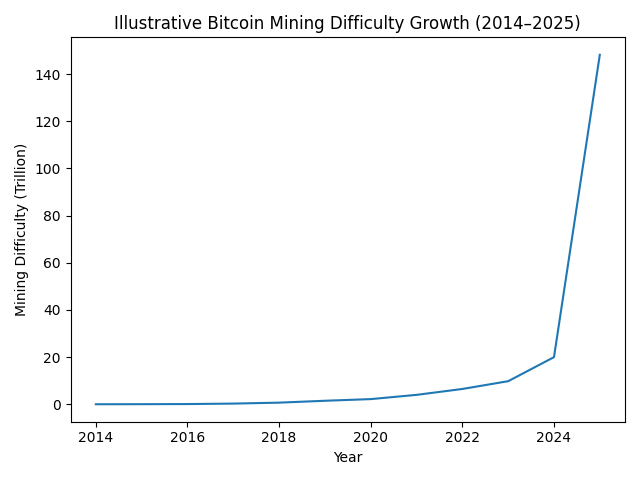
At the end of 2025, Bitcoin recorded a new historical milestone. During the final difficulty adjustment of the year, the network’s mining difficulty increased slightly to 148.2 trillion, the highest level ever observed. Data providers project that the next adjustment, expected on January 8, 2026, could push difficulty further toward 149 trillion, continuing a long-term upward trajectory.
This article examines what that milestone truly means. We go beyond surface-level reporting to analyze how difficulty adjustments protect decentralization, stabilize issuance, influence price dynamics, and shape the strategic landscape for miners, investors, and blockchain-based businesses.
Understanding Bitcoin Mining Difficulty in Plain Terms
Bitcoin mining difficulty measures how hard it is to find a valid block hash under the network’s consensus rules. In practical terms, it reflects how much computational effort miners must collectively expend to add new blocks to the blockchain.
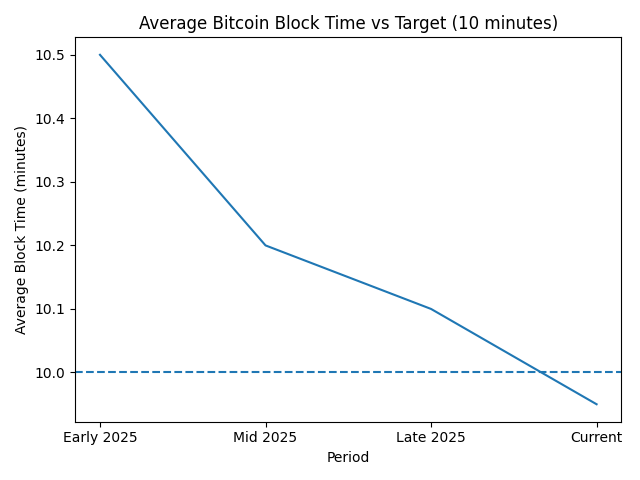
The Bitcoin protocol targets an average block time of approximately 10 minutes. If blocks are produced faster than this target, the network automatically increases difficulty. If blocks are produced too slowly, difficulty decreases. This feedback loop ensures that Bitcoin’s issuance schedule remains stable regardless of changes in computing power.
Difficulty adjustments occur every 2,016 blocks, roughly once every two weeks. This process is fully automated, transparent, and immune to discretionary human intervention—one of Bitcoin’s most underappreciated design strengths.
The End-of-2025 Adjustment: What Changed
According to network data, the final difficulty adjustment of 2025 pushed Bitcoin’s mining difficulty to 148.2 trillion. At the time of measurement, the average block time was approximately 9.95 minutes, slightly faster than the protocol’s target.
This deviation may seem trivial, but in a system as large as Bitcoin, even small timing differences signal substantial changes in total hash power. To restore the equilibrium, the protocol raised difficulty, making it incrementally harder for miners to find new blocks.
Projections indicate that if current trends persist, the next adjustment in early January 2026 will raise difficulty further, potentially surpassing 149 trillion.
Illustrative Bitcoin Mining Difficulty Growth (2014–2025)
Mining Difficulty and the Cost of Competition
An increase in mining difficulty directly translates into higher operational demands for miners. To maintain profitability, miners must either deploy more efficient hardware, access cheaper energy, or operate at significant scale.
Bitcoin mining has long since evolved into a capital-intensive industry. Modern mining operations require:
- Large upfront investment in ASIC hardware
- Long-term power contracts, often priced in USD
- Sophisticated cooling, hosting, and infrastructure management
- Treasury strategies to manage BTC revenue and fiat expenses
As difficulty rises, inefficient or undercapitalized miners are gradually forced out. This process, while painful for some operators, is part of Bitcoin’s natural economic selection mechanism.
2025 in Context: Price Volatility and Difficulty Resilience
Throughout 2025, Bitcoin mining difficulty demonstrated remarkable resilience. In September, during a period of strong BTC price appreciation, difficulty surged twice in rapid succession as miners rushed to deploy additional capacity.
Later in October, a historic market-wide downturn caused significant price volatility. Despite this, mining difficulty did not collapse. Instead, it stabilized and continued its long-term upward trend.
This divergence underscores an important insight: mining difficulty is not a short-term price indicator. It reflects long-term confidence in Bitcoin’s future revenue potential and security model rather than immediate speculative sentiment.
Average Bitcoin Block Time vs Target (10 minutes)
Why Difficulty Adjustment Protects Decentralization
One of Bitcoin’s most critical challenges is preventing excessive concentration of power. Without difficulty adjustment, a single entity deploying massive computing resources could dominate block production, undermining decentralization.
The difficulty mechanism ensures that sudden increases in hash power do not grant disproportionate influence. As more miners join or expand operations, the protocol raises difficulty, preserving fair competition and preventing runaway centralization.
This protection extends directly to Bitcoin’s security model. A so-called 51% attack, in which a miner or cartel controls the majority of network hash power, becomes increasingly expensive as total hash rate and difficulty rise.
Difficulty, Security, and Price Integrity
Even in the absence of a direct attack, excessive concentration of mining power could distort market dynamics. A dominant miner producing blocks at a disproportionate rate could accumulate large quantities of BTC and introduce sustained selling pressure, negatively affecting price stability.
By dynamically adjusting difficulty in proportion to total network hash power, Bitcoin ensures that no participant can easily monopolize block rewards. This safeguards not only decentralization but also the economic credibility of Bitcoin’s fixed supply schedule.
The result is a network that aligns incentives across participants while maintaining predictable issuance—an essential foundation for long-term value preservation.
Implications for Investors and Builders
For investors seeking new opportunities in digital assets, mining difficulty serves as a powerful macro indicator. Rising difficulty suggests continued capital inflow into infrastructure, confidence in future block rewards, and long-term commitment to network security.
For builders and entrepreneurs, difficulty trends highlight where value is accumulating. Infrastructure services, energy optimization, mining finance, custody solutions, and derivatives markets all expand alongside rising difficulty and hash rate.
Rather than viewing mining difficulty as a barrier, sophisticated market participants increasingly treat it as a signal of Bitcoin’s maturation into a durable financial layer.
Conclusion: Difficulty as Bitcoin’s Silent Guardian
The record-breaking mining difficulty at the end of 2025 is more than a technical milestone. It represents the quiet, continuous operation of one of Bitcoin’s most elegant design features—a self-regulating mechanism that balances security, decentralization, and economic predictability.
As Bitcoin enters 2026, rising difficulty reinforces the network’s resilience against attacks, its resistance to centralization, and its credibility as a long-term store of value. For those exploring new digital assets, revenue opportunities, or real-world blockchain applications, understanding mining difficulty is not optional—it is essential.
