

Main Points :
- Bitcoin long-term holders (LTHs) are showing early signs of behavioral change, with selective loss realization appearing for the first time in months.
- The Long-Term Holder SOPR briefly fell below 1.0, indicating localized capitulation, though broader averages remain positive.
- On-chain data suggests selling pressure has cooled significantly, creating ambiguity between a mid-cycle consolidation and an early bearish transition.
- Price compression combined with declining realized profits points to a high-energy market state that may soon resolve through a major breakout or breakdown.
- Institutional and analytical perspectives remain divided, with accumulation and caution coexisting in the current market structure.
1. A Market at an Inflection Point
Bitcoin is once again approaching a decisive moment. After several days of trading within a narrow range, the market is signaling tension rather than clarity. Analysts focusing on on-chain behavior argue that this is not merely a period of consolidation but a structural transition driven by long-term holder psychology.
Long-term holders—typically defined as wallets holding Bitcoin for more than 155 days—have historically acted as the market’s stabilizing force. Their willingness or reluctance to sell often determines whether corrections remain shallow or evolve into prolonged downturns. Recent data suggests that this cohort may be reassessing its conviction at current price levels.
At the time of analysis, Bitcoin had recently traded between $90,000 and $92,000, a zone last seen roughly nine months earlier. This overlap in historical price territory has placed a significant portion of long-term holders into unrealized losses, particularly those who accumulated during the mid-2025 rally.
2. Understanding LTH SOPR and Why It Matters
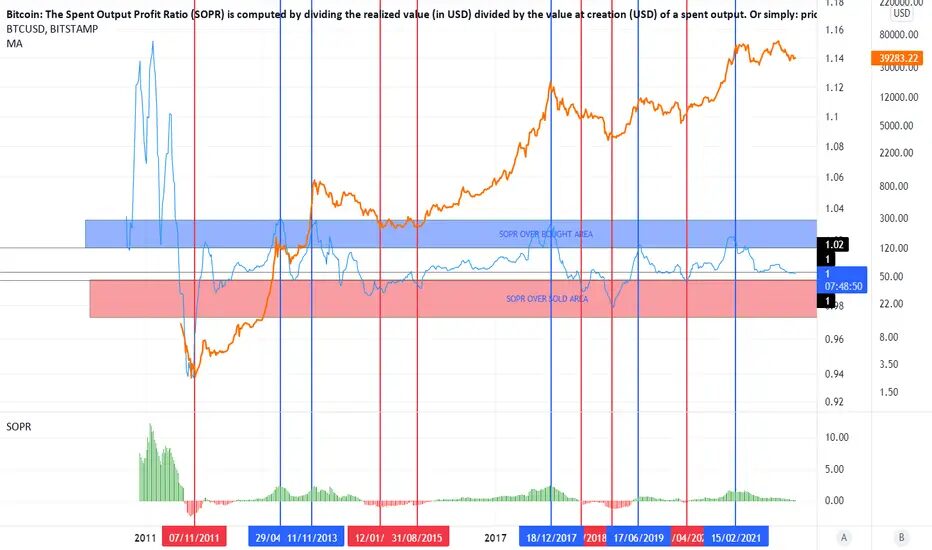
One of the most closely watched indicators in this context is the Long-Term Holder Spent Output Profit Ratio (LTH SOPR). This metric compares the price at which coins were acquired to the price at which they are spent. A value above 1.0 implies profit-taking, while a value below 1.0 indicates loss realization.
Recent observations show that LTH SOPR briefly dipped below the critical 1.0 threshold. This does not signal panic selling, but it does mark a psychological shift: some long-term holders are now willing to exit positions at a loss.
While the 30-day moving average of LTH SOPR remains healthy at approximately 1.18, it is significantly lower than the annual average near 2.0. Historically, sustained declines toward or below 1.0 have coincided with weakening bullish momentum, particularly if accompanied by rising sell volume.
However, the current situation is nuanced. The decline in realized profits may also imply that fewer long-term holders are selling altogether, reducing effective selling pressure rather than increasing it.
3. Selling Pressure: Weakness or Exhaustion?
Reduced realized profits can be interpreted in two ways. On one hand, they may suggest that holders are capitulating and confidence is eroding. On the other, they may indicate that the majority of sellers have already exited, leaving behind a more resilient holder base.
On-chain analyst Darkfost has emphasized this ambiguity. According to his analysis, the recent SOPR dip does not yet constitute a structural breakdown. Instead, it may represent localized stress among marginal long-term holders rather than broad capitulation.
For bullish continuation, however, stabilization is essential. LTH SOPR must hold above 1.0 and ideally begin trending upward again, signaling renewed confidence and profit realization at higher price levels.
4. Glassnode’s Perspective: From Distribution to Pause
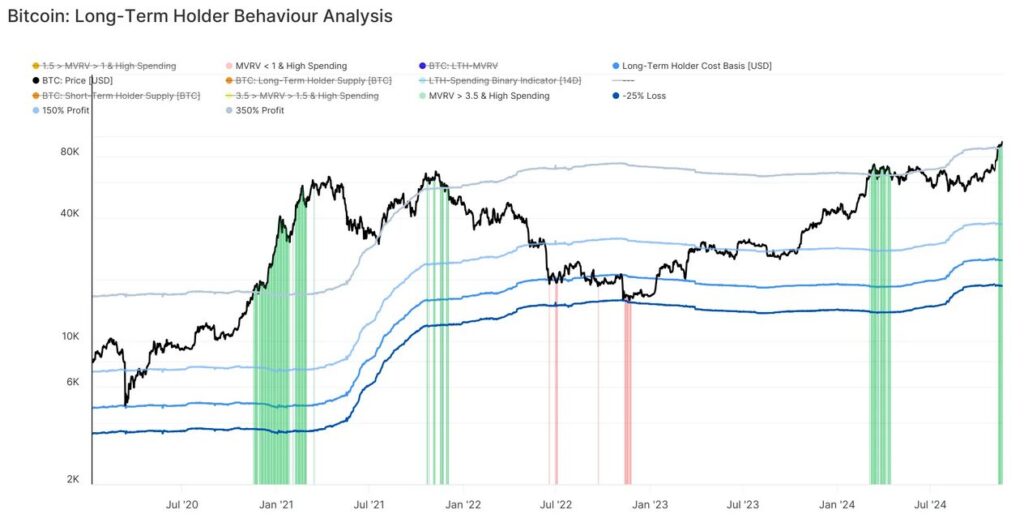
On-chain analytics firm Glassnode adds another layer to the discussion. Their data shows that long-term holders shifted from high-frequency selling during the latter half of 2025 to markedly lower selling activity entering January 2026.
This cooling of profit-taking aligns with patterns historically observed during either:
- temporary pauses within a broader bull market, or
- the early stages of deeper bearish phases.
Glassnode notes that realized profit levels have declined to ranges typically seen during shallow bearish corrections. Importantly, this does not confirm a full trend reversal but reinforces the prevailing uncertainty.
5. Price Compression and Stored Market Energy
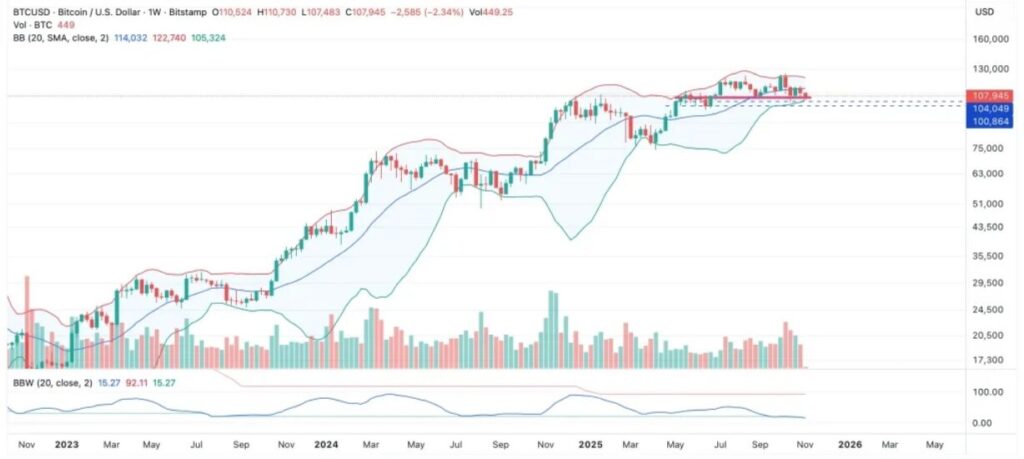
Beyond on-chain data, market structure itself is sending signals. Institutional analytics provider Bitcoin Vector highlights that Bitcoin has been trading in an unusually compressed price range, accompanied by elevated on-chain and exchange volume.
Such compression zones often act as pressure chambers. When price remains constrained despite significant volume, it implies that buyers and sellers are aggressively contesting control. The longer this condition persists, the more forceful the eventual breakout tends to be.
Bitcoin Vector points out that the current consolidation represents the third attempt to break out of this range. The previous two attempts failed, raising the critical question: will this attempt finally succeed, or will it once again result in a false breakout?
6. Diverging Interpretations Among Analysts
Not all analysts view declining selling frequency as bearish. Some argue that long-term holders are simply re-entering an accumulation phase, treating current prices as attractive entry points rather than exit opportunities.
Supporting this view, certain on-chain metrics suggest that total long-term holder supply has begun increasing again. If accurate, this would indicate net accumulation rather than distribution, reinforcing a longer-term bullish thesis.
This divergence in interpretation underscores a central theme of the current market: the same data can support both cautious optimism and restrained pessimism, depending on analytical framing.
7. Macroeconomic Context and Recent Price Action
Adding complexity to the picture, Bitcoin recently surged to approximately $96,000 following weaker-than-expected U.S. inflation data. This move marked its highest level since November 2025 and demonstrated Bitcoin’s continued sensitivity to macroeconomic signals, particularly expectations around monetary easing.
However, macro-driven rallies without corresponding on-chain confirmation often struggle to sustain momentum. Whether this move represents the beginning of a renewed uptrend or merely a reactionary spike remains to be seen.
8. What This Means for Investors and Builders
For investors seeking new digital assets or yield opportunities, the current environment demands patience and risk discipline. Volatility appears imminent, but directionality remains unresolved.
For builders and operators focused on practical blockchain applications, this period reinforces the importance of infrastructure resilience. Market cycles fluctuate, but systems designed for custody, settlement, compliance, and yield generation must function across both bullish and bearish regimes.
The behavior of long-term holders serves as a reminder that Bitcoin is not just a speculative asset but a long-duration monetary network shaped by conviction, time, and macroeconomic reality.
9. Conclusion: Uncertainty as a Signal
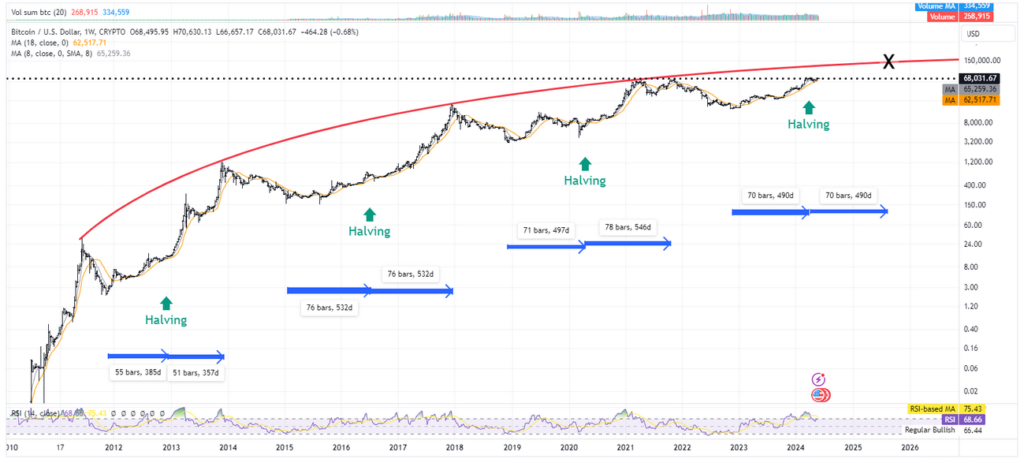
Bitcoin’s long-term holders are sending mixed signals. Small-scale capitulation exists alongside signs of renewed accumulation. Selling pressure has weakened, but confidence has not fully recovered. Price compression suggests a powerful move ahead, yet its direction remains unknown.
Rather than viewing this uncertainty as a flaw, market participants should recognize it as a signal. Transitional phases often precede the most consequential moves. Whether Bitcoin resolves this tension through a bullish continuation or a deeper corrective phase will depend on how long-term holders, macro conditions, and liquidity dynamics align in the weeks ahead.
