
Main Points :
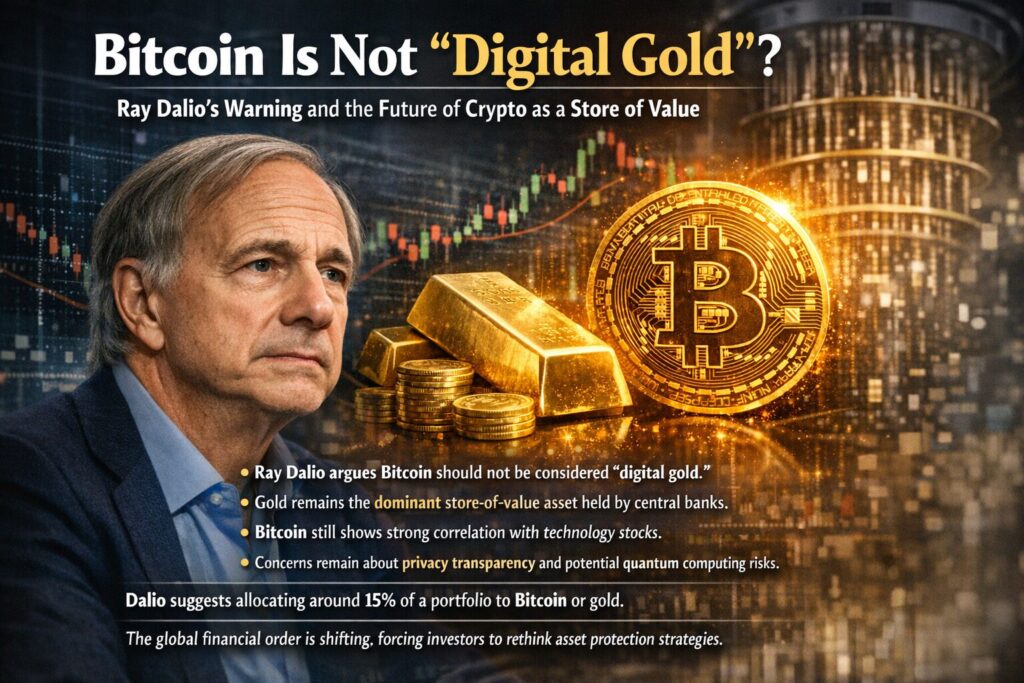
- Ray Dalio argues Bitcoin should not be considered “digital gold.”
- Gold remains the dominant store-of-value asset held by central banks.
- Bitcoin still shows strong correlation with technology stocks.
- Concerns remain about privacy transparency and potential quantum computing risks.
- Despite criticism, Dalio still suggests allocating around 15% of a portfolio to Bitcoin or gold.
- The global financial order is shifting, forcing investors to rethink asset protection strategies.
1. Ray Dalio Questions the “Digital Gold” Narrative
Ray Dalio, founder of Bridgewater Associates and one of the world’s most influential macro investors, recently reignited debate over Bitcoin’s role in the global financial system. Appearing on the widely followed All-In Podcast, Dalio argued that Bitcoin should not automatically be viewed as the digital equivalent of gold.
According to Dalio, gold occupies a unique historical and monetary role that Bitcoin has not yet achieved. Gold has been used as a store of value for thousands of years, and it is currently the second largest reserve asset held by central banks globally, after U.S. dollars.
Dalio emphasized a simple but powerful idea:
“Gold is not just a speculative commodity. It is the most established form of money that still exists.”
By contrast, he believes Bitcoin still behaves largely like a speculative technology asset rather than a universal reserve instrument.
This distinction matters because assets used as stores of value must survive economic crises, geopolitical turmoil, and long-term monetary transitions.
Gold has already passed those tests.
Bitcoin, in Dalio’s view, has not yet fully done so.
2. The Central Bank Problem
One of Dalio’s most significant arguments concerns institutional adoption—specifically central banks.
Central banks hold assets that stabilize national currencies and protect economies during crises. Today, those reserves primarily consist of:
- U.S. Treasury bonds
- Gold
- Foreign currencies
Dalio believes Bitcoin faces a major barrier in this area.
There is currently no strong incentive for central banks to accumulate Bitcoin as a strategic reserve asset.
This is not only due to volatility but also because Bitcoin’s design conflicts with traditional monetary policy tools.
Central banks require assets that can:
- be controlled within legal frameworks
- be liquidated quickly during crises
- function inside global financial infrastructure
Gold meets these criteria. Bitcoin, at least today, does not.
However, some analysts argue this may change if nation-state adoption of Bitcoin mining or reserves increases, something that has been discussed in countries facing currency instability.
3. Bitcoin’s Correlation With Technology Stocks
Dalio also pointed to another important issue: Bitcoin’s correlation with risk assets, especially technology stocks.
During many market cycles over the past decade, Bitcoin’s price movements have closely mirrored those of the Nasdaq and other tech-heavy indices.
This behavior challenges the narrative that Bitcoin functions as a hedge against traditional financial markets.
Instead, it often behaves like a high-beta technology investment.
In other words, when investors become risk-averse and sell technology stocks, they frequently sell Bitcoin as well.
This phenomenon becomes especially visible during liquidity crises.
When investors need cash quickly, they tend to liquidate assets that have appreciated the most or are easiest to sell.
Bitcoin often becomes one of those assets.
Illustrative Divergence Between Bitcoin and Gold
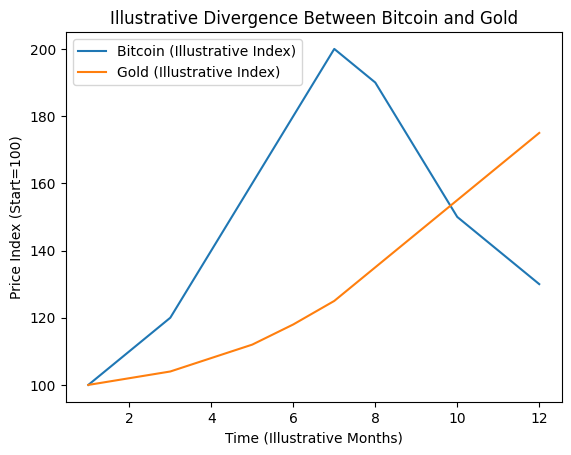
This chart illustrates how Bitcoin and gold sometimes move in different directions during market stress.
4. Privacy and Surveillance Concerns
Dalio also raised concerns about Bitcoin’s privacy characteristics.
Unlike cash transactions, Bitcoin transactions are recorded on a public blockchain. While addresses are pseudonymous, sophisticated analytics tools can often trace transactions back to individuals or institutions.
Dalio summarized this concern succinctly:
“All transactions can potentially be monitored.”
For investors seeking discreet capital storage, this transparency may become a disadvantage.
Ironically, Bitcoin was originally designed to enable peer-to-peer financial freedom.
Yet today, blockchain analytics companies can track:
- wallet flows
- exchange transfers
- large institutional movements
This creates a paradox where Bitcoin offers transparency for security but reduced privacy compared with physical assets like gold.
5. Quantum Computing Risks
Another concern Dalio mentioned is the potential impact of quantum computing.
While still largely theoretical, advanced quantum computers could one day break the cryptographic algorithms securing Bitcoin wallets.
If this happened before the network adopted quantum-resistant cryptography, certain wallets might become vulnerable.
Many blockchain developers argue this risk is manageable because:
- quantum computing technology is still years away from practical implementation
- networks can upgrade cryptography through protocol updates
Nonetheless, Dalio views this as an additional layer of uncertainty when considering Bitcoin as a long-term store of value.
6. Dalio Still Recommends Bitcoin Allocation
Despite his criticisms, Dalio has not rejected Bitcoin entirely.
In fact, in mid-2025 he recommended that investors allocate around 15% of their portfolios to either Bitcoin or gold to achieve the best risk-to-return balance.
This advice reflects Dalio’s broader macro view: the world is entering a period of major monetary transformation.
Government debt levels across developed economies have reached historic highs.
At the same time, currency debasement—through inflation and monetary expansion—continues to erode purchasing power.
In such environments, hard assets tend to outperform debt-based financial instruments.
Gold has historically filled this role.
Bitcoin may become part of the same category.
Example Diversified Portfolio Allocation
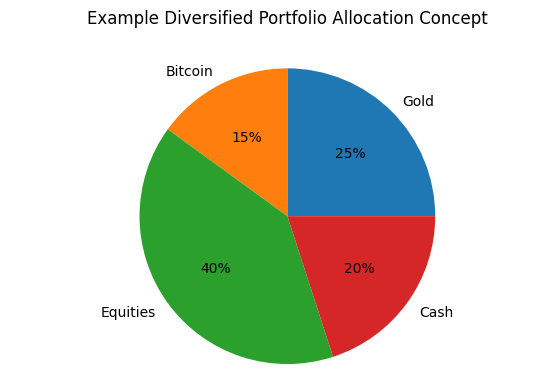
This chart illustrates how Bitcoin and gold may coexist within diversified portfolios.
7. Market Divergence Between Bitcoin and Gold
Recent market behavior appears to support some of Dalio’s arguments.
Between mid-2025 and early autumn, both Bitcoin and gold experienced strong rallies.
However, a sharp downturn in the crypto market later triggered approximately $20 billion in leveraged liquidations.
Following this crash, the two assets diverged significantly.
Bitcoin fell roughly 45% from its October peak, reaching around $68,420.
Meanwhile, gold continued rising and reached approximately $5,120 per ounce.
This divergence reinforced the perception that gold behaves as a defensive asset while Bitcoin remains more sensitive to speculative cycles.
8. The Collapse of the Global Order?
Beyond the Bitcoin debate, Dalio delivered an even more striking warning.
He recently argued that the global economic order led by the United States for nearly a century is beginning to fracture.
Several factors are driving this shift:
- geopolitical tensions
- rising sovereign debt
- shifting trade alliances
- the emergence of alternative financial systems
Dalio believes these structural changes will reshape global capital flows.
Investors will increasingly seek assets that cannot be easily diluted by government policies.
This is why discussions around gold, Bitcoin, and other scarce assets have intensified.
Illustrative Correlation Between Bitcoin and Tech Stocks
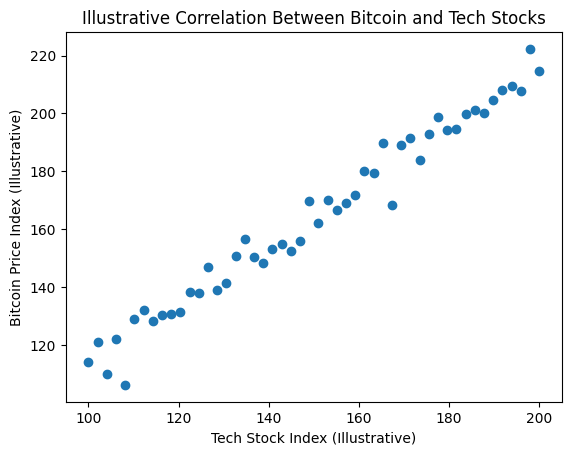
This chart illustrates how Bitcoin sometimes moves alongside technology equities.
9. Bitcoin’s Future as a Store of Value
Despite Dalio’s skepticism, many crypto analysts believe Bitcoin’s long-term trajectory remains strong.
Several developments support this view:
- Institutional adoption continues to grow.
- Bitcoin ETFs have opened access to mainstream investors.
- Sovereign wealth funds are increasingly studying digital assets.
- Layer-2 technologies are improving Bitcoin’s usability.
In addition, Bitcoin possesses several unique characteristics that gold lacks:
- fixed supply (21 million coins)
- borderless transferability
- programmable financial integration
- digital settlement infrastructure
These features could make Bitcoin particularly attractive in an increasingly digital global economy.
10. The Real Question: Digital Gold or Something Else?
Perhaps the real debate is not whether Bitcoin replaces gold.
Instead, the question may be whether Bitcoin represents an entirely new asset class.
Gold emerged from a physical world of scarcity and metallurgy.
Bitcoin emerged from a digital world of cryptography and decentralized networks.
Both assets share key properties:
- scarcity
- independence from governments
- resistance to monetary inflation
Yet they also differ fundamentally.
Gold is tangible.
Bitcoin is purely digital.
The future financial system may ultimately include both.
Conclusion
Ray Dalio’s warning that Bitcoin is not “digital gold” reflects a broader conversation about the nature of money in the 21st century.
Gold remains the most established store-of-value asset in human history and continues to dominate central bank reserves.
Bitcoin, however, is still evolving.
Its volatility, technological risks, and correlation with technology stocks mean it has not yet fully achieved the status of a safe-haven asset.
Nevertheless, Bitcoin’s innovation, scarcity, and growing institutional acceptance suggest it could become a critical component of future financial systems.
Rather than replacing gold, Bitcoin may ultimately stand beside it as a complementary hedge against an uncertain economic world.
For investors seeking new digital assets, new revenue opportunities, and practical blockchain applications, the most important lesson may be this:
The future of value storage will likely not belong to a single asset.
It will belong to a diversified ecosystem of scarce, decentralized, and technologically resilient financial instruments.
