
Main Points :
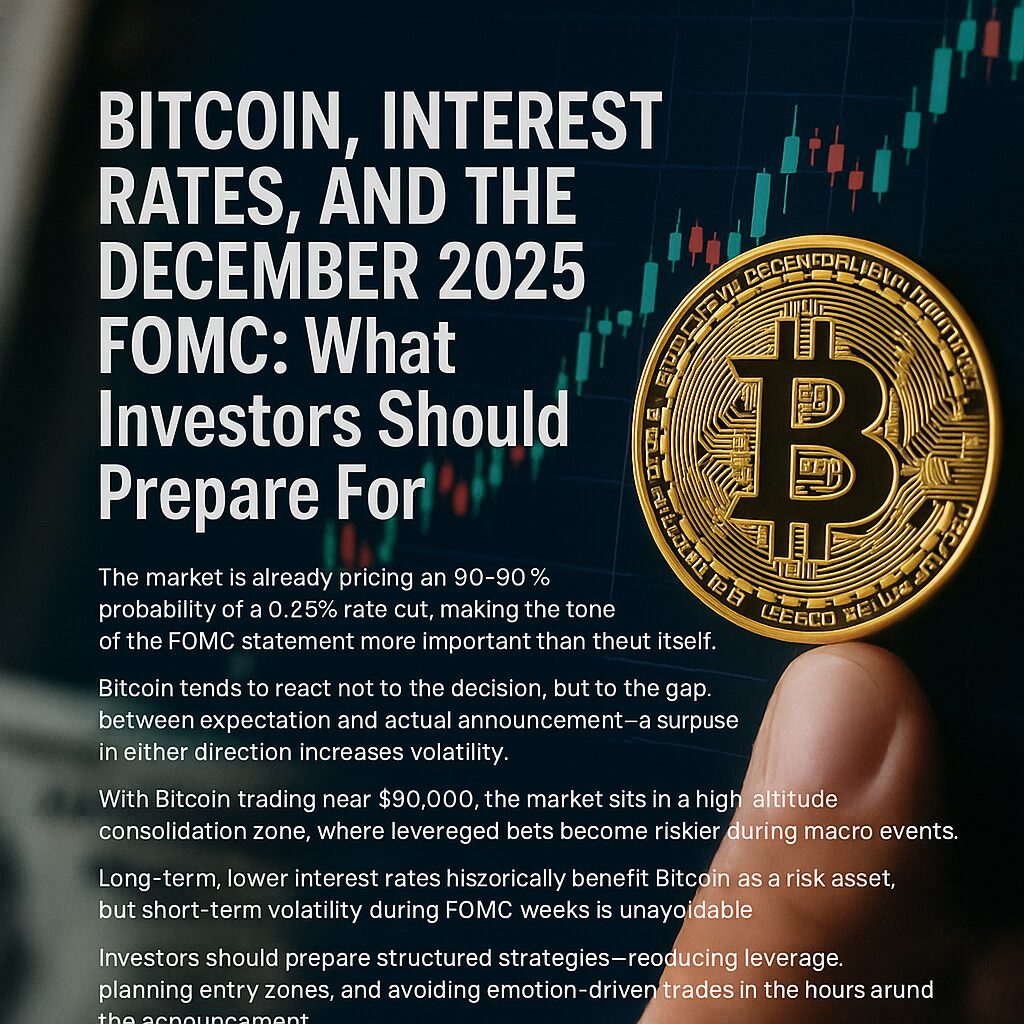
- The market is already pricing an 80–90% probability of a $0.25% rate cut, making the tone of the FOMC statement more important than the cut itself.
- Bitcoin tends to react not to the decision, but to the gap between expectation and actual announcement—a surprise in either direction increases volatility.
- With Bitcoin trading near $90,000, the market sits in a high-altitude consolidation zone, where leveraged bets become riskier during macro events.
- Long-term, lower interest rates historically benefit Bitcoin as a risk asset, but short-term volatility during FOMC weeks is unavoidable.
- Investors should prepare structured strategies—reducing leverage, planning entry zones, and avoiding emotion-driven trades in the hours around the announcement.
1. Introduction: Bitcoin Meets Monetary Policy
Bitcoin’s relationship with macroeconomics has grown stronger over the past five years. As institutional involvement deepened and Bitcoin ETFs became dominant sources of liquidity, the Federal Reserve’s interest-rate policy increasingly influences crypto markets.
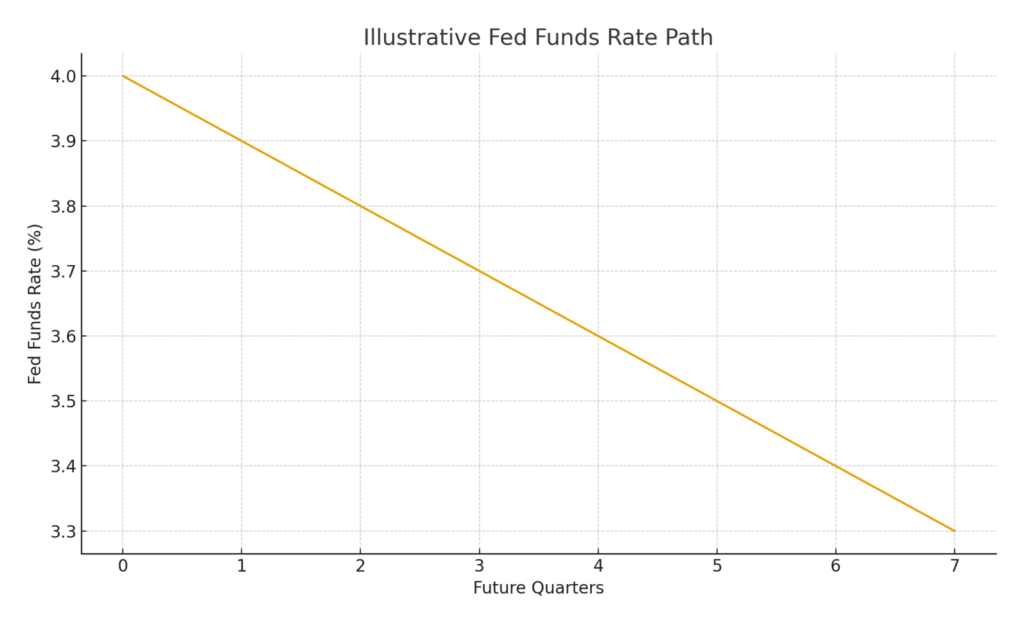
The December 2025 FOMC—scheduled for December 9–10 (U.S. time)—arrives at a moment when analysts widely expect a $0.25% rate cut, lowering the Federal Funds Target Range from 3.75–4.00% to 3.50–3.75%.
Yet what truly matters is not simply whether the Fed cuts rates, but how the decision compares against expectations.
This article summarizes the original Japanese reference content, expands it to ~2000 words, integrates recent global crypto trends, and provides practical guidance for investors exploring new income opportunities and real-world blockchain applications.
2. Understanding the FOMC and Why Bitcoin Reacts
2.1 What Is the FOMC?
The Federal Open Market Committee sets the monetary policy of the United States. It determines:
- Policy interest rates
- Asset purchases
- Forward-looking economic projections
The FOMC meets eight times per year, and each meeting acts as a volatility generator for risk assets.
2.2 Why Bitcoin Is Sensitive to Interest Rates
Interest rates affect liquidity.
- Higher rates → money becomes expensive → risk assets decline.
- Lower rates → liquidity increases → risk assets often rise.
Bitcoin, despite being a decentralized asset, trades as a global liquidity barometer.
Yet it is not only rates that matter, but expectations:
2.3 Markets Move on “Expectation vs Surprise”
Historically:
- If the Fed meets expectations → muted reaction
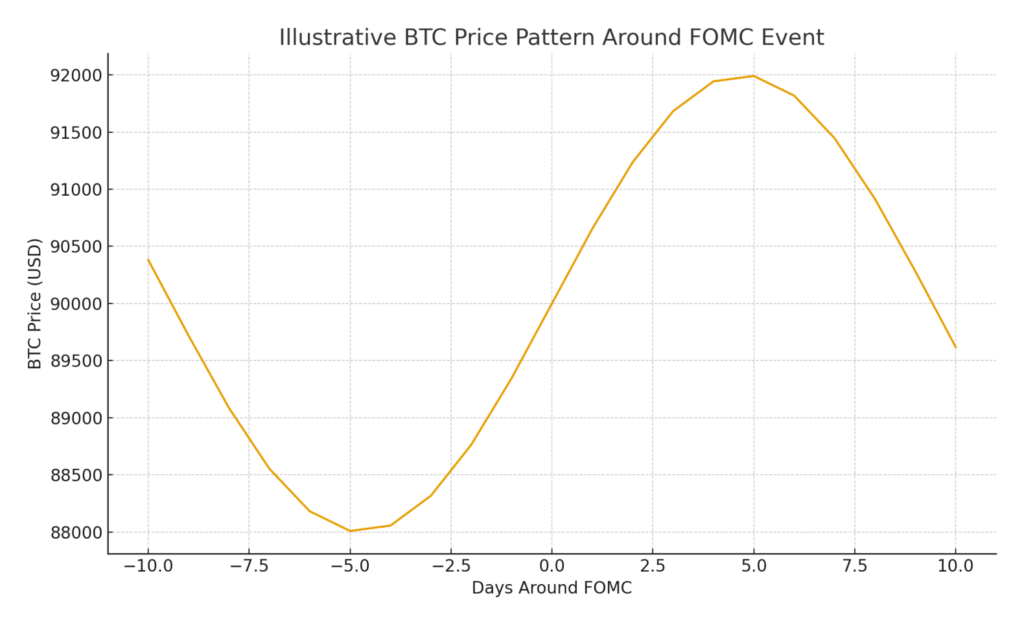
- If the Fed is more dovish than expected → Bitcoin rallies
- If the Fed is more hawkish than expected → Bitcoin declines sharply
This is why the December 2025 meeting carries weight:
Upside is limited unless the Fed surprises dovishly; downside risk increases if expectations are not met.
3. Economic Context Leading Into December 2025
3.1 Inflation and Growth Trends
The U.S. economy in late 2025 shows:
- Inflation trending downward but still above the 2% target
- Signs of labor-market cooling
- Treasury yields pricing slower 2026 growth
The Fed has already executed several cuts in 2025, shifting away from its earlier tightening phase.
3.2 The Market Consensus
CME FedWatch indicates:
- 80–90% probability of a $0.25% cut
- 10–20% probability of no change
Therefore, the actual rate change is almost irrelevant—
the market already priced it in.
What will matter:
- Forward guidance
- Statement language
- Dot-plot hints for 2026
3.3 Internal Division at the Fed
Reports suggest the December meeting may be the most divided in years, with:
- Hawks fearing a second wave of inflation
- Doves warning of employment weakening
A split vote would signal uncertainty and may raise volatility across crypto markets.
4. Bitcoin’s Current Setup Before the Meeting
4.1 High-Altitude Price Zone
As of early December 2025:
- Bitcoin trades around $90,000
- It previously reached $100,000 in October
- It is now consolidating in a high valuation band
This matters because:
- Traders hold large unrealized profits
- Many expect bullish continuation after rate cuts
- Over-positioning increases volatility risk
Bitcoin is not in a cheap accumulation zone—it is in a structurally extended zone, historically prone to event-driven shakeouts.
5. Scenario Analysis: How Bitcoin May React
Scenario A: $0.25% Cut + Dovish Tone (Positive but Limited Upside)
- Fed signals that additional cuts remain possible
- Recognizes cooling inflation
- Expresses flexibility toward easing in 2026
Expected market reaction:
- Bitcoin might spike briefly
- But since the cut is priced in, gains may fade
- Profit-taking likely above $92,000–$94,000
This is a “buy the rumor, sell the news” setup.
Scenario B: $0.25% Cut + Hawkish Tone (Short-Term Bearish)
- Fed warns about inflation risk
- Suggests slowing the pace of future cuts
- Projects a higher year-end 2026 rate than markets expect
Expected reaction:
- Risk assets decline
- Bitcoin potentially drops below $88,000
- Highly leveraged traders face liquidation cascades
This is the most common pattern:
a rate cut that triggers a market decline due to hawkish guidance.
Scenario C: No Cut (Strong Hawkish Surprise)
If the Fed keeps rates at 3.75–4.00%:
- Markets experience a shock
- Bitcoin, stocks, and gold sell off
- The U.S. dollar strengthens
Given the pricing of expectations, this scenario would likely cause a $5,000–$10,000 drop within days.
After the initial shock, Bitcoin may stabilize as macro uncertainty clears.
6. Recommended Investor Strategies
6.1 What NOT to Do Before the FOMC
- Do not rely on intuition-based high leverage.
- Do not assume “rate cut = guaranteed Bitcoin pump.”
- Do not ignore risk limits.
- Do not trade while half-asleep at 3 a.m. Japan time.
6.2 Strategy 1: Reduce Position Size Before the Event
Professional traders often:
- Reduce leverage
- Hold more cash (USD or stablecoins)
- Re-enter after trend confirmation
This avoids liquidation during the announcement spike.
6.3 Strategy 2: Long-Term Holders Ignore Noise
If Bitcoin is part of a multi-asset portfolio:
- FOMC volatility is temporary
- Dollar-cost-averaging remains valid
- Focus on multi-year adoption trends
6.4 Strategy 3: Post-Announcement Trend Trading
Wait for:
- The first strong breakout AFTER volatility settles
- Clear direction on 1-hour and 4-hour charts
- Predefined stop-loss levels
6.5 Pre-FOMC Checklist
- Confirm the announcement time
- Review open risk across spot and derivatives
- Identify support and resistance
- Set automatic stop-losses if needed
- Ensure you are well-rested before trading
7. Recent Market Trends Beyond the FOMC
To give broader context:
7.1 ETF Flows in Late 2025
- Bitcoin ETFs reached record inflows, especially from pension funds
- ETH ETFs follow with slower but steady adoption
7.2 Regulatory Environment
- European MiCA rollout increased institutional legitimacy
- Asian markets—Japan, Singapore, and Korea—tightened but clarified rules
- U.S. election cycle increased uncertainty in 2025, but post-2025 may bring clearer crypto taxation frameworks
7.3 Real-World Use Cases Growing
- Tokenized treasury markets exceed $25B
- Stablecoin settlement for payroll and commerce surges
- Enterprise blockchain becomes standard in logistics and banking
Bitcoin sits within a larger technological wave.
8. Graph Insert Points
Bitcoin Behavior Around FOMC
Illustrative Fed Rate Path
9. Conclusion
The December 2025 FOMC is unlikely to shock markets with the rate decision alone; the real driver will be the Fed’s forward guidance.
Bitcoin’s reaction will depend entirely on the surprise factor relative to expectations.
- Dovish cut → moderate upside
- Hawkish cut → likely downside
- No cut → significant volatility
For investors seeking new crypto opportunities and blockchain-based income streams, the key is not predicting the event, but preparing a disciplined strategy.
Bitcoin remains a long-term macro asset whose value grows as global liquidity cycles turn supportive. Rate cuts—whenever they fully materialize—tend to strengthen the multi-year bullish structure, even if short-term volatility remains high.
