

Main Points :
- Bitcoin appears to be in the middle phase of a structural bull market rather than near a cyclical peak.
- Spot ETF approvals have fundamentally altered capital inflow dynamics.
- Long-term holders and whales show limited distribution compared to prior cycle tops.
- Institutional average acquisition prices are rising, strengthening market support floors.
- Realized capitalization suggests higher-quality capital entering the ecosystem.
- Short-term volatility remains possible, but structural demand supports further upside.
- Investors should focus on leverage discipline and institutional flow monitoring.
I. A Structural Bull Market, Not a Speculative Blow-Off
According to analysis from CryptoQuant CEO Ki Young Ju, the current Bitcoin cycle differs structurally from prior bull markets. Historically, Bitcoin’s price cycles were characterized by retail-driven speculative surges followed by aggressive deleveraging and prolonged bear markets. However, the present environment reflects a more institutionalized capital structure.
In previous cycles—such as 2017 and 2021—parabolic price accelerations were accompanied by visible on-chain distribution from long-term holders. These phases culminated in overheated derivatives markets and aggressive leverage expansion. Today, however, on-chain data suggests a different behavioral profile.
Bitcoin, trading around the mid-$90,000 range in recent observations, shows resilience during pullbacks. Rather than rapid collapses following new highs, corrections have been relatively controlled, suggesting structural demand absorption.
Ju characterizes the current environment as “mid-bull cycle,” implying that the market has progressed beyond early accumulation but has not yet entered euphoria-driven blow-off territory.
II. The ETF Effect: Permanent Capital Meets Digital Scarcity
The approval of U.S. spot Bitcoin ETFs marked a turning point in market mechanics. Unlike futures-based ETFs, spot ETFs require actual Bitcoin purchases for share creation, creating direct structural demand.
This shift introduces three major changes:
- Continuous capital inflow via regulated financial channels.
- Lower volatility compared to purely speculative retail flows.
- A long-term investment thesis driven by portfolio allocation strategies.
Institutional asset managers increasingly treat Bitcoin as a macro asset class alongside gold and equities. Even modest portfolio allocations—1% to 3% of AUM—translate into substantial structural buying pressure.
This capital is qualitatively different from short-term speculative flows. ETF inflows represent compliance-driven, regulated, long-term capital pools. This aligns with the rising realized capitalization trend observed on-chain.
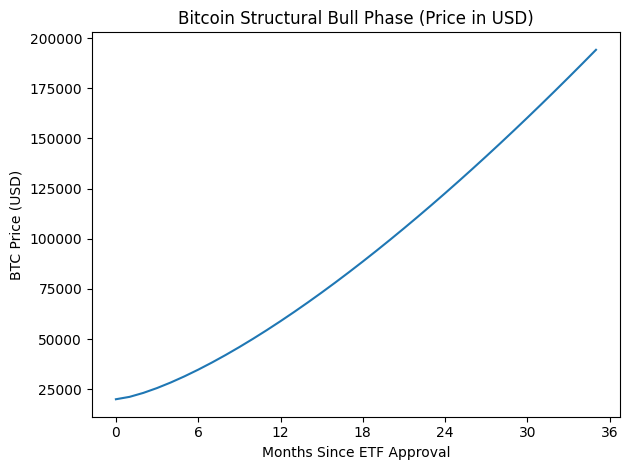
These charts illustrate the structural rise in both price and realized capitalization over multiple cycles.
III. Realized Capitalization: Measuring Capital Quality
Realized capitalization differs from market capitalization by valuing each coin at the price it last moved on-chain. This metric better reflects aggregate capital inflows and cost basis concentration.
Rising realized cap suggests:
- Strong capital retention.
- Higher average acquisition cost.
- Reduced probability of panic-driven capitulation.
Compared to prior cycle peaks, realized cap growth today reflects more persistent and higher-quality capital. This indicates the market floor is rising, not just the ceiling.
As institutional buyers accumulate at progressively higher levels—$40,000, $60,000, $80,000—the realized price base strengthens, reducing downside elasticity.
IV. Long-Term Holders and Whale Behavior
One of the most significant contrasts versus prior cycles lies in long-term holder behavior.
Historically, long-term holders distributed heavily near cycle peaks. Today, on-chain metrics indicate continued accumulation or at least restrained distribution.
Whale wallets—large addresses holding substantial Bitcoin—do not show the aggressive unloading patterns typical of late-stage mania.
This suggests:
- Conviction remains strong.
- Supply shock potential persists.
- The free float available for trading remains structurally constrained.
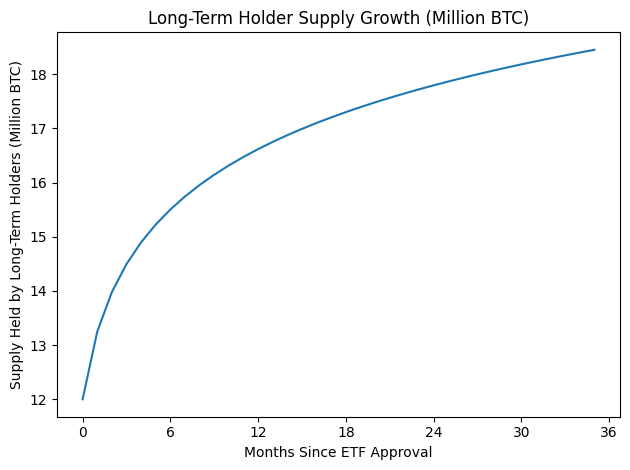
This chart illustrates how long-term holder supply can rise even during price appreciation, reinforcing structural scarcity.
V. Institutional Cost Basis and Market Floor Strength
As new institutional entrants accumulate Bitcoin, their average acquisition prices rise over time. Unlike early adopters with ultra-low cost bases, institutions entering via ETFs or structured products accumulate at market prices.
This dynamic produces a stair-step floor formation:
- $30,000 becomes support.
- $50,000 becomes support.
- $70,000 becomes support.
- And so on.
Each new wave of institutional capital strengthens higher price zones as psychological and economic support levels.
Unlike prior cycles dominated by retail speculation, institutional capital tends to rebalance rather than panic-sell. This reduces crash intensity and increases structural stability.
VI. Macro Conditions and Risk Environment
Bitcoin’s structural bull thesis does not eliminate macro risk. Interest rates, liquidity conditions, and geopolitical developments continue to influence short-term volatility.
However, Bitcoin increasingly behaves as a hybrid asset:
- Part digital gold.
- Part risk asset.
- Part monetary hedge.
If global liquidity expands, Bitcoin benefits as a high-beta liquidity asset. If fiat concerns intensify, Bitcoin benefits as a scarcity-driven hedge.
This dual exposure enhances its strategic positioning.
VII. Mid-Bull Characteristics: What Comes Next?
Mid-cycle characteristics typically include:
- Periodic 20%–30% corrections.
- Leverage flush-outs.
- Rotation into altcoins.
- Institutional rebalancing.
These corrections are not bear market confirmations but structural resets.
Historically, the most explosive phase occurs after prolonged consolidation within a mid-bull range. If structural demand persists and supply remains constrained, a final expansion phase remains plausible.
However, Ju emphasizes leverage discipline. Excessive leverage remains the primary systemic vulnerability.
VIII. Implications for Investors Seeking Yield and Blockchain Utility
For readers seeking new crypto assets or income opportunities, several themes emerge:
- Bitcoin remains the macro anchor.
- ETF capital validates institutional acceptance.
- On-chain metrics favor structural accumulation over speculation.
- Mid-cycle positioning allows strategic allocation.
- Altcoin opportunities often expand during mid-cycle phases.
Investors focused on practical blockchain use cases should note that institutional participation accelerates infrastructure maturation:
- Custody solutions improve.
- Regulatory clarity increases.
- Financial integration expands.
- Tokenization ecosystems strengthen.
Bitcoin’s structural bull market supports the broader digital asset economy.
IX. Conclusion: Structural Strength, Tactical Discipline
Bitcoin appears to be in the middle stage of a structural bull market driven by institutional capital, rising realized capitalization, and constrained supply dynamics.
Unlike prior cycles fueled by retail speculation alone, the present phase reflects structural capital integration via spot ETFs and macro allocation frameworks.
Short-term volatility remains inevitable. However, the combination of:
- Rising institutional cost bases,
- Long-term holder conviction,
- Realized capital growth,
- ETF structural demand,
supports the thesis of further upside potential.
Investors should manage leverage carefully, monitor institutional flows, and recognize that structural bull markets often progress in waves—not straight lines.
If current dynamics persist, Bitcoin’s bull cycle may still have significant runway ahead.
