
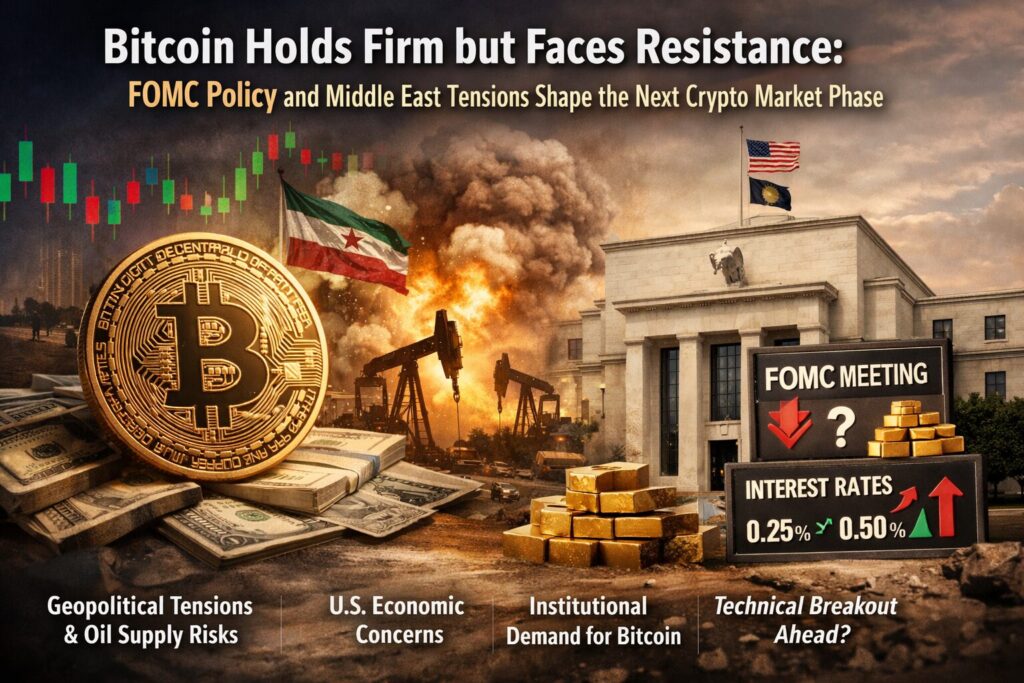
Key Points :
- Bitcoin has remained resilient near $76,000 despite global risk-off sentiment in traditional markets.
- Escalating tensions involving Iran and potential disruptions to oil supply are influencing global liquidity conditions.
- The upcoming Federal Open Market Committee (FOMC) meeting could reshape expectations for interest rate cuts in 2026.
- Concerns over U.S. fiscal sustainability and wartime spending may reinforce Bitcoin’s narrative as a non-sovereign store of value.
- Technical indicators suggest that if Bitcoin breaks above recent resistance levels, momentum-driven buying could accelerate.
Introduction: Bitcoin’s Unusual Stability in a Volatile World
During periods of geopolitical uncertainty, traditional financial markets often react quickly. Equities fall, the U.S. dollar strengthens, bond yields fluctuate, and investors seek safe-haven assets. However, in recent weeks Bitcoin has shown an unusual characteristic: resilience in the face of macroeconomic turbulence.
According to recent market analysis, Bitcoin has been trading around $76,000, holding firm despite a surge in geopolitical tension related to Iran and rising oil prices. While global markets have exhibited clear risk-off behavior—characterized by declining equities, rising crude oil prices, and stronger demand for the U.S. dollar—Bitcoin has remained relatively stable and even attempted to test higher levels.
This unusual divergence raises an important question for investors: Is Bitcoin gradually becoming a macro asset comparable to gold, or is the current stability simply temporary market noise?
Understanding this question requires examining three key factors shaping the crypto market today:
- Geopolitical risks and energy markets
- Monetary policy expectations in the United States
- Structural demand from institutional and macro investors
Together, these elements may define the next phase of the cryptocurrency market.
Geopolitical Tensions and Energy Markets: The Iran Factor
One of the most significant drivers of global market sentiment in recent weeks has been the escalating geopolitical tension involving Iran and shipping routes in the Middle East.
Reports have suggested that Iran could potentially mine the Strait of Hormuz, one of the most critical energy shipping routes in the world. Nearly 20% of global oil supply passes through this narrow maritime corridor. Any disruption could immediately push oil prices sharply higher.
Iranian officials have even warned that oil prices could surge toward $200 per barrel if the conflict intensifies. For context, crude oil currently trades closer to $80–$90 per barrel, meaning such a move would represent a massive shock to the global economy.
Energy price spikes have several cascading effects:
- Rising inflationary pressure
- Tighter monetary policy expectations
- Reduced global liquidity
Historically, these factors tend to hurt risk assets, including cryptocurrencies.
However, the situation is more nuanced this time. Governments within the G7 alliance have discussed the possibility of coordinating emergency releases of strategic petroleum reserves in order to stabilize oil markets. Meanwhile, the International Energy Agency (IEA) has signaled its willingness to cooperate if supply disruptions occur.
These actions temporarily eased energy price pressure earlier in the week, which helped support Bitcoin’s price momentum.
Yet the geopolitical backdrop remains fragile. If conflict escalates further, the resulting surge in oil prices could tighten global liquidity conditions and place downward pressure on speculative assets—including cryptocurrencies.
The FOMC and Monetary Policy Uncertainty
Another major factor shaping the Bitcoin market is the upcoming meeting of the U.S. Federal Reserve’s Federal Open Market Committee (FOMC).
The FOMC plays a central role in determining U.S. interest rate policy. Because global financial markets are heavily influenced by the availability of U.S. dollar liquidity, Federal Reserve decisions often have a direct impact on cryptocurrency prices.
Before the recent escalation in geopolitical tensions, market participants largely expected no major policy changes at the upcoming meeting. However, the surge in oil prices and inflation risks may force policymakers to adopt a more cautious stance.
Higher oil prices can fuel inflation through multiple channels:
- Transportation costs
- Manufacturing input costs
- Consumer energy expenses
If the Federal Reserve perceives that inflation risks are rising again, it may delay or reduce the number of anticipated interest rate cuts for the year.
This possibility is reflected in the Summary of Economic Projections (SEP) released by the Federal Reserve. Investors closely watch the so-called “dot plot,” which indicates policymakers’ expectations for future interest rates.
A more hawkish outlook—meaning fewer or slower rate cuts—could dampen liquidity in financial markets. In such a scenario, speculative assets like cryptocurrencies might face short-term pressure.
However, the relationship between Bitcoin and interest rates is evolving. Increasingly, Bitcoin is being viewed not just as a speculative asset but also as a macro hedge against monetary instability.
U.S. Fiscal Concerns and the Bitcoin Narrative
A surprising element in recent market developments has been the scale of U.S. military spending associated with the Iran conflict.
Reports indicate that the United States spent roughly $11.3 billion in military operations during the first six days of the conflict alone.
While markets did not immediately react strongly to this figure, it raises broader concerns about the sustainability of U.S. fiscal policy.
The U.S. federal debt already exceeds $34 trillion, and the government’s annual interest payments are rapidly increasing as higher interest rates make debt servicing more expensive.
In traditional financial markets, fiscal concerns often manifest through:
- Rising long-term bond yields
- A steepening yield curve
- Increased demand for alternative stores of value
Interestingly, none of these signals have appeared strongly yet. The U.S. yield curve has actually flattened in recent sessions, while gold prices declined due to a stronger dollar.
Yet fiscal sustainability remains a long-term theme that could benefit Bitcoin. As government debt continues to expand globally, investors may increasingly seek assets that are not tied to sovereign balance sheets.
Bitcoin, with its fixed supply of 21 million coins, fits this narrative perfectly.
For many macro investors, Bitcoin is increasingly viewed as digital collateral outside the traditional financial system.
On-Chain Activity and Network Fundamentals
Beyond macroeconomic factors, Bitcoin’s underlying network data provides insight into market dynamics.
Key on-chain indicators include:
- Transaction volume
- Active addresses
- Miner flows to exchanges
These metrics help analysts determine whether price movements are driven by genuine network usage or short-term speculation.
Recent data suggests that Bitcoin network activity remains stable. While transaction counts have fluctuated, the number of active addresses continues to show steady growth over longer time frames.
This trend suggests that the Bitcoin network is still attracting new users and capital.
Miner behavior also plays a critical role in market dynamics. When miners transfer large amounts of Bitcoin to exchanges, it often indicates potential selling pressure.
Recent data indicates that while some mining pools have transferred assets to exchanges, the overall flow remains within normal ranges.
In other words, there is no clear sign of large-scale capitulation by miners, which would typically occur during bearish market phases.
Technical Analysis: Resistance and Breakout Potential
From a technical perspective, Bitcoin is approaching an important inflection point.
Recent price action suggests that Bitcoin is consolidating below a key resistance level near $77,000–$78,000.
A successful breakout above this level could trigger momentum-based buying from traders and algorithmic strategies.
Technical traders are closely watching:
- Previous weekly highs
- Moving average convergence
- Momentum indicators such as RSI
If Bitcoin breaks above previous highs, it could trigger short covering and trend-following inflows.
However, analysts caution that geopolitical risks could still create volatility. Unexpected developments in the Middle East or sudden shifts in monetary policy could cause rapid market reversals.
Institutional Adoption Continues to Expand
Despite macro uncertainty, institutional interest in Bitcoin continues to grow.
Large asset managers, hedge funds, and sovereign wealth funds are increasingly exploring digital assets as part of diversified portfolios.
The approval of Bitcoin exchange-traded funds (ETFs) in multiple jurisdictions has made it easier for institutional investors to gain exposure without directly holding cryptocurrency.
These products have attracted billions of dollars in inflows, reinforcing Bitcoin’s role as a legitimized financial asset class.
Additionally, global payment companies and fintech platforms are integrating Bitcoin into their ecosystems, expanding its use cases beyond speculation.
Chart Insertions
Bitcoin Price Trend (USD)
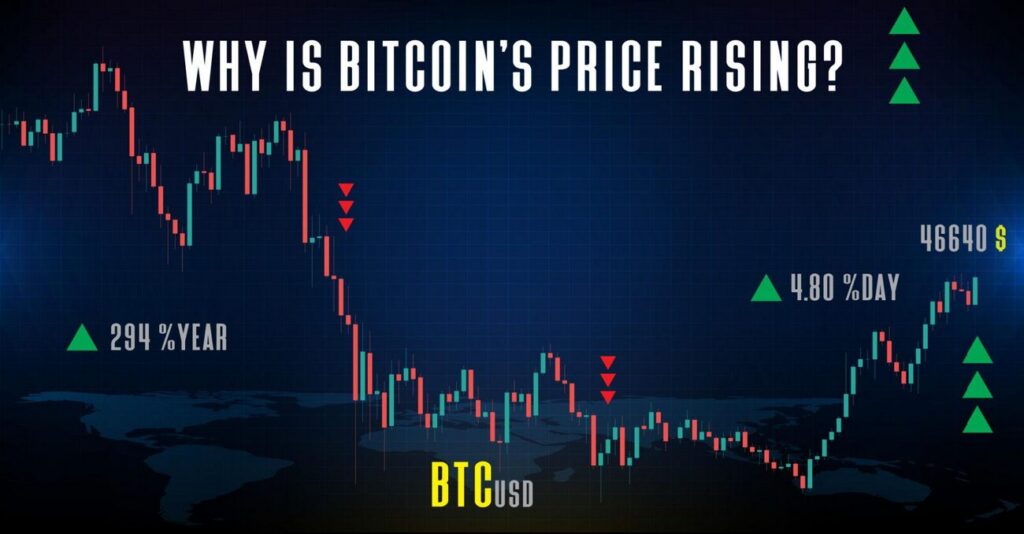
This chart should illustrate Bitcoin’s consolidation below resistance and highlight the recent attempt to test higher price levels.
Macro Drivers Influencing Bitcoin
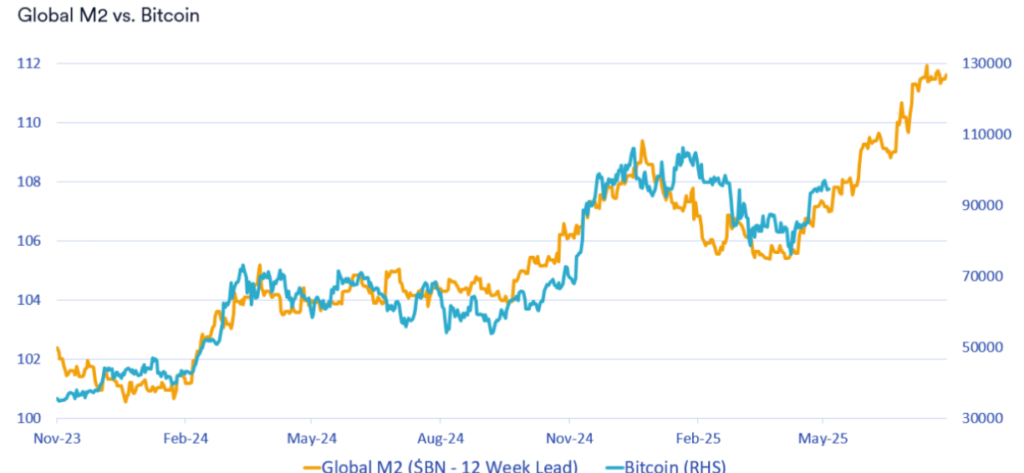
This diagram should visualize the relationship between oil prices, interest rates, geopolitical risk, and Bitcoin’s price behavior.
Market Outlook: A Delicate Balance
Looking ahead, Bitcoin’s trajectory will likely depend on a delicate balance between macroeconomic forces and structural adoption.
Several potential scenarios could emerge:
Bullish Scenario
- Escalating fiscal concerns drive capital into non-sovereign assets
- Institutional inflows continue through ETFs
- Bitcoin breaks above key resistance levels
Neutral Scenario
- Geopolitical tensions remain contained
- Monetary policy remains stable
- Bitcoin trades sideways while adoption grows
Bearish Scenario
- Oil prices surge dramatically
- Inflation forces central banks to maintain tight policy
- Liquidity contraction pressures risk assets
In reality, markets often move between these scenarios as new information emerges.
Conclusion: Bitcoin at a Macro Crossroads
Bitcoin currently stands at an interesting crossroads in its evolution as a financial asset.
On one hand, geopolitical risks and tightening monetary conditions could limit short-term upside. Rising oil prices, inflation concerns, and potential shifts in Federal Reserve policy all represent headwinds for speculative markets.
On the other hand, structural forces supporting Bitcoin remain intact. Institutional adoption continues to grow, the network’s fundamentals remain stable, and the broader narrative of Bitcoin as a non-sovereign store of value is gaining traction.
If fiscal concerns surrounding major economies—particularly the United States—begin to dominate market psychology, Bitcoin could benefit from increased capital inflows seeking alternative stores of value.
For investors searching for new sources of yield, emerging digital assets, or practical blockchain applications, understanding these macro forces will be essential.
The next phase of the crypto market may not be driven solely by technological innovation or retail speculation. Instead, it may increasingly be shaped by the same macroeconomic dynamics that influence global financial markets.
In that sense, Bitcoin is no longer just a cryptocurrency.
It is becoming a macro asset class in its own right.
