

Key Takeaways :
- Bitcoin reached a new weekly high around $93,500 even as the U.S. Congress delayed deliberations on the CLARITY Act.
- Market volatility continues to compress, indicating a transition from speculative trading to longer-term positioning.
- On-chain data shows limited exchange inflows and muted profit-taking, suggesting reduced downside panic.
- ETF outflows and weak retail participation temper excessive optimism, pointing to a market supported primarily by large holders.
- Regulatory uncertainty is increasingly viewed not as a binary risk, but as a gradual integration process into institutional finance.
Introduction: Regulation Delayed, Market Unshaken
The long-anticipated CLARITY Act, designed to define the market structure of cryptocurrencies in the United States, has once again been postponed in Congress. Yet contrary to what many would expect, Bitcoin’s price action has remained remarkably resilient. Instead of reacting with heightened volatility or aggressive sell-offs, Bitcoin climbed to a new weekly high of approximately $93,500, maintaining strength above the psychologically important $90,000 level.
This market behavior underscores a broader and more important narrative: Bitcoin is no longer trading solely as a high-beta speculative asset. Instead, it is increasingly behaving like an institutionally absorbed macro asset, where regulatory uncertainty is absorbed gradually rather than triggering abrupt risk-off events.
CLARITY Act Delay: Political Friction, Market Maturity
Why the CLARITY Act Matters
The CLARITY Act aims to establish a comprehensive framework for U.S. cryptocurrency markets, addressing jurisdictional authority, stablecoin incentives, decentralized finance (DeFi) oversight, and the regulatory boundaries between agencies. Its passage has been widely viewed as a milestone toward long-term regulatory certainty.
However, Senate committees—including Agriculture and Banking—have delayed planned amendment discussions until late January. According to Senator John Boozman, unresolved disagreements over stablecoin design, DeFi supervision, and agency authority remain key obstacles.
Market Reaction: Indifference, Not Fear
Historically, regulatory delays or hostile signals triggered sharp inflows of Bitcoin to exchanges as traders prepared to sell. This time, such behavior has been notably absent. Instead, Bitcoin traded within a narrow range, briefly dipping below $91,000 before rebounding above $93,500 during New York trading hours.
This muted response suggests that market participants increasingly perceive regulatory developments as long-term structural issues rather than immediate price catalysts.
Volatility Compression: A Sign of Structural Transition
One of the most striking features of the current market is the sustained compression in Bitcoin’s volatility.
What Volatility Compression Indicates
Volatility compression typically precedes significant price expansion, but it also reflects a shift in market composition. When short-term speculators dominate, price swings are sharp and frequent. When longer-term holders accumulate, volatility narrows.
In Bitcoin’s case, this compression appears to be driven by patient capital rather than indecision.
Exchange Netflows Confirm Calm Conditions
[Bitcoin Exchange Netflow (CryptoQuant)]
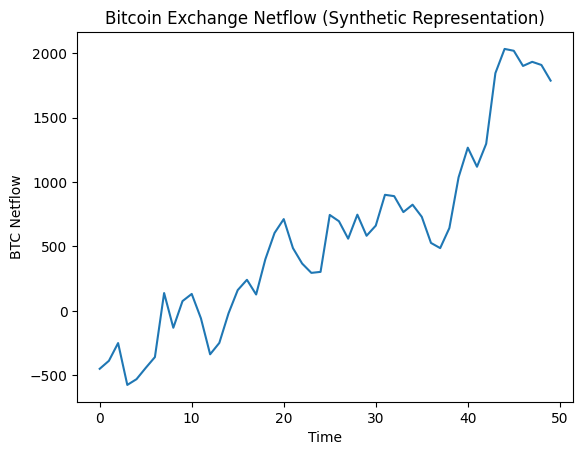
Data from on-chain analytics firms shows that Bitcoin exchange netflows remain subdued. There is no evidence of panic-driven deposits that typically precede sharp drawdowns. According to XWIN Research, this lack of preparatory selling indicates confidence in current price levels.
SOPR and On-Chain Behavior: Profits Deferred, Not Realized
Understanding SOPR
The Spent Output Profit Ratio (SOPR) measures whether coins moved on-chain are being sold at a profit or loss. Values around or below 1 indicate limited profit-taking.
What Current SOPR Data Shows
[Bitcoin SOPR Indicator]
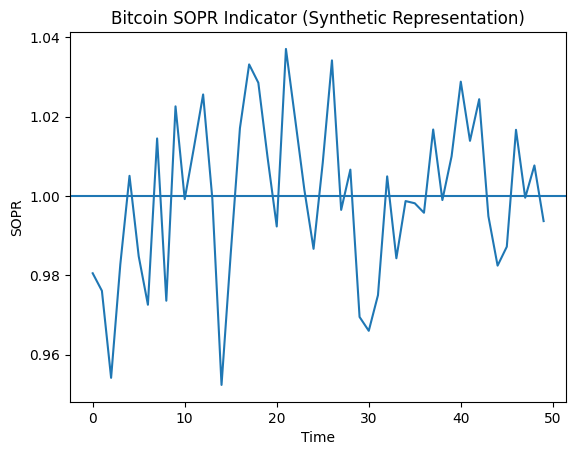
Bitcoin’s SOPR hovering near 1 suggests that holders are largely refraining from realizing gains. This behavior reflects a market dominated by participants willing to extend holding periods rather than rotate capital quickly.
Such conditions are typical of consolidation phases that precede longer-term trend continuation rather than distribution.
ETFs: Liquidity Outflows Without Market Collapse
Record ETF Outflows Raise Caution
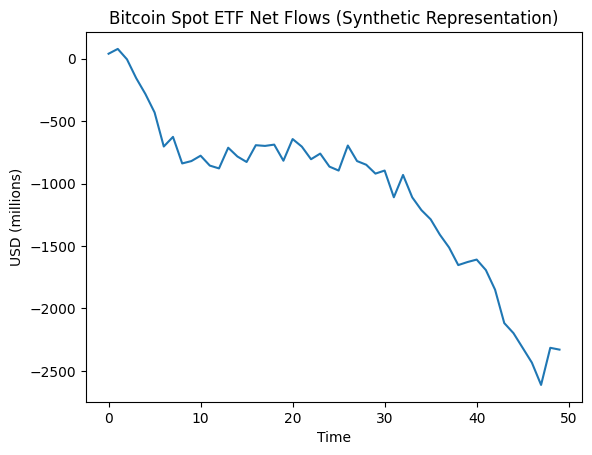
Despite Bitcoin’s price resilience, spot Bitcoin ETFs have recorded their largest liquidity outflows to date—exceeding $6 billion. The average realized price of ETF holdings is estimated around $86,000, leaving many post-October 2025 inflows in unrealized loss territory.
[Bitcoin ETF Net Flows]
Why the Market Absorbed the Shock
Importantly, ETF outflows stabilized over the past two weeks, and the broader market did not experience cascading sell pressure. This suggests that ETF holders, while reducing exposure, are not triggering systemic stress.
The implication is clear: ETF flows matter, but they no longer singularly dictate Bitcoin’s price trajectory.
Retail Absence: A Silent Market Phase
Small Investors Still on the Sidelines
Data indicates that 30-day Bitcoin demand from small buyers (purchases between $0 and $10,000) remains deeply negative. Unlike past bull markets driven by retail enthusiasm, the current cycle lacks broad-based retail participation.
Coinbase Premium Remains Neutral
[Coinbase Premium Index]
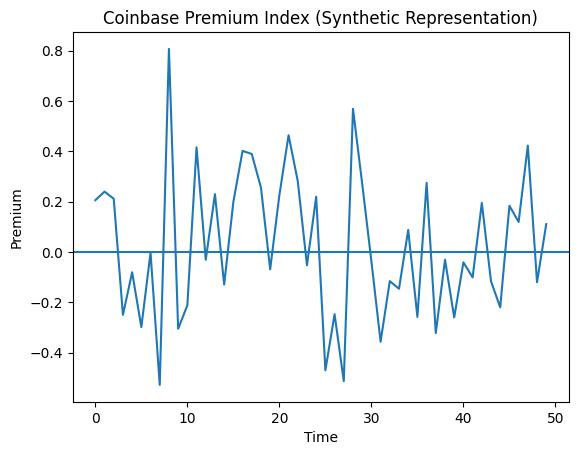
The Coinbase Premium Index—a proxy for U.S. retail and institutional spot demand—has yet to turn decisively positive. Market commentators emphasize that a sustained premium would signal renewed demand from U.S.-based buyers.
Until then, upside momentum remains steady but restrained.
Interpreting the Bigger Picture: Bitcoin as Institutional Infrastructure
The evolving response to regulatory delays highlights Bitcoin’s transition from an adversarial asset to an integrated financial instrument.
Rather than viewing the CLARITY Act as a binary pass/fail risk, markets increasingly treat it as one step in a multi-year institutional alignment process. In this context, Bitcoin’s price stability amid uncertainty is not accidental—it reflects structural maturation.
For investors and builders seeking new revenue opportunities or practical blockchain applications, this environment favors long-term positioning, infrastructure development, and yield strategies over short-term speculation.
Conclusion: Stability Is the Signal
Bitcoin’s ability to set new weekly highs amid regulatory delays, ETF outflows, and muted retail participation signals a profound shift in market dynamics. Volatility compression, calm on-chain behavior, and institutional absorption suggest that Bitcoin is entering a phase where stability itself becomes the bullish signal.
For those looking beyond price charts—to real-world adoption, financial integration, and sustainable revenue models—this period may prove more significant than any explosive rally.
