

Main Points :
- Bitcoin holders have shifted from net realized profits to net realized losses for the first time since October 2023, according to on-chain data.
- Over 69,000 BTC in cumulative realized losses have been recorded since late December, signaling weakening bullish momentum.
- On-chain profit cycles are increasingly resembling the early stages of the 2021–2022 bear market transition.
- Macro pressures, including U.S. trade policy risks and derivatives-driven sell pressure, are amplifying downside risks.
- Debate continues over whether Bitcoin’s traditional four-year halving cycle still applies in an era of spot ETFs and institutional adoption.
- Stablecoin dominance (USDT.D) is emerging as a critical leading indicator of risk-off behavior.
1. Bitcoin’s On-Chain Profit Structure Has Turned Negative
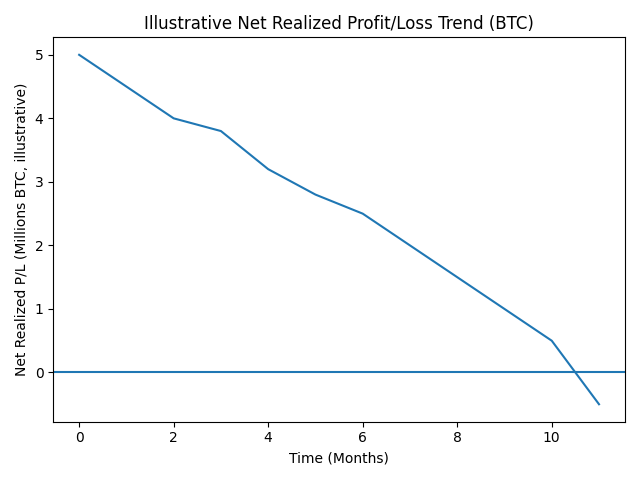
According to a weekly market report released by CryptoQuant, Bitcoin holders have entered a phase of net realized losses over the past 30 days. This marks the first such occurrence since October 2023 and represents a notable shift in market structure.
Since December 23, approximately 69,000 BTC worth of cumulative realized losses have been recorded. At the same time, the volume of BTC being realized at a profit has continued to decline, suggesting that fewer market participants are confident enough to exit positions profitably at current price levels.
This transition is not merely a short-term fluctuation. On-chain realized profit metrics show that each subsequent profit-taking peak—observed in January 2024, December 2024, July 2025, and October 2025—has been progressively smaller than the previous one. This declining amplitude strongly suggests that bullish momentum has been structurally weakening for over a year.
[Illustrative Net Realized Profit/Loss Trend]
2. Echoes of the 2021–2022 Market Transition
CryptoQuant notes that the current on-chain pattern closely resembles the transition period between the 2021 bull market and the 2022 bear market. During that earlier cycle, realized profits peaked in early 2021 and gradually declined before flipping into sustained net losses as prices rolled over.
Today, annual net realized profits have sharply contracted—from roughly 4.4 million BTC at their peak to approximately 2.5 million BTC, a level comparable to March 2022. Historically, such compression has coincided with the early phase of prolonged bearish conditions rather than short-lived corrections.
This matters because realized profit and loss metrics reflect actual investor behavior, not sentiment surveys or price-based indicators. When holders consistently lock in losses, it often indicates forced selling, declining conviction, or liquidity stress—conditions that can persist for extended periods.
3. Macro and Structural Headwinds Are Intensifying
Short-term pressures are compounding the on-chain weakness. Analysts affiliated with CryptoQuant point to macroeconomic developments, particularly the strengthening of U.S. tariff policies under the Trump administration, as a material downside risk for Bitcoin post-2025.
Stronger trade barriers tend to tighten global liquidity and strengthen the U.S. dollar—conditions historically unfavorable for risk assets, including cryptocurrencies. At the same time, derivatives market data from major exchanges such as Binance indicate rising sell pressure from large holders (“whales”), especially via perpetual futures and options positioning.
These dynamics suggest that the current downturn is not purely crypto-native but increasingly entangled with global macro forces.
4. Is the Four-Year Bitcoin Cycle Breaking Down?
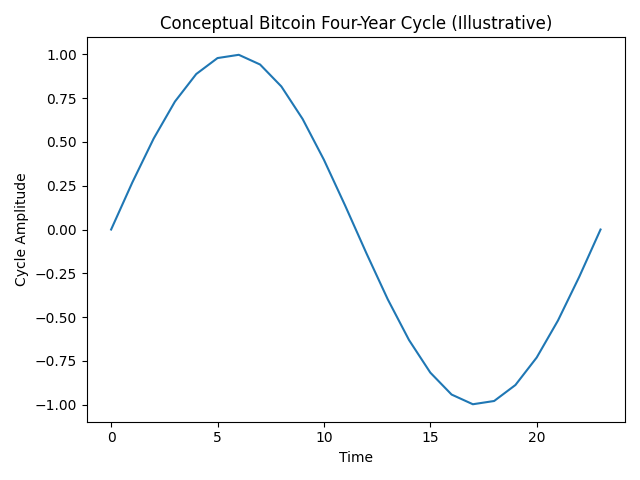
The current market environment has reignited debate over Bitcoin’s traditional four-year cycle, driven by halving events that reduce block rewards and new supply issuance.
Under the classical model, Bitcoin entered a bear market around October 2025, with a potential bottom projected around October 2026. However, a growing number of analysts argue that this framework may no longer fully apply.
The approval of spot Bitcoin ETFs, increased participation by institutional investors, and structurally lower volatility have fundamentally altered Bitcoin’s market microstructure. Unlike prior cycles dominated by retail speculation, today’s market features long-term allocators, regulated vehicles, and balance-sheet-driven flows.
As a result, price behavior may become less cyclical and more macro-correlated, resembling commodities or alternative macro assets rather than purely speculative instruments.
[Conceptual Bitcoin Four-Year Cycle]
5. Stablecoin Dominance as a Leading Risk Indicator
Trader and analyst Christian Chifoi highlights the growing importance of USDT Dominance (USDT.D)—the proportion of the total crypto market held in Tether—as a forward-looking indicator.
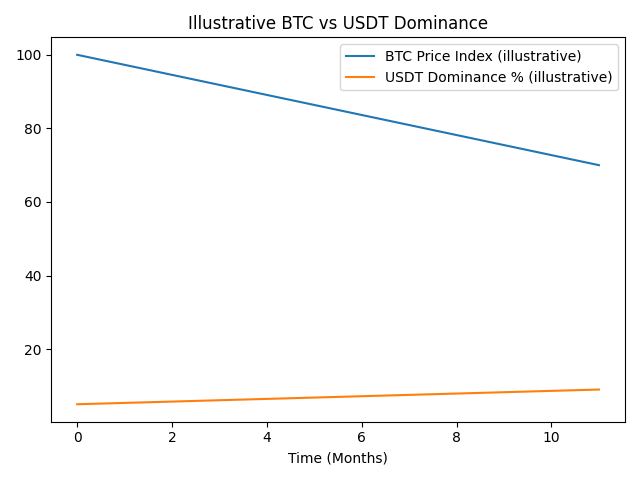
When investors become risk-averse, they tend to rotate out of volatile assets like Bitcoin and into stablecoins, pushing USDT.D higher. Conversely, declining USDT dominance often precedes bullish expansions as capital flows back into risk assets.
Currently, USDT.D has been trending upward, reinforcing the narrative that the market is in a defensive, capital-preservation phase rather than an accumulation phase.
[Illustrative BTC vs USDT Dominance]
6. What This Means for Investors and Builders
For investors seeking new digital assets or yield opportunities, the current environment demands selectivity and patience. Historically, early bear markets are characterized by false bottoms, sharp rallies, and prolonged consolidation.
However, for builders and operators focused on practical blockchain use cases—payments, settlement, tokenization, and financial infrastructure—down cycles often present the best opportunity to build. Lower speculative noise allows real adoption metrics to stand out, and talent becomes more accessible.
Projects that can demonstrate real cash flow, utility-driven demand, or integration with traditional finance may emerge stronger when the market eventually turns.
Conclusion: A Transitional Phase, Not an End
Bitcoin’s shift into net realized losses is a meaningful signal that the market has entered a transitional phase. While it may be premature to declare a full-scale “crypto winter,” the data strongly suggest that the easy gains of the previous cycle are over.
Whether this period evolves into a prolonged bear market or a structurally different consolidation phase will depend on macro conditions, institutional behavior, and real-world adoption. For now, discipline, risk management, and a focus on fundamentals are likely to matter more than speculation.
