
Main Points :
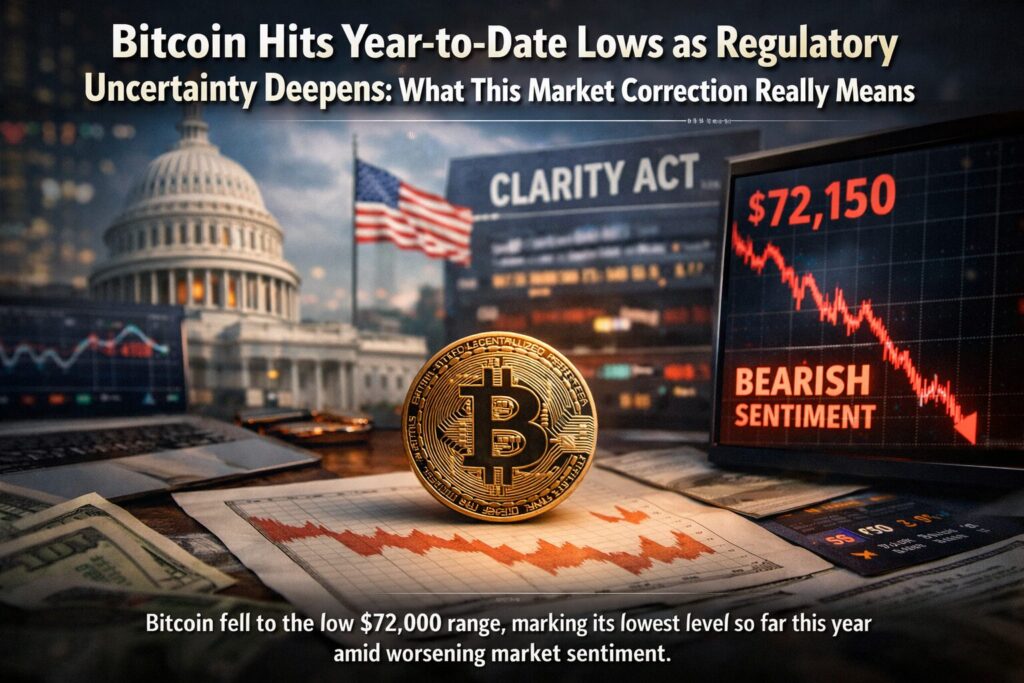
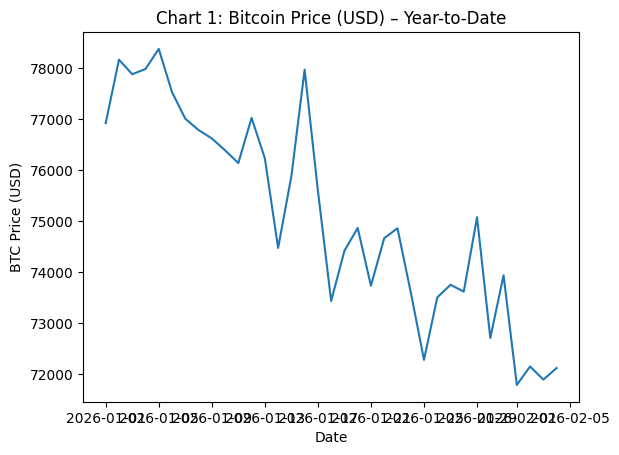
- Bitcoin fell to the low $72,000 range, marking its lowest level so far this year amid worsening market sentiment.
- Stalled negotiations over the U.S. “Clarity Act” have amplified regulatory uncertainty, undermining investor confidence.
- Weak correlation with equities, gold, and oil suggests Bitcoin is moving on crypto-specific fundamentals rather than macro alone.
- Options market data and sentiment indices indicate a sharp shift toward bearish positioning.
- Despite near-term pressure, regulatory clarity remains a key long-term catalyst for institutional adoption and new crypto business models.
1. Market Overview: Bitcoin Breaks Its Year-to-Date Low
On February 4, Bitcoin (BTC) briefly declined into the low $72,000 range, registering a new year-to-date low. This move occurred against a backdrop of deteriorating investor sentiment driven by both regulatory and macroeconomic factors. While Bitcoin has experienced periodic corrections throughout previous cycles, the current downturn stands out for its timing: it coincides with heightened expectations—and subsequent disappointment—around U.S. regulatory developments.
According to market data aggregated by CoinPost Terminal, the sell-off accelerated during Asian trading hours and persisted into U.S. sessions, suggesting global risk-off behavior rather than a localized event.
[Bitcoin price (USD) – YTD daily chart with key support levels]
2. The Clarity Act: Why Regulatory Stalemate Matters More Than Price
At the center of the latest downturn is the so-called “Clarity Act,” a proposed U.S. crypto market structure bill intended to clearly define regulatory jurisdiction between agencies such as the SEC and CFTC. The bill has been widely viewed as a necessary step to lower compliance uncertainty for banks, fintech firms, and institutional investors considering entry into the digital asset space.
However, reports that discussions held at the White House failed to reach consensus—particularly between major U.S. banks and crypto industry representatives—triggered renewed fears that regulatory ambiguity could persist far longer than anticipated.
For market participants, this is not merely a political issue. Regulatory clarity directly affects:
- Whether banks can custody or intermediate crypto assets
- How stablecoins are issued and settled
- Whether tokenized real-world assets can scale legally
The stalling of the Clarity Act therefore strikes at the foundation of crypto’s next growth phase, rather than its speculative fringe.
3. Correlation Analysis: Bitcoin Moves on Its Own Axis
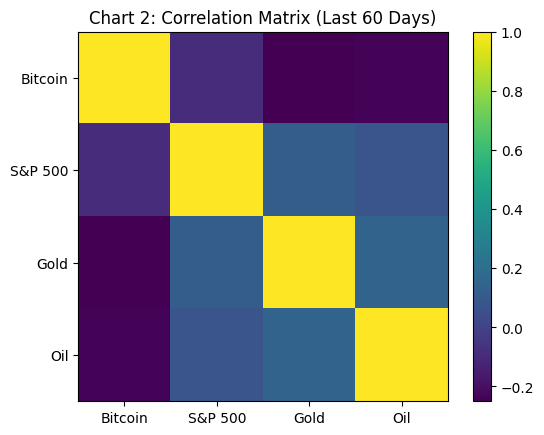
Interestingly, recent data show that Bitcoin’s correlation with traditional asset classes has weakened considerably. Over a two-month observation period, correlations were recorded as:
- S&P 500: -0.09
- Gold: -0.25
- Oil: -0.24
These weak negative correlations suggest that Bitcoin is currently trading on crypto-native narratives—regulation, derivatives positioning, and internal liquidity—rather than simply mirroring equity or commodity markets.
This decoupling challenges the simplistic “risk-on tech proxy” narrative and reinforces the idea that Bitcoin is evolving into a distinct macro asset class, albeit one still vulnerable to policy shocks.
[Correlation matrix heatmap: BTC vs S&P 500, Gold, Oil (last 60 days)]
4. Options Market Signals: Put Demand Surges
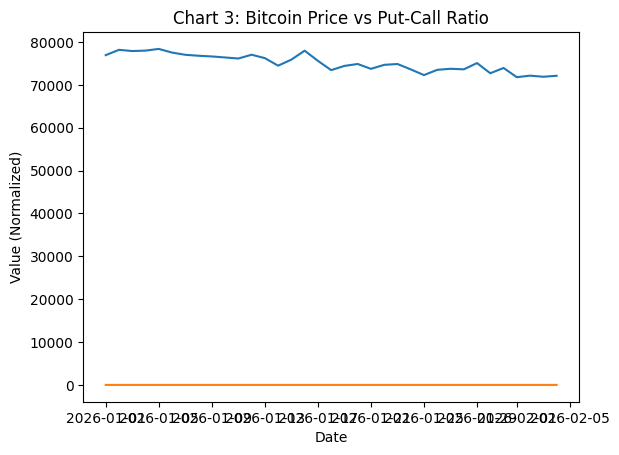
Derivatives markets are often where sentiment shifts first, and current options data are flashing clear warning signs. A sharp increase in put option activity has driven the Put-Call Ratio (PCR) significantly higher, indicating that traders are aggressively hedging downside risk or outright positioning for further declines.
Historically, elevated PCR levels tend to coincide with:
- Short-term capitulation phases
- Heightened volatility
- Potential medium-term reversal points
However, such reversals typically require a catalyst—either macro stabilization or positive regulatory news—which is currently absent.
[Bitcoin options Put-Call Ratio over time with price overlay]
5. Fear and Greed Index: Sentiment Near Extreme Fear
The Crypto Fear & Greed Index has fallen to levels comparable to last spring, when escalating trade tensions and tariff disputes weighed heavily on global markets. Extreme fear readings often signal that selling pressure is becoming emotionally driven rather than fundamentally rational.
For long-term investors and builders, this environment is paradoxical. While price action is discouraging, sentiment extremes have historically coincided with periods of strategic accumulation by institutions and high-conviction players.
6. Macro Backdrop: Earnings, Data, and Event Risk
Adding to crypto-specific concerns is a dense calendar of macroeconomic events:
- February 5: U.S. ISM Non-Manufacturing Index
- February 6: U.S. Employment Report
- February 10: U.S. Retail Sales
- February 10–12: Consensus Hong Kong 2026
With major U.S. tech companies reporting earnings and global liquidity conditions tightening, investors are reducing exposure to volatile assets. Bitcoin, despite its growing institutional base, remains vulnerable during such periods.
7. Strategic Implications for Crypto Investors and Builders
For readers seeking new crypto assets, revenue opportunities, or practical blockchain use cases, the current market offers several lessons:
First, regulatory clarity remains the single most important unlock for large-scale adoption. Infrastructure projects aligned with compliance—custody, payments, tokenization—are better positioned than purely speculative tokens.
Second, derivatives and on-chain data should be monitored as closely as price. Sentiment indicators often provide early signals that spot markets lag.
Finally, builders should treat downturns as design periods. Historically, many of crypto’s most enduring business models—stablecoins, DeFi primitives, custody infrastructure—were refined during bear phases.
Conclusion: Volatility Today, Structure Tomorrow
Bitcoin’s drop to year-to-date lows reflects more than temporary risk aversion. It underscores a market grappling with unresolved regulatory questions at a moment when institutional participation is poised to accelerate. While near-term price action may remain volatile, the long-term trajectory hinges on whether policymakers can provide the clarity that capital, builders, and users alike require.
For those focused on sustainable revenue models and real-world blockchain integration, the current correction may ultimately prove less a crisis than a crucible.
