
Main Points :
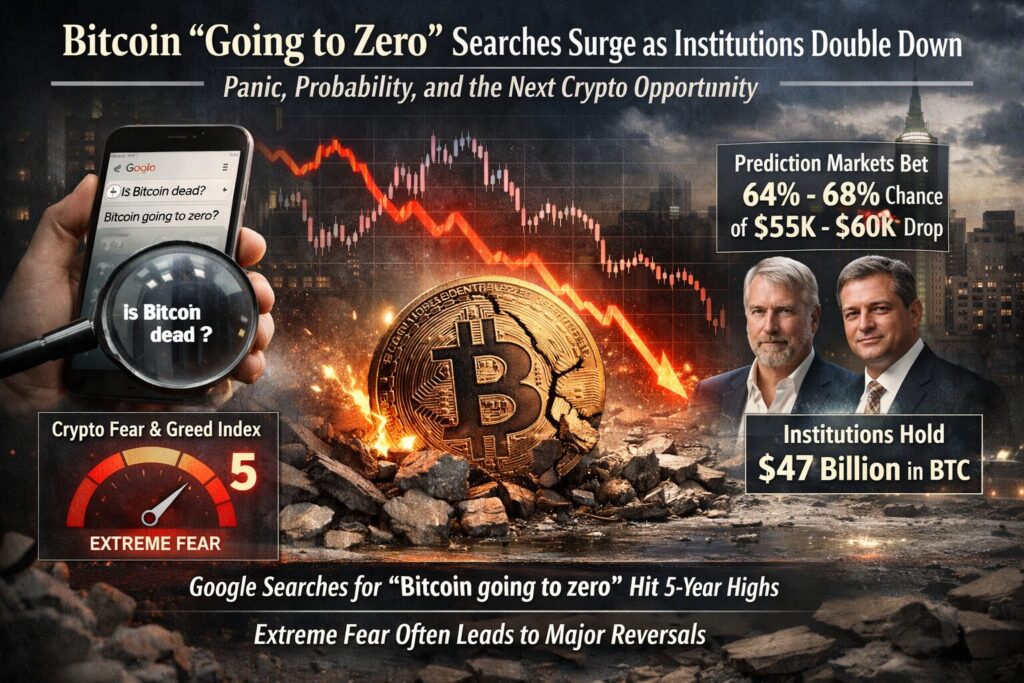
- Google searches for “Bitcoin going to zero” and “Is Bitcoin dead?” have reached five-year highs.
- The Crypto Fear & Greed Index plunged to 5, matching historic lows last seen in 2019.
- Bitcoin trades around $67,000, roughly 47% below its all-time high near $126,000.
- Prediction markets assign a 64–68% probability of a drop toward $55,000–$60,000.
- Institutional buyers, led by Strategy and its chairman Michael Saylor, continue aggressive accumulation, holding approximately $47 billion in BTC.
- Historical data shows extreme fear phases have often preceded powerful reversals.
1. Fear at Historic Extremes: When “Zero” Becomes a Trending Topic
“Google Search Interest vs Fear & Greed Index (5-Year High Fear Event)”
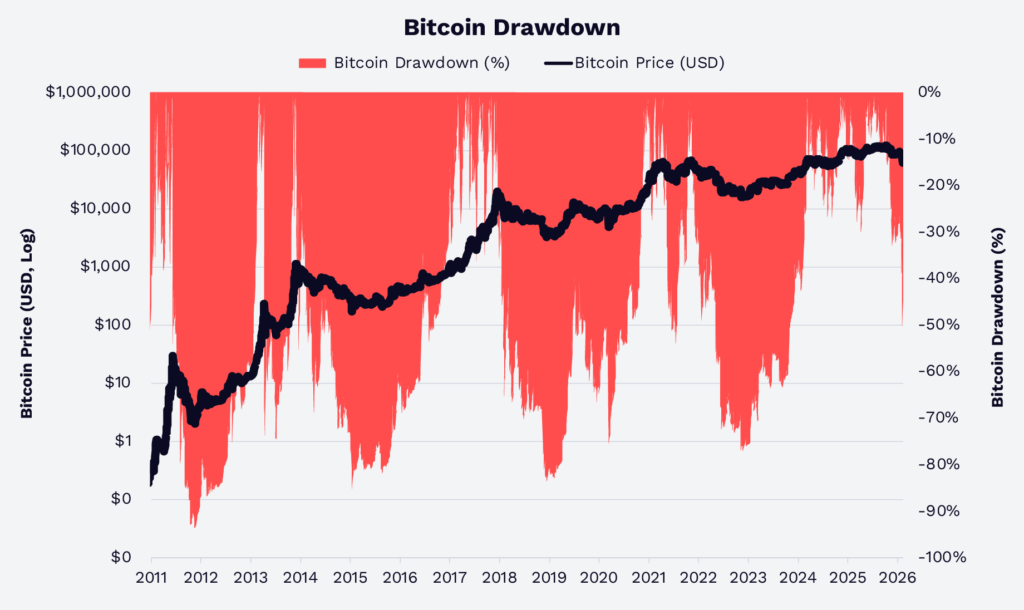
On February 19, 2026, Google Trends data revealed a dramatic surge in global search interest for phrases such as “bitcoin going to zero” and “is bitcoin dead.” Search activity reached the highest level in five years. Historically, such spikes in existential queries have coincided with intense market drawdowns and widespread retail capitulation.
At the same time, the Crypto Fear & Greed Index — a composite sentiment metric derived from volatility, trading volume, social media trends, and market momentum — collapsed to a reading of 5 on a scale of 0 to 100. This matches the lowest levels recorded since 2019. A reading of 5 signifies extreme fear — not ordinary pessimism, but systemic psychological stress across market participants.
Bitcoin’s price currently hovers near $67,000, reflecting a 47% correction from its October 2025 all-time high of approximately $126,000. While such a drawdown appears dramatic in isolation, it remains well within historical volatility norms for Bitcoin. Previous cycles have witnessed 60–80% corrections before recovery phases.
However, the intensity of retail search behavior suggests something deeper than routine volatility: it reflects crisis narrative formation. When retail investors begin searching whether an asset is “dead” or “going to zero,” they are not simply reacting to price. They are questioning the long-term viability of the asset class itself.
Yet markets are rarely unanimous at inflection points.
2. Prediction Markets Signal Further Downside — But Not Collapse
“Probability Distribution: $55K vs $84K Scenarios”
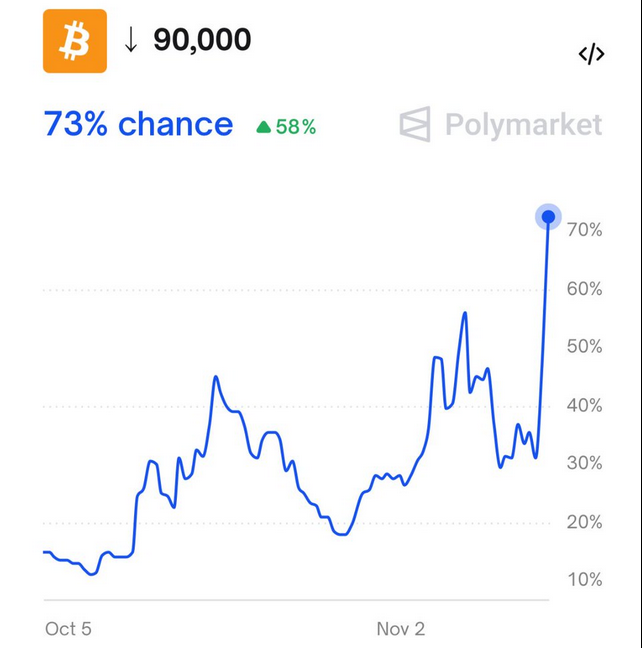
While search trends reflect fear, prediction markets quantify it. Platforms such as Polymarket and Myriad Markets currently assign a 64% probability that Bitcoin falls toward $55,000 before recovering to $84,000. Polymarket similarly places a 68% probability on movement toward $60,000.
Institutional research desks, including major global banks and on-chain analytics firms, have identified $50,000–$55,000 as a potential next support zone. These projections are based on technical retracement levels, liquidity clusters, derivatives open interest, and realized cost basis analysis.
Crucially, none of these professional forecasts assign meaningful probability to Bitcoin reaching zero.
This distinction matters. There is a difference between volatility and extinction.
Markets are pricing downside risk — not existential failure.
For sophisticated investors, this divergence between retail panic (“zero”) and institutional modeling (“support zone”) may represent asymmetrical opportunity.
3. Institutional Contrarianism: Strategy’s $47 Billion Commitment
“Corporate BTC Holdings Growth – Strategy Accumulation Curve”
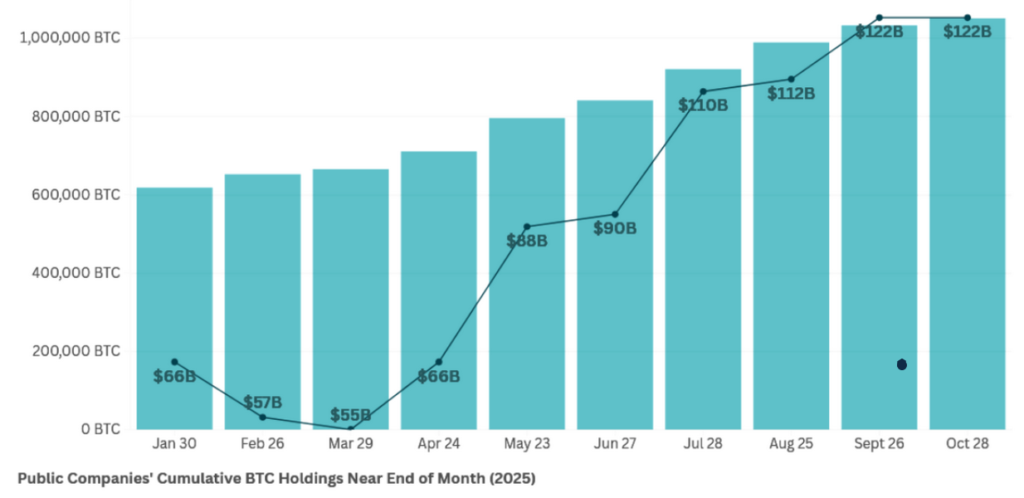
Against the backdrop of panic-driven searches, Strategy — formerly known as MicroStrategy — continues to accumulate Bitcoin.
Chairman Michael Saylor confirmed that the company’s BTC holdings have reached approximately $47 billion in value, with ongoing quarterly purchases. In a recent interview, he stated plainly: “If I believed it was going to zero, I would act accordingly. I do not.”
This approach is not reactive trading. It is structural capital allocation.
Corporate treasury strategies differ fundamentally from retail sentiment. Strategy’s model treats Bitcoin as a long-term reserve asset — akin to digital property — rather than a short-term speculative instrument.
This divergence illustrates a classic market phenomenon:
Retail sentiment is pro-cyclical.
Institutional capital is often counter-cyclical.
When retail searches spike toward “zero,” corporate treasuries increase exposure.
Such asymmetry has historically defined major market bottoms.
4. Historical Parallels: When Extreme Fear Marked Reversal Points
Santiment has previously documented that during prior episodes when the Fear & Greed Index fell below 20, price stabilization frequently followed within weeks or months.
In 2020, during the pandemic crash, sentiment collapsed as Bitcoin fell below $5,000. Within twelve months, it surpassed $60,000.
In 2022, following exchange failures and macro tightening, sentiment cratered again as Bitcoin revisited $16,000. The subsequent cycle carried it to $126,000 by late 2025.
This does not imply inevitability of recovery — but it demonstrates that extreme fear has often preceded structural accumulation phases.
On-chain metrics today show long-term holders increasing their relative share of supply, while short-term holders reduce exposure. Exchange reserves remain structurally lower than in prior cycles, suggesting supply tightening during drawdowns.
When fear peaks, liquidity thins — and capital with conviction enters.
5. Macro Context: Liquidity Cycles and Risk Appetite
Bitcoin does not exist in isolation. Its volatility intersects with global liquidity conditions, monetary policy, and risk asset flows.
Recent macro pressures include:
- Elevated real interest rates
- Slower global growth
- Equity market volatility
- Strength in the U.S. dollar
However, forward-looking markets increasingly price potential easing in late 2026 as inflation stabilizes. Historically, Bitcoin has responded positively to liquidity expansion and declining real yields.
Thus, the present correction may represent a transitional phase between tightening and future easing cycles.
For blockchain entrepreneurs and investors seeking opportunity, the key is timing accumulation relative to liquidity cycles — not reacting to headline fear.
6. Practical Implications for Crypto Builders and Investors
For readers searching for new crypto opportunities and revenue streams, the current environment offers several strategic considerations:
- Accumulation Windows: Severe drawdowns historically created high risk-adjusted entry points for long-term capital.
- Infrastructure Expansion: Bear phases often accelerate protocol development and real-world blockchain integration.
- Treasury Allocation Models: Corporate adoption models (as seen with Strategy) may become more common among fintech and Web3 companies.
- Volatility-Based Yield Strategies: Options markets expand during fear phases, increasing premium generation opportunities.
- On-Chain Real Utility: Periods of price stagnation often redirect focus toward payments, stablecoins, and enterprise blockchain adoption.
Rather than asking whether Bitcoin goes to zero, sophisticated participants ask:
Where does structural value persist?
Where is capital quietly accumulating?
Where is volatility mispriced?
Conclusion: Fear as a Mirror — Not a Forecast
Retail searches proclaim “zero.”
Prediction markets project $55,000.
Institutions accumulate billions.
These are not contradictions — they are layers of the same market.
Extreme fear often functions as a mirror of emotion, not a predictor of extinction. Bitcoin has survived multiple 40–80% drawdowns over its history. Each time, narratives of death re-emerged — and each time, structural adoption deepened.
Today’s environment reveals a striking asymmetry:
Retail fear is at historic highs.
Institutional conviction remains intact.
For investors and blockchain builders, the question is not whether volatility will continue. It will. The question is whether capital discipline aligns with long-term conviction.
Markets rarely reward comfort.
They often reward clarity during discomfort.
