
Main Points :
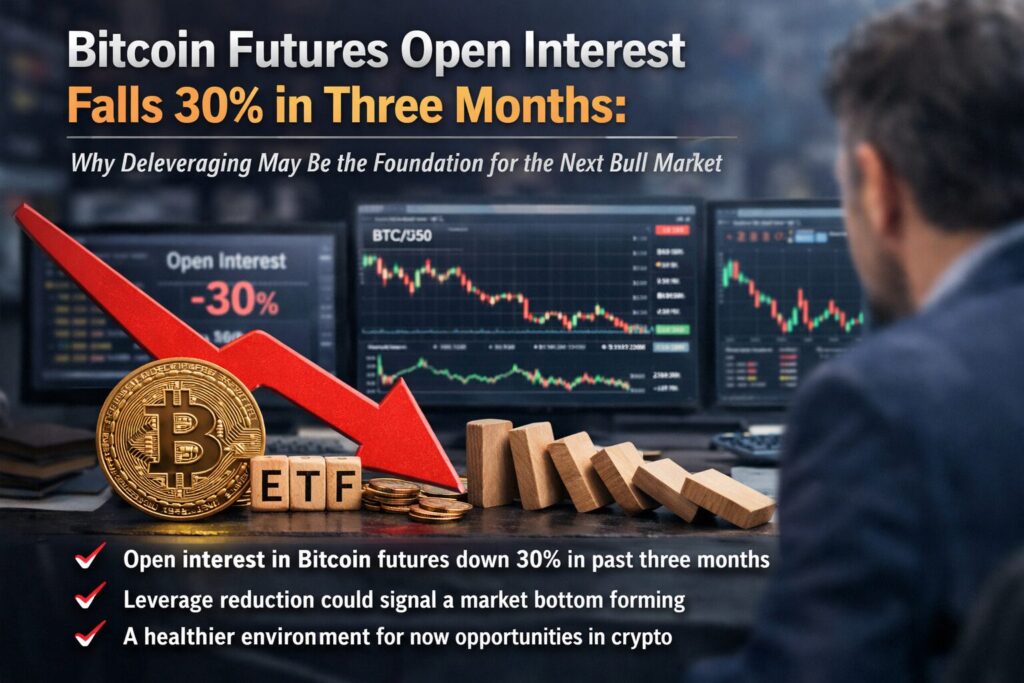
- Bitcoin futures open interest has declined by roughly 30% over the past three months, signaling broad deleveraging in the derivatives market.
- Historically, sharp reductions in leverage have often coincided with major market bottoms and the start of more sustainable bullish phases.
- While spot Bitcoin prices are rising, derivatives data suggest the market has not yet fully entered a structurally strong bull phase.
- For investors seeking new crypto assets, yield opportunities, and practical blockchain use cases, this reset may represent a healthier entry environment rather than a warning sign.
1. A Structural Reset in the Bitcoin Derivatives Market
According to on-chain analytics firm CryptoQuant, Bitcoin’s derivatives market has undergone a significant contraction in recent months. Since early October, open interest (OI) in Bitcoin futures has fallen by approximately 31%. Open interest represents the total value of outstanding, unsettled derivative contracts, and it is one of the most widely used indicators for measuring leverage and speculative positioning in crypto markets.
CryptoQuant interprets this sharp decline not as a sign of weakness, but as a “deleverage signal” — evidence that excessive and fragile leverage has been flushed out of the system. In leveraged markets like crypto, this process is often painful in the short term but constructive over longer horizons. When leverage builds too aggressively, even small price moves can trigger cascading liquidations, amplifying volatility and undermining confidence.
The October 10 market drop, which triggered widespread forced liquidations, serves as a textbook example. Positions that were overextended were rapidly closed, reducing systemic risk. From a structural standpoint, this cleansing process lowers the probability of sudden, leverage-driven crashes and creates a more stable foundation for organic price appreciation.
2. Historical Context: Why Deleveraging Often Aligns With Market Bottoms
Crypto analyst Darkfost, cited in the CryptoQuant report, emphasizes that historically, similar periods of sharp open interest contraction have often coincided with important market bottoms. In previous cycles, deleveraging phases acted as a reset mechanism, clearing speculative excess and allowing long-term capital to re-enter under healthier conditions.
This pattern is not unique to crypto. In traditional finance, futures and margin markets frequently undergo comparable resets after periods of excessive risk-taking. What distinguishes crypto is the speed and magnitude of these adjustments. Markets that can deleverage rapidly may appear unstable, but they also adapt faster.
That said, Darkfost also issues an important caveat. If Bitcoin were to experience a deeper price decline and enter a prolonged bear market, open interest could fall further. Such a scenario would imply a more extended adjustment period rather than an immediate bullish reversal. In other words, deleveraging is a necessary condition for recovery, but not a sufficient one on its own.
3. From Speculative Frenzy to Sustainable Positioning
The current contraction follows an extraordinary expansion earlier in the cycle. During 2025, speculative enthusiasm drove Bitcoin futures open interest to record highs. On October 6, aggregate open interest exceeded $15 billion, marking an all-time peak.
For comparison, during the previous bull market peak in November 2021, Binance’s Bitcoin open interest topped out at around $5.7 billion. The 2025 figures therefore represent nearly a threefold increase in leverage exposure. Such growth underscores how aggressively traders embraced derivatives as a primary vehicle for Bitcoin exposure.
This context is critical. When open interest grows faster than spot market demand, price action becomes increasingly dependent on leveraged positions rather than real asset accumulation. The resulting rallies tend to be fragile. In contrast, when prices rise alongside falling open interest, it often indicates that short positions are being closed and that buying pressure is shifting toward spot markets.
4. Falling Open Interest, Rising Prices: A Constructive Signal
One of the most notable features of the current market is that Bitcoin’s spot price has risen by roughly 10% year-to-date, even as derivatives open interest has declined. This divergence is typically interpreted as a bullish signal.
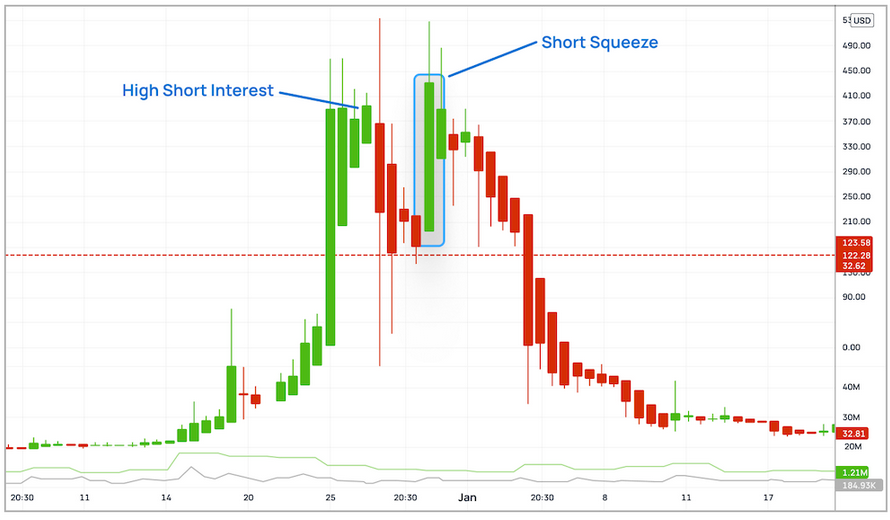
When leveraged short sellers are forced to close positions, selling pressure is removed from the market. This phenomenon, commonly known as a short squeeze, can propel prices higher. More importantly, if price gains persist after shorts have exited, it suggests that spot buyers — not leverage — are driving the rally.
Such spot-led rallies are generally more sustainable. They imply that investors are accumulating Bitcoin as an asset, not merely trading price fluctuations with borrowed capital. For long-term participants and institutions, this distinction matters greatly.
5. Current Market Size: Still Large, But Cooling
Data from CoinGlass shows that total Bitcoin open interest across all exchanges and derivative instruments currently stands at approximately $65 billion. This is down nearly 28% from the early October peak of over $90 billion, aligning closely with CryptoQuant’s estimates.
Despite the decline, these figures highlight that the derivatives market remains enormous. Leverage has been reduced, but not eliminated. From a systemic perspective, this suggests a transition phase rather than a full regime shift.
In the options market, Deribit continues to dominate Bitcoin options trading. The largest concentration of open interest is clustered around the $100,000 strike price, with notional exposure exceeding $2.2 billion. Call options significantly outweigh put options, indicating that many traders remain positioned for upside over the medium term.
6. Why This Is Not Yet a Full Bull Market
Despite these constructive signals, derivatives analytics firm Greeks Live cautions that the market has not yet entered a structurally bullish phase. According to its analysis, current trading behavior appears reactive — responding to price movements rather than reflecting a decisive shift in long-term expectations.
In practical terms, this means that while leverage has been reduced, conviction has not yet fully returned. A true bull market is typically characterized by sustained spot accumulation, rising long-term open interest aligned with hedging and institutional strategies, and declining sensitivity to short-term price shocks.
At present, Bitcoin appears to be in an intermediate state: healthier than before, but not yet decisively bullish.
7. Implications for Investors Seeking New Opportunities
For readers interested in discovering new crypto assets, yield strategies, or real-world blockchain applications, this environment carries several implications.
First, reduced leverage lowers systemic risk. This creates a safer backdrop for exploring longer-term strategies such as staking, structured products, or yield-bearing DeFi protocols. Second, spot-driven price appreciation tends to attract institutional interest, which can accelerate the development of compliant financial products such as ETFs, custody services, and regulated derivatives.
Finally, deleveraging phases often coincide with renewed focus on fundamentals. Developers, enterprises, and regulators tend to make the most progress during quieter market periods, laying the groundwork for the next expansion cycle.
8. Conclusion: Deleveraging as a Bullish Foundation, Not a Signal to Rush
The roughly 30% decline in Bitcoin futures open interest over the past three months should not be interpreted as a bearish omen. Instead, it reflects a necessary and historically constructive reset of market structure. Excessive leverage has been reduced, volatility risk has declined, and price gains are increasingly supported by spot demand.
However, caution remains warranted. The derivatives market has cooled, but it has not yet transformed into a fully bullish configuration. For sophisticated participants, this period may best be viewed as a foundation-building phase — one that rewards patience, risk discipline, and a focus on real adoption rather than speculative excess.
