
Main Points :
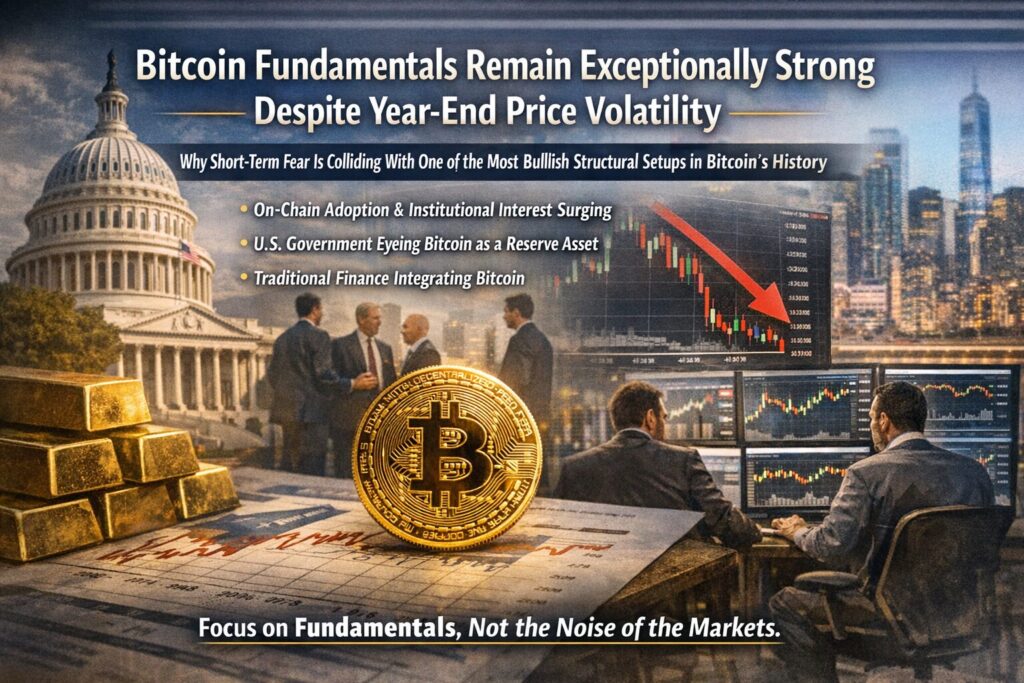
- Bitcoin’s price correction toward year-end has sharply contrasted with strengthening on-chain, institutional, and macro fundamentals.
- Strategy CEO Phong Le argues that Bitcoin’s fundamentals are “as good as they have ever been,” regardless of short-term volatility.
- Corporate treasury strategies, mNAV metrics, and sovereign interest—particularly from the U.S. government—are reshaping Bitcoin’s role as a global reserve asset.
- Traditional financial institutions are actively searching for ways to integrate Bitcoin, signaling a multi-year structural shift.
- Long-term investors and builders should focus less on price noise and more on capital structure, adoption vectors, and institutional flows.
1. Market Fear vs. Structural Reality
As 2025 approaches its final quarter, Bitcoin’s market price and investor sentiment have weakened noticeably. After reaching an all-time high of $125,100 on October 5, Bitcoin retraced nearly 30%, trading around $87,687 at the time of writing. Meanwhile, the widely followed Fear & Greed Index has remained in “Extreme Fear” territory since December 12.
Yet according to Strategy CEO Phong Le, this divergence between price action and fundamentals is precisely why disciplined investors must maintain perspective.
Speaking on the Coin Stories podcast, Le emphasized that Bitcoin’s short-term price movements are often chaotic and emotionally driven—but fundamentally disconnected from the asset’s long-term trajectory.
“This year, Bitcoin’s fundamentals are as good as they have ever been,” Le stated, adding that price volatility should not distract investors from structural progress.
This distinction—between market psychology and economic substance—has become increasingly critical as Bitcoin matures from a speculative instrument into a macro-relevant asset class.
2. Why Short-Term Price Action Is a Poor Signal
Bitcoin’s price behavior has always defied conventional valuation models. Unlike equities, it generates no cash flows; unlike bonds, it yields no coupons. As a result, short-term movements often reflect liquidity conditions, derivatives positioning, or sentiment cascades rather than fundamental deterioration.
Le argues that Bitcoin investors must approach the asset systematically and quantitatively, rather than emotionally.
“Short-term price is extremely hard to predict,” he noted. “You have to engage with Bitcoin in a mathematical and structured way.”
This philosophy has driven Strategy’s focus on mNAV (market Net Asset Value)—a metric comparing the company’s market capitalization to the value of its Bitcoin holdings.
3. Understanding mNAV and the Corporate Bitcoin Treasury Model
At present, Strategy holds approximately 671,268 BTC, valued at roughly $58.63 billion. However, due to the recent pullback in Bitcoin’s price, Strategy’s mNAV has fallen below 1, reaching approximately 0.93.
This means the company’s equity market valuation is currently below the net value of its Bitcoin reserves—an anomaly that Le views not as a weakness, but as a temporary market inefficiency.
[Strategy’s mNAV vs. Bitcoin Price Over Time]
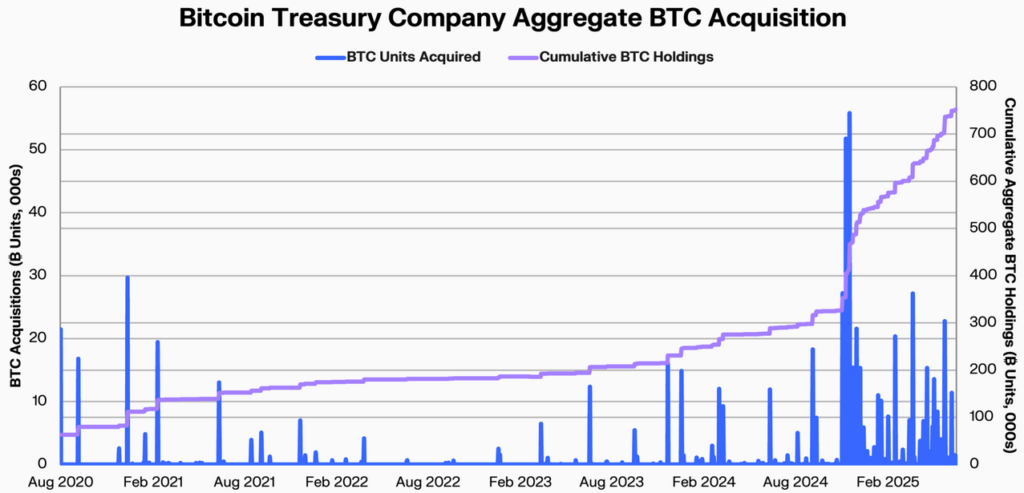
The mNAV framework is increasingly influential among institutions exploring Bitcoin treasury strategies. It provides a transparent lens for assessing leverage, capital efficiency, and long-term exposure—especially as more firms emulate Strategy’s approach.
4. Government Support: A Structural Inflection Point
Perhaps the most bullish long-term factor highlighted by Le is the evolving stance of the U.S. government toward Bitcoin.
He noted that, for the first time in Bitcoin’s history, the U.S. government appears to be openly supportive—not merely tolerant—of Bitcoin’s role within the global financial system.
This shift became explicit in March, when President Donald Trump signed an executive order formally establishing a Strategic Bitcoin Reserve. While operational details have yet to be disclosed, the symbolism alone represents a historic departure from prior regulatory ambiguity.
From a macro perspective, this development reframes Bitcoin from a “risk asset” into a potential sovereign reserve hedge, alongside gold and foreign currencies.
5. Traditional Finance Is Racing to Catch Up
Le also revealed that he and Strategy chairman Michael Saylor have been holding meetings with traditional banks across the United States and the United Arab Emirates.
The message from these institutions is consistent: they recognize Bitcoin’s inevitability—but are unsure how to integrate it.
“Traditional financial institutions are trying to figure out how to catch up,” Le explained. “The existing power structures are moving toward Bitcoin participation.”
This quiet but persistent institutional engagement suggests that Bitcoin adoption is no longer a matter of if, but how fast.
6. Institutional Research Reinforces the Bullish Thesis
Supporting this view, Galaxy Digital’s Head of Research, Alex Thorn, stated in September that the U.S. government was likely to formally announce its strategic Bitcoin reserve before year-end.
Although that timeline has not yet materialized, the expectation itself underscores how dramatically Bitcoin’s status has evolved within institutional discourse.
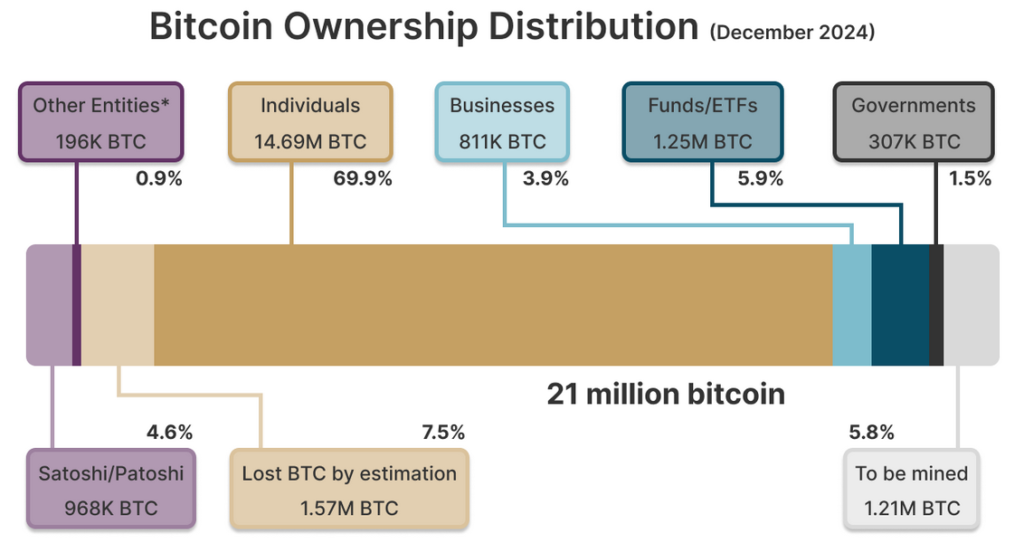
[Bitcoin Adoption—From Retail Speculation to Sovereign Interest]
7. What This Means for Investors and Builders
For readers seeking new crypto assets, revenue opportunities, or practical blockchain use cases, the implications are clear:
- Volatility is not weakness—it is a byproduct of a monetizing asset.
- Capital structure matters—understanding leverage, treasury strategy, and mNAV is now essential.
- Institutional gravity is real—banks and governments move slowly, but when they move, they reshape markets.
- Bitcoin is no longer just a trade—it is becoming financial infrastructure.
Builders should focus on tools that align with institutional adoption: custody, treasury analytics, compliance-ready wallets, and capital-efficient yield strategies.
8. Conclusion: Noise Fades, Structure Endures
Bitcoin’s year-end price decline has tested investor conviction—but it has not weakened the network’s foundations. On the contrary, government endorsement, corporate treasury expansion, and institutional convergence suggest that Bitcoin’s role in the global financial system is strengthening at an unprecedented pace.
As Phong Le succinctly put it, Bitcoin’s fundamentals are “as good as they have ever been.” For those capable of seeing beyond short-term fear, the coming years may represent one of the most asymmetric opportunities in modern finance.
