

Key Points :
- On January 21, 2026, U.S. Bitcoin (BTC) and Ethereum (ETH) spot ETFs recorded more than $1 billion in net outflows.
- The largest outflow came from BlackRock’s IBIT, with roughly $360 million withdrawn.
- ETH spot ETFs saw around $300 million in net outflows on the same day.
- XRP and SOL spot ETFs experienced modest net inflows.
- Analysts attribute the outflows to risk-off behavior by institutional investors reacting to macro uncertainty.
- Despite the outflows, analysts maintain confidence that long-term institutional demand remains intact.
- Broader macro trends (higher interest rates, geopolitical risk) are influencing crypto investment flows.
- Historical patterns suggest such outflows are not structural weaknesses in the ETF market.
Introduction: A Sharp Shift in Crypto ETF Flows
On January 21, 2026, the U.S. crypto market saw a significant movement in capital flows: Bitcoin and Ethereum spot ETFs collectively saw over $1 billion in net outflows. This development captured the attention of investors and analysts alike, raising questions about institutional appetite and the broader state of the crypto market.
The sudden shift in investment flows underlines the growing influence of institutional capital on crypto markets — particularly through regulated exchange-traded products that provide traditional investors with exposure to digital assets without holding the tokens directly. In this article, we explore the details of these outflows, the market context in which they occurred, analyst interpretations, and how this trend fits into longer-term institutional adoption of crypto.
Detailed Breakdown of January 21 ETF Flows
According to data from SoSoValue and The Block, the Bitcoin spot ETF complex experienced significant outflows on January 21:
- Total BTC spot ETF net outflow: approximately $700 million.
- Largest individual ETF outflow: BlackRock’s IBIT, losing about $360 million.
- This was the largest single-day outflow from Bitcoin spot ETFs since November 21, 2025.
[Bitcoin Spot ETF Outflows Chart]
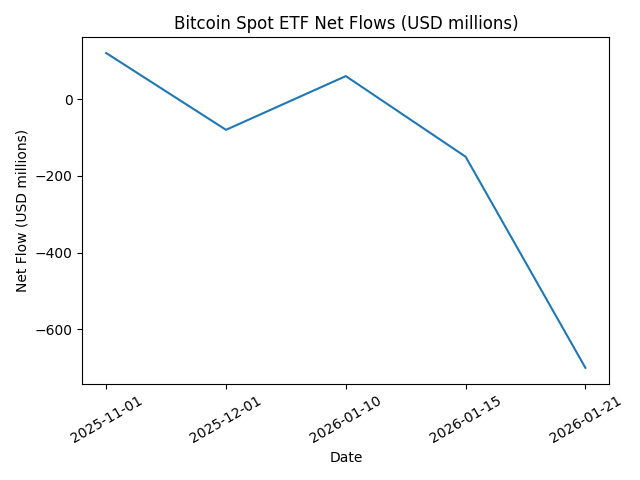
Chart showing historical daily net flows for BTC spot ETFs, highlighting January 21, 2026.
Similarly, the Ethereum spot ETF segment saw considerable outflows:
- ETH spot ETF net outflow: roughly $300 million on January 21.
- The magnitude of this one-day outflow was the largest for ETH spot ETFs over the past several months.
[Ethereum Spot ETF Outflows Chart]
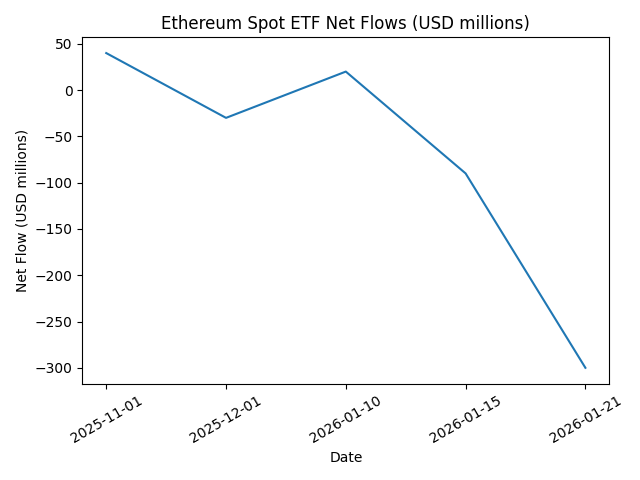
Chart showing historical daily net flows for ETH spot ETFs, marking the January 21 outflow.
In contrast to BTC and ETH, XRP and Solana (SOL) spot ETFs saw modest net inflows relative to other days, though the amounts were not large when compared to the outflows in BTC and ETH instruments.
Understanding the Market Reaction
Why did institutional investors pull capital from two of the largest digital asset ETFs? Experts point to macroeconomic and risk factors that tend to trigger defensive positioning among professional investors.
Macro Risk Aversion and Institutional Behavior
Rachael Lucas, a crypto analyst at BTC Markets, told The Block that the outflows resemble “typical risk-off behavior.” In other words, when markets face periods of uncertainty or investors perceive heightened risk, institutions often reduce exposure to volatile or higher-beta assets first — and crypto frequently falls into that category.
Several macro factors likely contributed to this risk-off response:
- Rising global interest rates — including higher Japanese long-term yields — can make yield-bearing assets more attractive relative to non-yielding assets like Bitcoin and Ethereum.
- Geopolitical tensions — ongoing global developments (such as strategic shifts involving the U.S., Europe, and the Arctic region) may elevate perceived risk premium.
- Market volatility — sudden or sustained price swings across asset classes can prompt risk managers to reduce exposure where possible.
Institutions may sell ETF shares to reduce market risk, even if they remain fundamentally bullish on digital assets.
Are These Outflows Structural? Analyst Perspective
While a $1 billion outflow in a single day sounds alarming, analysts emphasize that this does not necessarily signal a structural problem in the ETF market.
Long-Term Asset Base Still Strong
Lucas pointed out that while the daily outflow amount was large, the total assets under management (AUM) and historical net inflows remain significant. This suggests that long-term capital commitments are still intact, even if short-term reallocations occur.
In institutional portfolios, risk management is dynamic — capital is shifted not because investors have abandoned crypto ETFs, but often because they are adjusting exposure in response to evolving markets. This behavior has historical precedent; previous periods of macro volatility also saw temporary crypto ETF outflows followed by renewed inflows once markets stabilized.
Institutional Adoption Continues
Multiple data sources show that institutional participation in crypto markets has grown steadily since the introduction of spot Bitcoin and Ethereum ETFs in the U.S. This growth trajectory reflects broader acceptance of digital assets as part of diversified portfolios, especially among asset managers who seek regulated exposure without custody complexities.
Moreover, the presence of institutional investors can increase market depth and liquidity, making the ecosystem more resilient over time. Therefore, short-term outflows should be interpreted in the context of overall market maturity rather than crisis signals.
Broader Market Implications
Correlation with Macro Asset Classes
The behavior seen in crypto ETFs is not isolated. In risk-off environments, investors often rotate capital toward perceived safe havens — such as government bonds, high-grade credit, or cash — and away from risk assets, including stocks, commodities, and crypto.
Higher interest rates make traditional fixed income slightly more attractive, especially for risk-averse entities managing institutional portfolios. While crypto has often been likened to “digital gold,” its price correlation with risk assets like equities has been observed during volatile periods.
Effect on Crypto Price Dynamics
Large outflows from ETFs can exert downward pressure on market prices, especially when institutional holders sell positions to reduce exposure. However, the relationship between ETF flows and broader spot price moves is complex:
- ETFs represent only one segment of investor activity.
- Retail demand, miner flows, staking behavior, and decentralized finance (DeFi) activity all affect price and liquidity.
- ETF redemptions may not translate directly into spot selling if authorized participants manage redemptions efficiently.
Thus, while ETF flows are an important indicator, they are one piece of a multifaceted market picture.
What This Means for Investors Seeking New Crypto Opportunities
For readers interested in discovering new digital assets or identifying next-generation revenue sources, this episode highlights three practical lessons:
1. Crypto Markets Are Still Tied to Macro Trends
Even as crypto matures, it does not operate in isolation from global financial conditions. Investors should monitor:
- Interest rates across major economies.
- Inflation expectations and central bank policy signals.
- Geopolitical developments that affect risk sentiment.
These factors influence not only traditional markets but also digital asset flows.
2. Diversification and Risk Management Matter
Large institutional investors often position portfolios to reduce overall risk exposure during uncertain times. Retail or emerging institutional investors should consider diversification strategies:
- Allocating capital across multiple assets (BTC, ETH, altcoins).
- Using risk-management tools like stop-loss orders or dynamic allocation models.
- Considering staking, yield-earning protocols, and other income sources beyond simple price speculation.
3. Long-Term Trends Still Favor Adoption
Despite episodic outflows, the broader trend of institutional adoption persists. The existence of regulated ETFs in major jurisdictions indicates growing infrastructure and acceptance. For investors interested in operational blockchain use cases, this trend supports:
- On-ramping through regulated products.
- Institutional participation in decentralized networks (staking, node operations).
- Development of institutional-grade products and services (custody, compliance tooling).
Conclusion: Short-Term Volatility, Long-Term Participation
The significant net outflows from Bitcoin and Ethereum spot ETFs on January 21, 2026 reflect temporary risk aversion among institutional investors, influenced by macroeconomic uncertainty and shifting market sentiment. While the magnitude of these outflows is notable, it does not necessarily signal a fundamental breakdown in confidence or the end of institutional interest in crypto.
Analysts emphasize that markets are still maturing, and institutional capital tends to rotate rather than retreat outright when faced with volatility. For forward-looking investors and practitioners in blockchain and digital assets, this episode reinforces the importance of understanding macro drivers, maintaining diversified exposure, and aligning with long-term adoption trends.
