
Main Points :
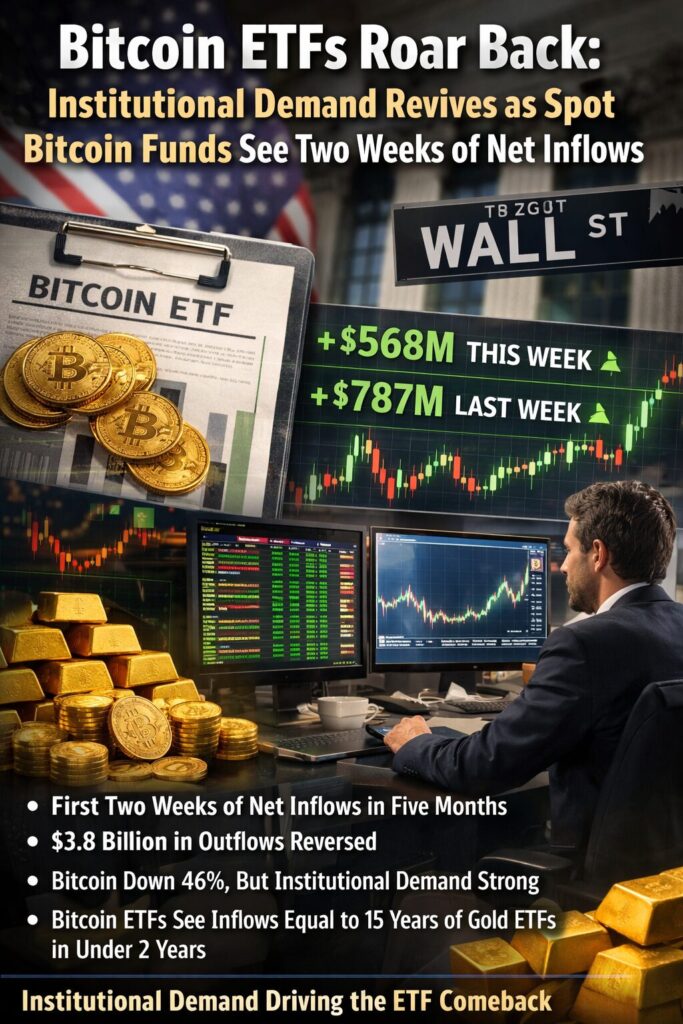
- U.S. spot Bitcoin ETFs recorded two consecutive weeks of net inflows for the first time in five months.
- Approximately $568 million flowed into Bitcoin ETFs this week, following $787 million the previous week.
- The reversal comes after five weeks of heavy outflows totaling about $3.8 billion.
- Despite volatility and a 46% Bitcoin price decline, institutional demand remains resilient.
- In less than two years, Bitcoin ETFs have attracted inflows comparable to what gold ETFs accumulated over 15 years.
The Return of Institutional Capital: Bitcoin ETFs Show Renewed Momentum
A Long-Awaited Reversal in Bitcoin ETF Flows
After several weeks of capital outflows, the U.S. spot Bitcoin ETF market has shown a notable shift in sentiment. According to market data from SoSoValue, spot Bitcoin exchange-traded funds (ETFs) recorded net inflows for two consecutive weeks, marking the first such streak in roughly five months.
During the most recent week, Bitcoin ETFs collectively saw approximately $568 million in net inflows, following a previous week that brought around $787 million into these investment vehicles. The back-to-back positive weeks signal a recovery in investor appetite after a prolonged period of capital withdrawal.
This shift is particularly significant because the market had just experienced five consecutive weeks of outflows totaling roughly $3.8 billion. The largest single weekly withdrawal during that stretch occurred in late January, when investors removed nearly $1.49 billion from Bitcoin ETF products.
Institutional investors appear to be gradually returning to the market, suggesting that the earlier wave of withdrawals may have been driven more by macroeconomic uncertainty and profit-taking rather than a structural decline in confidence.
Weekly Net Flows in U.S. Spot Bitcoin ETFs (USD)
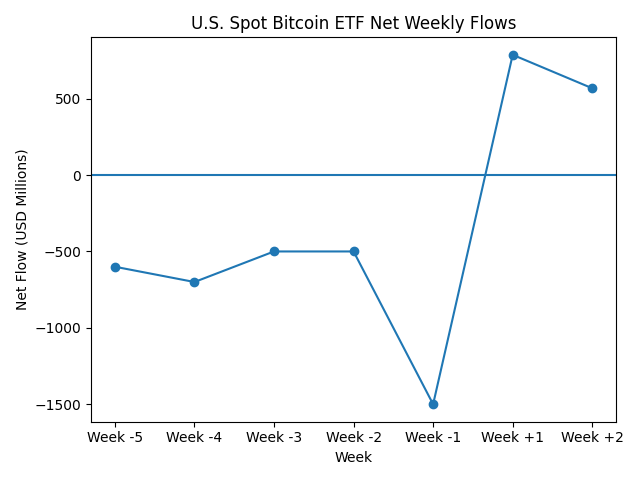
Graph concept:
- X-axis: Weeks
- Y-axis: Net inflows/outflows ($)
- Highlight recent two positive weeks after five negative weeks.
Daily Flow Volatility Reflects Market Uncertainty
Mixed Investor Behavior Throughout the Week
Although the weekly totals ended in positive territory, daily flows revealed significant volatility in investor sentiment.
At the beginning of the week, ETF inflows were strong:
- Monday: $458 million inflow
- Tuesday: $225 million inflow
- Wednesday: $462 million inflow
These inflows suggested that investors were once again positioning themselves for exposure to Bitcoin through regulated financial instruments.
However, sentiment shifted later in the week:
- Thursday: $227 million outflow
- Friday: $348 million outflow
This pattern indicates that while institutional investors are still interested in Bitcoin exposure, the market remains sensitive to short-term macroeconomic signals such as interest-rate expectations, inflation data, and broader risk-asset performance.
In other words, the inflows demonstrate renewed confidence, but the volatility highlights that the crypto market is still navigating a complex global financial environment.
Bitcoin ETFs vs Gold ETFs: A Historic Comparison
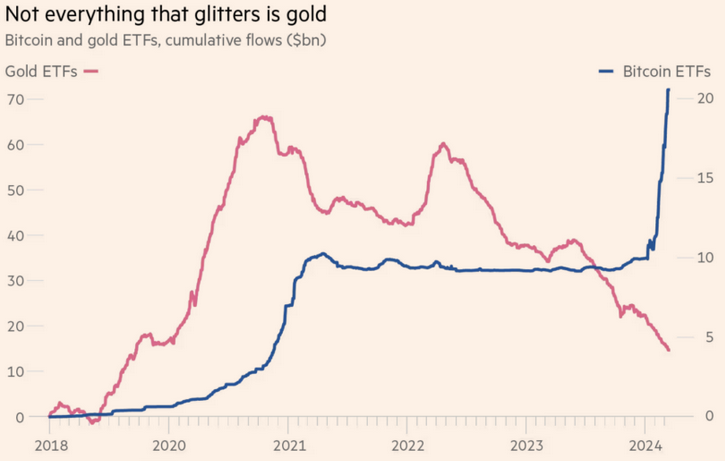
Matching Gold’s 15-Year Inflows in Less Than Two Years
One of the most striking developments in the Bitcoin ETF market was highlighted by Fernando Nikolić, marketing director at Blockstream.
In a recent analysis, he pointed out that spot Bitcoin ETFs have accumulated inflows comparable to those of gold ETFs over a 15-year period — in less than two years since their launch.
This comparison is remarkable because gold ETFs have historically been one of the most successful financial products ever introduced to institutional markets. When the first gold ETF launched in 2004, it opened the door for large-scale institutional investment into gold as a financial asset.
Yet Bitcoin ETFs have managed to reach similar levels of investor capital in a dramatically shorter timeframe.
Several factors explain this acceleration:
- Digital asset infrastructure has matured, making Bitcoin more accessible.
- Institutional custodians and compliance frameworks have improved.
- Global macro uncertainty has increased demand for alternative assets.
Even more notable is that this milestone occurred despite a period of weak market performance.
During the same timeframe, Bitcoin experienced a 46% price decline, along with several months of subdued trading activity.
Despite these headwinds, institutional demand has remained robust.
Institutional Demand Remains Strong Despite Market Corrections
The Persistence of Bitcoin as a Strategic Asset
Historically, major corrections in Bitcoin markets often trigger fears that institutional interest may fade. However, the ETF data suggests the opposite.
Even during periods of declining prices, institutional investors appear to view Bitcoin as a long-term strategic allocation rather than a speculative short-term trade.
Large asset managers such as BlackRock, Fidelity, and Ark Invest have continued to promote Bitcoin ETFs as portfolio diversification tools.
Institutional investors are increasingly framing Bitcoin within the broader context of macro hedging, particularly against:
- Currency debasement
- Inflation risks
- Geopolitical instability
In this sense, Bitcoin is gradually entering the same category as traditional safe-haven assets.
Is Bitcoin Really “Digital Gold”?
A Debate That May No Longer Matter
For years, analysts have debated whether Bitcoin should be considered “digital gold.”
According to Nikolić, that discussion may already be outdated.
He argues that Bitcoin is not trying to imitate gold — instead, Bitcoin is reshaping the concept of store-of-value assets entirely.
His remark summarized the idea succinctly:
“The debate about whether Bitcoin is digital gold is meaningless. Bitcoin is not trying to become gold. Bitcoin is making gold look slow.”
This statement reflects a broader shift in investor thinking.
Gold historically served as the primary hedge against monetary instability. However, Bitcoin offers several advantages:
- Portability: Bitcoin can be transferred globally within minutes.
- Scarcity: The supply cap of 21 million coins is mathematically enforced.
- Transparency: The blockchain provides full auditability.
- Liquidity: Global trading operates 24/7.
These characteristics make Bitcoin particularly attractive in a digital financial system.
The Broader Crypto Market Context
ETF Momentum Could Influence the Entire Crypto Ecosystem
The performance of Bitcoin ETFs has implications beyond Bitcoin itself.
Historically, institutional inflows into Bitcoin tend to create ripple effects across the broader cryptocurrency market.
Several trends are already emerging:
1. Expansion of Crypto ETF Products
After Bitcoin ETFs were approved, attention quickly turned to Ethereum ETFs and other digital asset funds.
Asset managers are exploring ETFs tied to:
- Ethereum
- Solana
- Basket-style crypto indexes
2. Institutional Infrastructure Development
Banks and financial institutions are expanding services such as:
- crypto custody
- institutional trading desks
- tokenized asset platforms
3. Increased Corporate Treasury Adoption
Companies are beginning to consider Bitcoin as a treasury reserve asset, following examples set by firms like MicroStrategy.
Implications for Investors Seeking the Next Opportunity
For investors looking for the next major crypto opportunity, the ETF inflow data provides several insights.
First, institutional capital is clearly not leaving the market. Instead, it is cycling through phases of accumulation and consolidation.
Second, the ETF ecosystem itself may become a powerful driver of future crypto adoption. As regulated investment products expand, more traditional investors gain exposure to digital assets.
Third, the growth of ETFs reinforces Bitcoin’s role as the gateway asset of the cryptocurrency market.
Historically, capital entering Bitcoin often later flows into:
- Ethereum
- Layer-1 blockchain ecosystems
- decentralized finance platforms
- emerging altcoins
For those exploring new crypto projects, understanding where institutional capital is entering the market can provide valuable signals.
Conclusion: A New Phase of Institutional Bitcoin Adoption
The recent two-week streak of net inflows into U.S. spot Bitcoin ETFs marks an important turning point for the cryptocurrency market.
After several weeks of heavy withdrawals, investors are once again allocating capital into Bitcoin through regulated financial vehicles. The shift suggests that institutional demand remains resilient even during periods of price volatility.
Perhaps the most remarkable aspect of the current trend is the speed at which Bitcoin ETFs have grown. Achieving capital inflows comparable to gold ETFs in less than two years underscores the rapid institutionalization of digital assets.
While short-term market fluctuations will likely continue, the broader trajectory appears clear: Bitcoin is increasingly becoming integrated into global financial portfolios.
For investors and builders within the blockchain ecosystem, this trend signals a fundamental transformation. Digital assets are no longer merely experimental technologies — they are evolving into core components of the modern financial system.
