
Main Points :
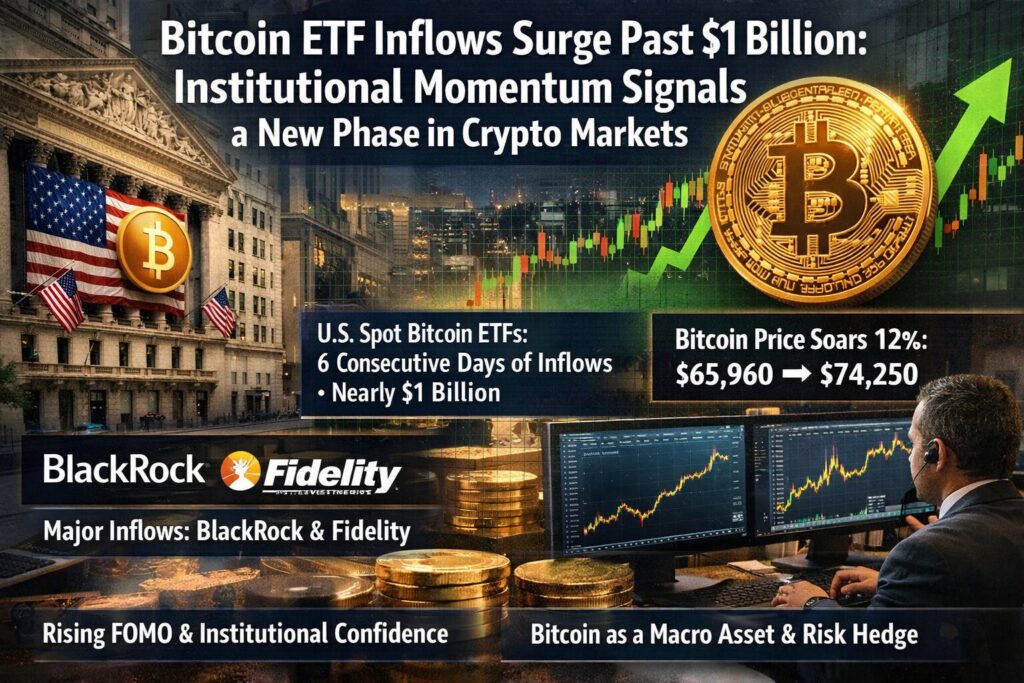
- U.S. spot Bitcoin ETFs recorded 6 consecutive days of inflows, totaling nearly $1 billion
- Bitcoin price surged over 12%, from $65,960 to $74,250
- Major inflows driven by BlackRock (IBIT) and Fidelity
- Market momentum linked to geopolitical uncertainty and macro hedging behavior
- Rising FOMO and improving sentiment indicators suggest renewed institutional confidence
- Signals a broader shift toward Bitcoin as a macro asset and risk hedge
1. ETF Inflows and Price Rally: A Strong Institutional Signal
The U.S. spot Bitcoin ETF market has once again captured the attention of both institutional and retail investors. Over a six-day consecutive trading period, these ETFs recorded sustained inflows, marking the longest streak since October of the previous year. During this period, nearly $1 billion ($962.8 million) flowed into Bitcoin ETFs, reflecting a significant increase in institutional participation.
This surge in capital coincided with a sharp rise in Bitcoin’s price. The asset climbed from approximately $65,960 to $74,250, representing a gain of over 12.5%. Such synchronized movement between ETF inflows and price appreciation suggests a reinforcing feedback loop: as institutional demand increases, prices rise, which in turn attracts more inflows.
On a single day alone, net inflows reached $199.4 million, with BlackRock’s iShares Bitcoin Trust (IBIT) contributing $139.4 million and Fidelity’s Wise Origin Bitcoin Fund adding $64.5 million. These two players continue to dominate ETF flows, highlighting the importance of traditional financial institutions in shaping the crypto market.
Bitcoin Price vs ETF Net Inflows (March Period)
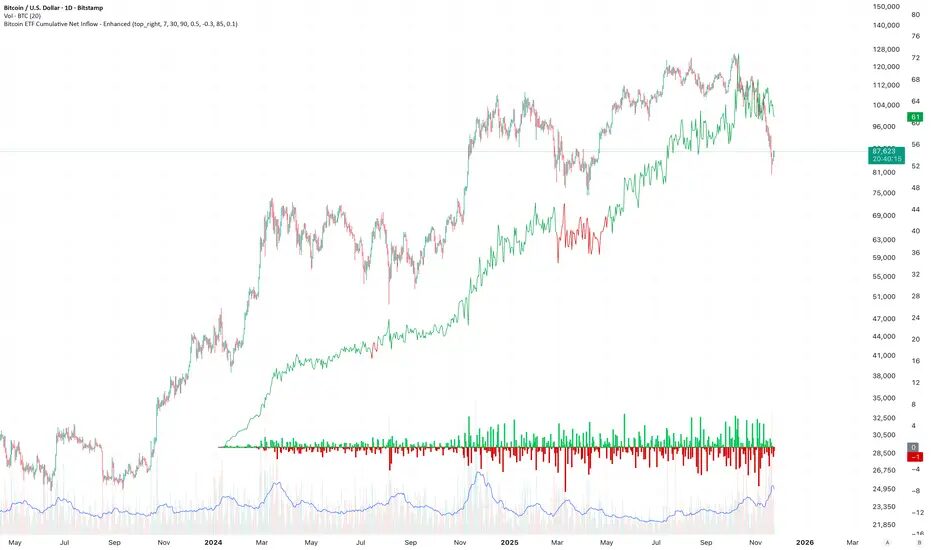
Description: Line chart showing BTC price (left axis) and ETF inflows (right axis), illustrating correlation.
2. Market Structure: Why ETFs Are Changing Bitcoin’s Role
The introduction of spot Bitcoin ETFs has fundamentally altered the structure of the crypto market. Previously, access to Bitcoin required direct custody, exchange accounts, or complex financial instruments. Now, ETFs provide a regulated, familiar vehicle for institutional capital.
This shift has several important implications:
- Lower barriers to entry for institutional investors
- Improved liquidity and price discovery
- Integration of Bitcoin into traditional portfolio allocation models
Unlike previous crypto cycles dominated by retail speculation, the current trend suggests a more mature market driven by asset managers, hedge funds, and even pension-related capital.
BlackRock’s dominance is particularly noteworthy. As the world’s largest asset manager, its continued inflows signal confidence not just in Bitcoin as a speculative asset, but as a long-term store of value.
3. Geopolitical Risk and Bitcoin as a Hedge
Interestingly, the recent rally has unfolded against a backdrop of heightened geopolitical uncertainty, including tensions involving the United States, Iran, and Israel, as well as volatility in oil markets.
Historically, Bitcoin has been debated as either a “risk-on” asset (like equities) or a “risk-off” hedge (like gold). The current situation suggests that Bitcoin may be evolving into a hybrid macro asset.
Investors appear to be reallocating capital into Bitcoin as a hedge against:
- Currency instability
- Energy market volatility
- Escalating geopolitical tensions
This aligns with a broader trend where Bitcoin is increasingly compared to gold—not just as a store of value, but as a borderless, digital hedge against systemic risk.
Bitcoin vs Gold Performance During Geopolitical Events
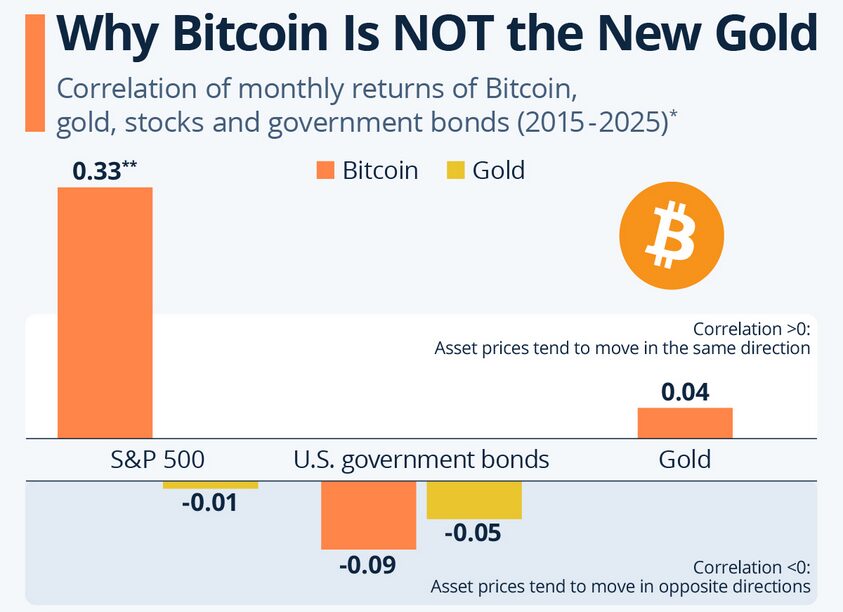
Description: Comparative performance chart showing BTC and gold price movements during recent geopolitical tensions.
4. Sentiment Shift: From Extreme Fear to Renewed Optimism
Market sentiment indicators also support the bullish narrative. The Crypto Fear & Greed Index rose to 28, moving out of the “extreme fear” zone for the first time since late January.
Meanwhile, blockchain analytics platform Santiment reported a surge in FOMO (Fear of Missing Out), reaching its highest level since early January.
This shift in sentiment is critical. Markets often move not just on fundamentals, but on perception and psychology. When investors begin to believe that a trend is sustainable, capital inflows can accelerate rapidly.
Santiment noted that traders are increasingly viewing crypto as a sector with strong upside potential over the coming weeks and months—even amid ongoing global uncertainty.
5. Comparing with Previous Inflow Cycles
The current inflow streak, while significant, is still smaller than the previous major cycle observed between September and October 2025, when ETFs recorded 9 consecutive days of inflows totaling approximately $6 billion.
During that earlier period, Bitcoin reached its all-time high of approximately $126,080.
This comparison raises an important question:
Are we witnessing the early stages of another major bull cycle?
There are several differences this time:
- More stable institutional participation
- Greater regulatory clarity
- Increased integration with traditional finance
These factors suggest that the current cycle may be more sustainable, albeit potentially slower and more structured.
6. Implications for Investors and Builders
For readers interested in new crypto assets, revenue opportunities, and practical blockchain applications, this trend offers several actionable insights.
a. Institutional Flow Tracking as Alpha
ETF inflows are becoming a critical indicator of market direction. Monitoring these flows can provide early signals of trend reversals or accelerations.
b. Rotation into Altcoins
Historically, strong Bitcoin rallies are often followed by capital rotation into altcoins. This creates opportunities in:
- Layer 1 and Layer 2 ecosystems
- DeFi protocols
- AI + blockchain integrations
c. Infrastructure Opportunities
As institutional adoption grows, demand for infrastructure increases:
- Custody solutions
- Compliance tools (KYT, Travel Rule)
- Liquidity aggregation systems
This aligns closely with real-world blockchain applications, particularly in regulated environments like EMI and VASP operations.
Capital Flow Cycle (BTC → ETH → Altcoins)
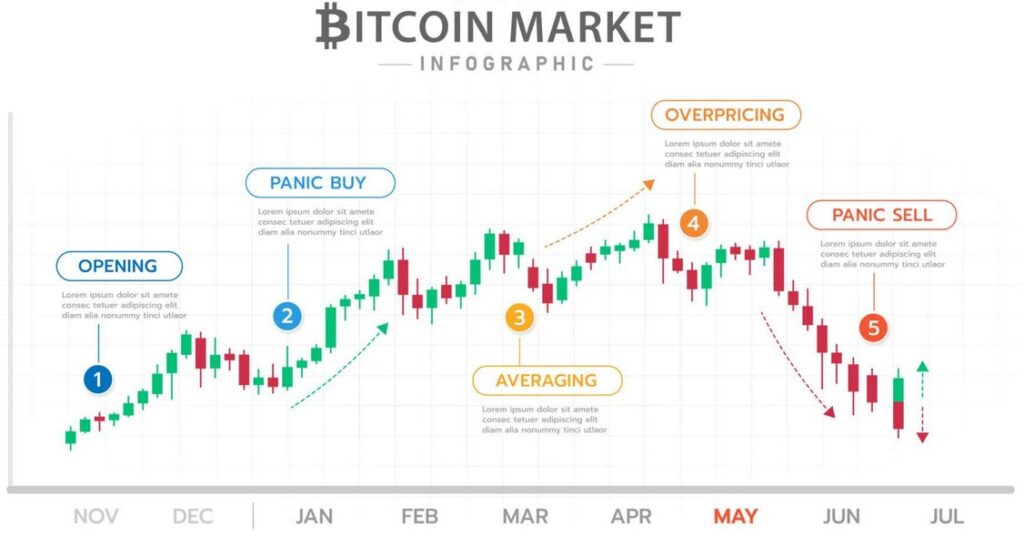
Description: Flow diagram showing typical capital rotation cycle in crypto markets.
7. The Bigger Picture: Bitcoin as a Financial Primitive
Ultimately, the significance of this ETF inflow trend extends beyond short-term price movements.
Bitcoin is increasingly being treated as a financial primitive—a foundational asset within the global financial system. Its role is expanding from:
- Speculative asset
→ Store of value
→ Macro hedge
→ Portfolio allocation component
This transformation is being driven not by retail hype, but by institutional frameworks, regulatory integration, and macroeconomic necessity.
Conclusion
The recent surge in Bitcoin ETF inflows, totaling nearly $1 billion, combined with a 12%+ price increase, marks a critical moment in the evolution of the crypto market.
While geopolitical uncertainty and market volatility continue to shape investor behavior, Bitcoin is emerging as a resilient asset that benefits from both risk-on and risk-off dynamics.
For investors and builders alike, the key takeaway is clear:
the crypto market is entering a new phase—one defined by institutional capital, macro relevance, and structural maturity.
The question is no longer whether Bitcoin will be adopted, but how deeply it will integrate into the global financial system—and how early participants can position themselves to benefit from that transition.
