

Key Takeaways :
- Bitcoin spot ETFs recorded $1.42 billion in net inflows in a single week, marking the strongest performance since early October.
- Inflows were heavily concentrated mid-week, suggesting intentional institutional allocation rather than retail speculation.
- Ethereum ETFs also saw inflows, but momentum weakened toward the end of the week, highlighting a divergence between BTC and ETH demand.
- Declining whale selling pressure combined with ETF absorption is tightening effective Bitcoin supply.
- Macro analysts caution that short-term ETF inflows alone are insufficient to sustain a long-term bull trend without continued accumulation.
1. A Sudden Revival in Bitcoin ETF Momentum
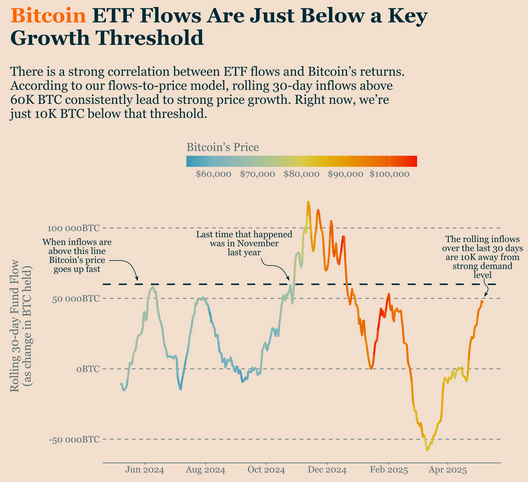
Bitcoin spot exchange-traded funds (ETFs) experienced a dramatic resurgence in capital inflows, posting $1.42 billion in net weekly inflows, the strongest weekly performance since early October. This reversal comes after several weeks of muted or negative flows, signaling a potential shift in institutional sentiment toward Bitcoin.
According to data from SoSoValue, inflows were not evenly distributed across the week. Instead, they were sharply concentrated in the middle of the week, with Wednesday alone recording approximately $844 million in net inflows, the largest single-day inflow in recent months. Tuesday followed closely with $754 million, reinforcing the view that large investors were deliberately re-entering the market rather than reacting impulsively to short-term price movements.
Although Friday saw an outflow of roughly $395 million, the magnitude of mid-week buying outweighed late-week profit-taking, resulting in a robust net positive weekly total. Historically, such patterns often reflect portfolio rebalancing decisions by institutions, rather than speculative retail activity.
2. Ethereum ETFs: Strong Start, Weak Finish
Ethereum spot ETFs also recorded notable inflows earlier in the week, though the overall picture was less decisive. On Tuesday, Ethereum ETFs attracted approximately $290 million, followed by $215 million on Wednesday. However, unlike Bitcoin, Ethereum ETFs failed to sustain momentum.
By Friday, Ethereum ETFs experienced outflows of around $180 million, bringing total net weekly inflows down to approximately $479 million. This contrast underscores a growing divergence in institutional behavior: while Bitcoin is increasingly viewed as a macro hedge and reserve-style asset, Ethereum remains more closely tied to application-layer growth expectations, which are currently facing uncertainty due to fee compression, L2 competition, and evolving token economics.
3. Institutional Capital Returns Amid Supply Tightening
Vincent Liu, Chief Investment Officer at Kronos Research, interprets the renewed ETF inflows as an early sign that long-only institutional investors are cautiously returning to the market. Speaking to Cointelegraph, Liu emphasized that ETF inflows represent capital entering Bitcoin through regulated, compliant channels, which tend to be stickier and less speculative than offshore derivatives trading.
He noted that if ETF absorption continues while whale selling pressure stabilizes, the effective circulating supply of Bitcoin tightens, creating conditions more conducive to a risk-on environment. This dynamic is particularly important in a post-halving context, where new supply issuance is already structurally constrained.
Weekly and Daily Bitcoin ETF Inflows (USD)
4. Whale Behavior: Distribution Pressure Is Easing
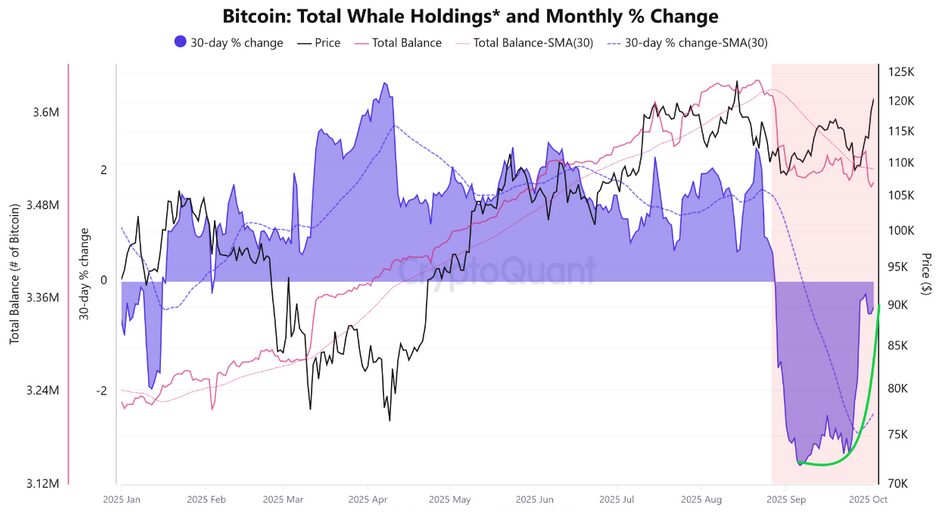
On-chain data further supports the narrative of tightening supply. Large Bitcoin holders—commonly referred to as “whales”—have reduced net selling activity compared to late December levels. While whales are not yet aggressively accumulating, the slowdown in distribution has materially reduced one of the market’s primary sources of sell-side pressure.
This shift is critical. When ETF inflows coincide with heavy whale selling, the market often remains range-bound. However, when whale selling subsides while ETFs continue to accumulate, price dips are more likely to be absorbed, leading to higher lows over time.
Declining Whale Selling Pressure and Supply Absorption
Liu cautions that this is not yet a confirmed regime change. Rather, it represents an early-stage transition that requires sustained confirmation through continued ETF inflows, improving market structure, and stable macro conditions.
5. Why Short-Term ETF Inflows Are Not Enough
Despite the optimism, not all analysts are convinced that the recent surge guarantees a sustained uptrend. The Bitcoin macro analysis newsletter Econometrics argues that short-term spikes in ETF inflows tend to produce temporary price rebounds, rather than durable bull markets.
Historically, when ETF inflows slow or reverse after a brief surge, Bitcoin prices often retrace gains. From a cumulative perspective, total ETF flows remain deeply negative relative to earlier peaks, suggesting that one strong week does not erase months of net outflows.
According to the newsletter, a genuine trend reversal requires multiple consecutive weeks of strong ETF demand, indicating structural rather than opportunistic allocation. Without this persistence, ETF inflows may stabilize prices temporarily but fail to establish a long-term upward trajectory.
6. Implications for Investors Seeking New Crypto Opportunities
For investors searching for new crypto assets or alternative revenue streams, the current environment offers several important lessons:
First, Bitcoin is increasingly behaving as a financial instrument integrated into traditional capital markets, rather than a purely speculative digital asset. ETF flows, institutional allocation models, and macro positioning now play a dominant role in price discovery.
Second, Ethereum’s comparatively weaker ETF performance suggests that not all major cryptocurrencies benefit equally from institutional channels. Investors focused on yield generation, infrastructure plays, or application-level growth may need to look beyond ETFs to capture Ethereum-centric opportunities, such as staking, restaking, or Layer-2 ecosystems.
Third, supply dynamics matter more than ever. In a market where new issuance is limited and large holders are selling less, incremental demand has an outsized impact, especially when it comes from regulated, long-only capital.
7. Strategic Outlook: What Comes Next
Looking ahead, the sustainability of this rally hinges on three key factors:
- Persistence of ETF inflows over several consecutive weeks.
- Continued moderation in whale selling behavior, confirming reduced distribution.
- Macro stability, particularly interest rate expectations and risk appetite across global markets.
If these elements align, Bitcoin could transition from episodic rallies to a more structurally supported uptrend. Conversely, if ETF inflows fade quickly, recent gains may prove fragile.
Conclusion
The recent $1.42 billion weekly inflow into Bitcoin ETFs marks a meaningful shift in short-term market dynamics and suggests that institutional investors are once again testing the waters. Combined with easing whale selling pressure, this has created a temporary environment of supply tightness that favors upward price movement.
However, history and macro analysis caution against overconfidence. Without sustained ETF demand and broader structural confirmation, short-term inflows alone are unlikely to support a long-lasting bull market.
For market participants interested in practical blockchain applications, new crypto assets, and next-generation revenue models, the message is clear: Bitcoin is entering a more institutionalized phase, where patience, flow analysis, and supply dynamics matter as much as narrative and innovation.
