

Main Takeaways :
- Bitcoin is in a late-stage bear market consolidation phase, where downside momentum is clearly decelerating.
- Realized losses driven by newly emerged whales have peaked, while short-term holder capitulation is no longer accelerating.
- Demand remains weak; the critical question is no longer renewed selling, but which cohort will begin accumulating first.
- Structural signals suggest a potential transition phase rather than an imminent trend reversal.
1. Market Context: A Bear Market in Its Late Adjustment Phase
As of late December 2025, Bitcoin (BTC) is best understood as being in the late-stage adjustment and stagnation phase of a bear market. While the broader directional bias remains weak, the character of the market has changed materially. Selling pressure is no longer intensifying in a one-directional cascade, but instead appears to be losing momentum.
Historically, Bitcoin’s most severe drawdowns are characterized by violent and accelerating sell-offs, driven by forced liquidations, cascading margin calls, and synchronized panic across holders. The current environment differs. Volatility has compressed, realized losses are declining, and price action has entered a range-bound equilibrium.
This shift does not signal the start of a new bull market. Rather, it suggests the market is transitioning from capitulation to assessment—a phase where participants pause, re-evaluate risk, and selectively position for the next cycle.
2. Structural Oversold Conditions: Rare but Meaningful
From a long-term historical perspective, Bitcoin has only entered a deeply oversold structural zone approximately six times. These episodes typically coincide with macro stress events or endogenous crypto shocks.
The recent decline from $124,000 to $84,000 fits the profile of such rare episodes. On-chain data indicates that this move was not driven primarily by legacy long-term holders, but by newly formed whale entities—large holders that accumulated during the late bull market and subsequently realized losses as prices reversed.
“Bitcoin Realized Losses by New Whale Cohorts”
(Bitcoin on-chain realized loss new whales chart)
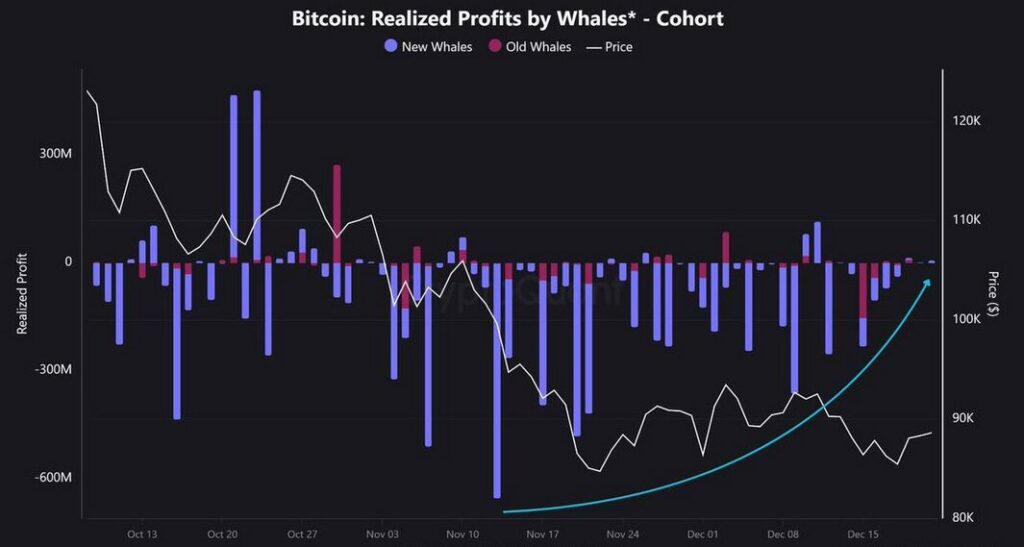
Crucially, realized losses attributed to these new whales have now peaked and flattened, suggesting that the bulk of forced or panic-driven selling has already occurred. This is a classic sign that the capitulation phase may be complete, even if prices remain depressed.
3. Short-Term Holders: Capitulation Without Acceleration
Another key indicator is the Short-Term Holder Spent Output Profit Ratio (STH-SOPR). This metric remains below 1.0, confirming that short-term holders are still realizing losses. However, the rate of deterioration has slowed significantly.
In previous bear market troughs, SOPR often collapses sharply below 1.0 and remains there while losses accelerate. In contrast, the current reading suggests loss-taking is ongoing but no longer intensifying.
This implies:
- The most reactive participants have already exited.
- Remaining short-term holders are either unwilling or unable to sell further at current prices.
- Supply-side pressure is temporarily exhausted.
From a market microstructure perspective, this creates a liquidity vacuum, where prices drift sideways until a new demand impulse emerges.
4. Sentiment: Fear Without Panic
Market sentiment indices currently sit around 29, firmly in the “Fear” zone. Importantly, this represents fear without panic, a subtle but critical distinction.
During true market bottoms, sentiment often collapses into extreme fear or despair, accompanied by:
- High volatility spikes
- Exchange inflow surges
- Social disengagement
Today’s environment shows none of these extremes. Fear has stabilized rather than worsened, reinforcing the interpretation that the market is digesting losses rather than experiencing fresh trauma.
5. Wallet Distribution: Redistribution, Not Capitulation
One of the more nuanced developments is in wallet distribution data. The number of wallets holding 1 BTC or more has declined modestly. At first glance, this appears bearish.
However, a deeper analysis reveals that larger holding cohorts are increasing their aggregate balances, suggesting that Bitcoin is being reallocated from smaller holders to more capitalized entities.
“Bitcoin Supply Distribution by Wallet Size”
(Bitcoin wallet distribution by balance chart)
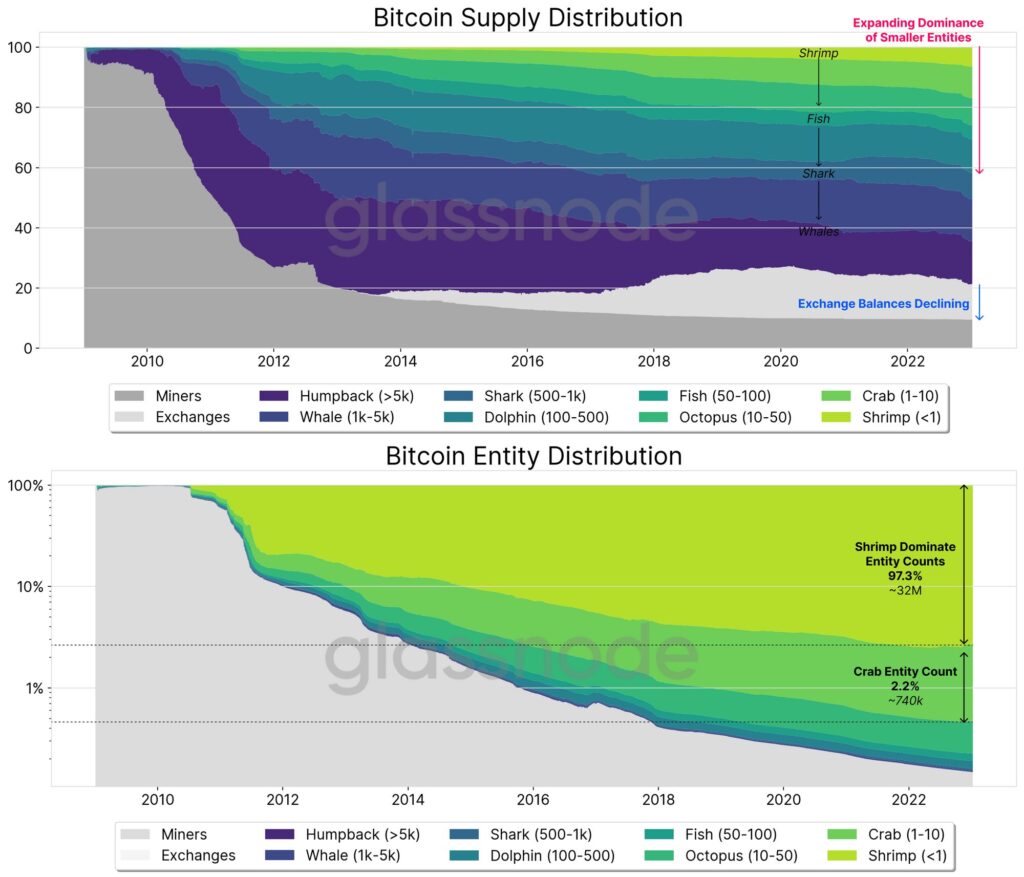
This pattern is historically consistent with late bear market phases, where informed or well-capitalized participants quietly accumulate while retail participation remains subdued.
6. Demand Remains the Missing Ingredient
Despite signs that selling pressure is fading, demand remains weak. There is no meaningful resurgence in:
- Spot inflows
- On-chain transaction growth
- Retail participation metrics
This absence of demand explains why prices have not rebounded sharply. Importantly, however, lack of demand is not the same as excess supply. In late-stage bear markets, supply exhaustion typically precedes demand recovery.
The market is therefore not asking, “Who is selling next?” but rather, “Who will step in to buy first?”
7. Who Are the Potential Accumulators?
Several cohorts could plausibly emerge as the next buyers:
- Mid-sized institutions seeking strategic exposure after drawdowns
- Crypto-native funds rotating from yield strategies back into spot BTC
- High-net-worth individuals responding to long-term valuation metrics
- Treasury allocators hedging currency debasement risk
Notably absent—for now—are retail-driven speculative flows. Historically, retail demand tends to arrive after early accumulation phases, not before.
8. Counter-Scenario: Risks of Prolonged Stagnation
A cautious view remains warranted. If:
- Short-term holder losses re-accelerate, and
- Demand indicators continue to deteriorate,
the consolidation phase could extend for months, resembling previous long basing structures seen in 2015 and 2019.
Such environments are psychologically taxing, often shaking out impatient participants without dramatic price declines. From a strategic standpoint, this favors capital discipline over aggressive positioning.
9. Strategic Implications for Investors and Builders
For investors seeking new crypto assets or yield opportunities, this environment rewards:
- Patience
- On-chain literacy
- Focus on balance sheet strength and survivability
For builders and operators, particularly those interested in practical blockchain applications, periods like this often provide:
- Lower development costs
- Reduced speculative noise
- Higher-quality partnerships
Late bear markets historically incubate the infrastructure that powers the next expansion phase.
10. Conclusion: A Market Waiting for Its Next Conviction
Bitcoin is no longer in free fall. Selling pressure has eased, capitulation appears largely complete, and structural indicators suggest exhaustion rather than renewed collapse.
Yet recovery is not automatic. The market is suspended in a decision-making phase, awaiting the return of conviction from a new class of buyers.
The defining question of the coming months is not whether Bitcoin will fall further—but who will have the courage, capital, and time horizon to accumulate before demand becomes obvious again.
