
Main Points :
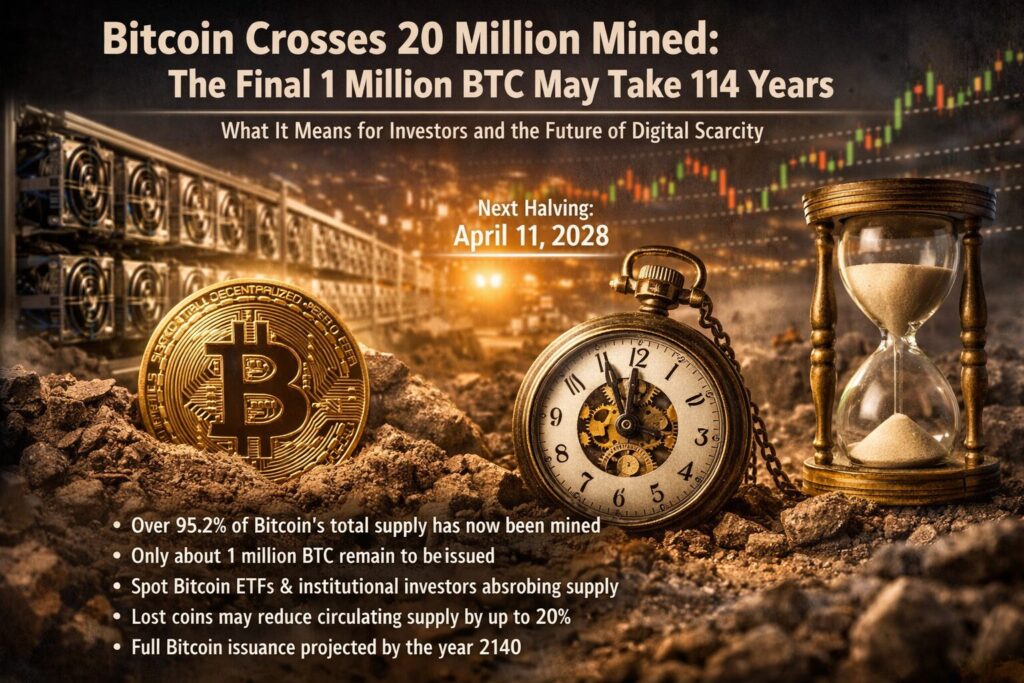
- Over 95.2% of Bitcoin’s total supply has now been mined
- Only about 1 million BTC remain to be issued
- The next Bitcoin halving is expected around April 11, 2028
- Spot Bitcoin ETFs and institutional investors continue absorbing supply
- Lost coins may reduce the real circulating supply by up to 20%
- Full Bitcoin issuance is projected to complete around the year 2140
1. Bitcoin Surpasses 20 Million Mined — A Historic Milestone
Bitcoin has crossed one of the most significant supply milestones in its history: more than 20 million BTC have now been mined, representing over 95.2% of the maximum supply of 21 million coins.
This milestone occurred approximately 17 years and two months after the Bitcoin genesis block was mined in January 2009. According to on-chain blockchain data, the event took place at block height 939,999.
The block that pushed Bitcoin beyond the 20 million mark was mined by Foundry USA, currently the largest Bitcoin mining pool in the United States. Mempool blockchain data confirmed the milestone, showing the circulating supply reaching 20,000,018.75 BTC.
With fewer than 1 million BTC left to be mined, Bitcoin’s monetary policy is entering a new phase — one defined by increasing scarcity and structural supply compression.
For investors, traders, and developers building on blockchain infrastructure, this milestone highlights Bitcoin’s role as the first fully predictable monetary system in history.
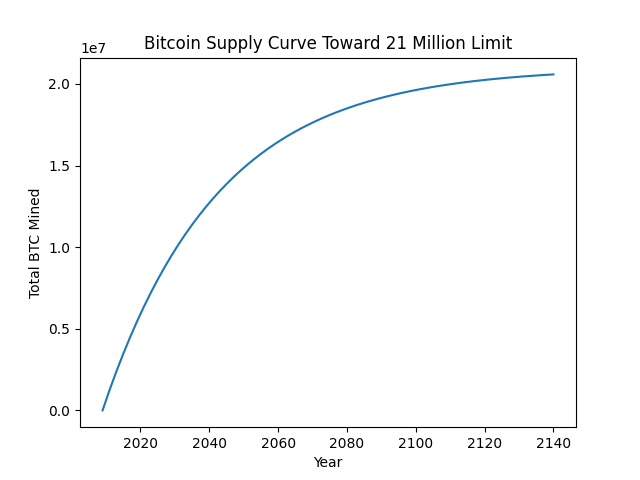
Graph showing:
- X-axis: Year (2009 → 2140)
- Y-axis: BTC supply
- Curve flattening over time
- Markers:
- Genesis block (2009)
- 20M BTC milestone (2026)
- Final supply (2140)
2. The Halving Mechanism: Bitcoin’s Engine of Scarcity
Bitcoin’s issuance schedule follows a strict protocol designed by its pseudonymous creator Satoshi Nakamoto.
At launch in 2009, each mined block rewarded miners with 50 BTC. However, the protocol includes a built-in rule: the reward is cut in half approximately every 210,000 blocks, or roughly every four years.
This mechanism is known as the Bitcoin halving.
Historical Halvings
| Halving | Year | Block Reward |
|---|---|---|
| 1st | 2012 | 50 → 25 BTC |
| 2nd | 2016 | 25 → 12.5 BTC |
| 3rd | 2020 | 12.5 → 6.25 BTC |
| 4th | 2024 | 6.25 → 3.125 BTC |
| 5th (expected) | 2028 | 3.125 → 1.5625 BTC |
The most recent halving occurred April 20, 2024, reducing block rewards from 6.25 BTC to 3.125 BTC.
As a result, the number of newly issued bitcoins per day fell from roughly:
- 900 BTC/day → 450 BTC/day
This mechanism ensures that Bitcoin’s supply growth declines exponentially over time.
For comparison, most fiat currencies expand their supply indefinitely, while Bitcoin is mathematically capped.
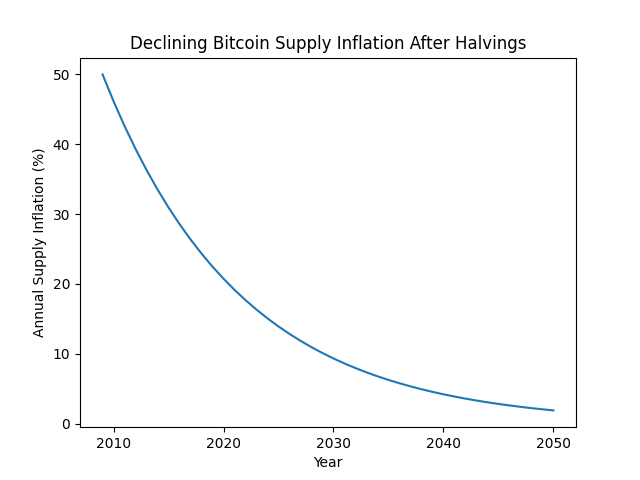
Graph:
- X-axis: Year
- Y-axis: Annual supply inflation
- Declining curve from ~50% (early years) to near 0% (after 2040)
3. Why the Final 1 Million BTC Will Take 114 Years
While Bitcoin took only 17 years to reach 20 million coins, mining the last 1 million BTC will take over a century.
This occurs because each halving dramatically reduces issuance.
Example progression:
| Period | Reward | Estimated BTC Issued |
|---|---|---|
| 2024–2028 | 3.125 BTC | ~656,000 BTC |
| 2028–2032 | 1.5625 BTC | ~328,000 BTC |
| 2032–2036 | 0.78125 BTC | ~164,000 BTC |
The reward continues halving until it becomes negligible.
By approximately 2140, the final fraction of Bitcoin will be mined.
At that point:
- Mining revenue will rely almost entirely on transaction fees rather than block rewards.
- Bitcoin will operate as a fully supply-fixed monetary system.
4. Institutional Demand Is Absorbing Bitcoin Supply
While supply growth slows, demand from institutions has accelerated dramatically.
A major driver has been the launch of spot Bitcoin ETFs in major financial markets.
Current estimates show:
- Spot ETFs hold about 6.3% of all mined Bitcoin
- Estimated value: approximately $86 billion
These ETFs allow traditional investors — including pension funds, hedge funds, and family offices — to gain exposure to Bitcoin without managing private keys.
Institutional accumulation is creating a new market dynamic where large financial entities steadily absorb available supply.
This phenomenon is sometimes referred to as “structural demand”.
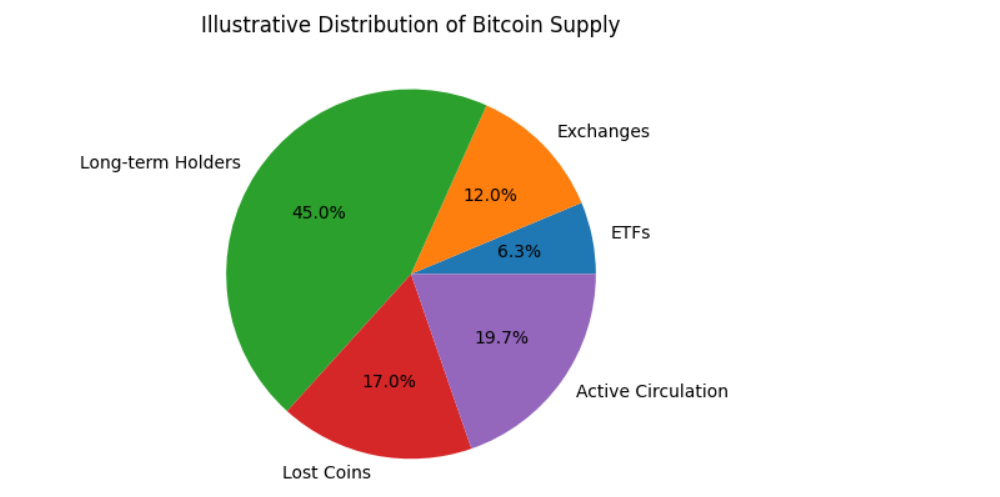
Pie chart showing:
- ETFs: 6.3%
- Exchanges: ~12%
- Long-term holders
- Lost coins
- Active circulation
5. Exchange Balances Continue to Decline
At the same time institutional demand grows, Bitcoin held on exchanges is shrinking.
Current on-chain estimates show that exchange wallets hold roughly:
2.4 million BTC
This is significantly lower than historical peaks.
Lower exchange balances suggest:
- More users are holding BTC in self-custody wallets
- Long-term holding behavior is increasing
- Immediate liquid supply is decreasing
This dynamic can contribute to stronger price volatility when demand surges.
6. The Hidden Supply Shock: Lost Bitcoin
One of the most fascinating aspects of Bitcoin’s economics is the number of coins that may be permanently lost.
Estimates suggest that 3 million to 4 million BTC may never be recoverable due to:
- Lost private keys
- Discarded hard drives
- Early wallets abandoned
- Deceased holders without key recovery
If accurate, the effective circulating supply could be closer to:
17 million BTC or less
This means Bitcoin may be far scarcer than its theoretical 21 million cap suggests.
Even the estimated 1 million BTC owned by Satoshi Nakamoto have never moved, reinforcing the perception of long-term scarcity.
7. The Next Halving in 2028
The next Bitcoin halving is expected around April 11, 2028.
At that time:
- Block reward will drop from 3.125 BTC → 1.5625 BTC
- Daily issuance will fall again by roughly 50%
Historically, halvings have preceded major market cycles:
| Halving | Major Bull Cycle |
|---|---|
| 2012 | 2013 bull market |
| 2016 | 2017 crypto boom |
| 2020 | 2021 institutional rally |
Whether the same pattern repeats remains uncertain, but supply compression is expected to intensify.
8. Bitcoin as a Global Scarcity Asset
Bitcoin’s controlled supply has led many analysts to compare it to digital gold.
However, Bitcoin differs from gold in several key ways:
| Asset | Supply Predictability |
|---|---|
| Gold | Unknown future supply |
| Fiat currency | Unlimited |
| Bitcoin | Fixed 21 million |
Because the issuance schedule is transparent and immutable, Bitcoin represents a programmatic monetary system.
For investors searching for long-term stores of value or hedge assets, this property has become increasingly attractive.
9. Implications for Crypto Investors and Builders
For investors exploring the next generation of digital assets and blockchain opportunities, Bitcoin’s 20 million milestone highlights several trends:
Scarcity-Driven Value
As supply growth slows, scarcity dynamics may become stronger.
Infrastructure Growth
Institutional adoption is expanding financial infrastructure including:
- ETFs
- custodians
- derivatives markets
- payment networks
Layer-2 Ecosystem
Developments such as:
- Lightning Network
- Bitcoin sidechains
- tokenized assets on Bitcoin
are expanding its practical utility beyond simple value storage.
Conclusion: The Long Tail of Bitcoin’s Monetary Experiment
The mining of Bitcoin’s 20 millionth coin marks a historic milestone in the evolution of digital money.
More than 95% of all Bitcoin that will ever exist is already in circulation, yet the final portion of supply will unfold gradually over more than a century.
This slow emission schedule — combined with rising institutional demand, declining exchange balances, and permanently lost coins — is reinforcing Bitcoin’s role as one of the scarcest financial assets ever created.
For investors seeking new crypto opportunities, the implications are clear:
Bitcoin’s era of rapid supply growth is ending, and the market is entering a phase defined by extreme scarcity, long-term holding behavior, and institutional accumulation.
Whether used as digital gold, collateral for decentralized finance, or a foundation for new blockchain applications, Bitcoin’s economic design continues to reshape how the world thinks about money.
The final Bitcoin may not be mined until around the year 2140, but the economic effects of its scarcity are already unfolding today.
