
Main Points :
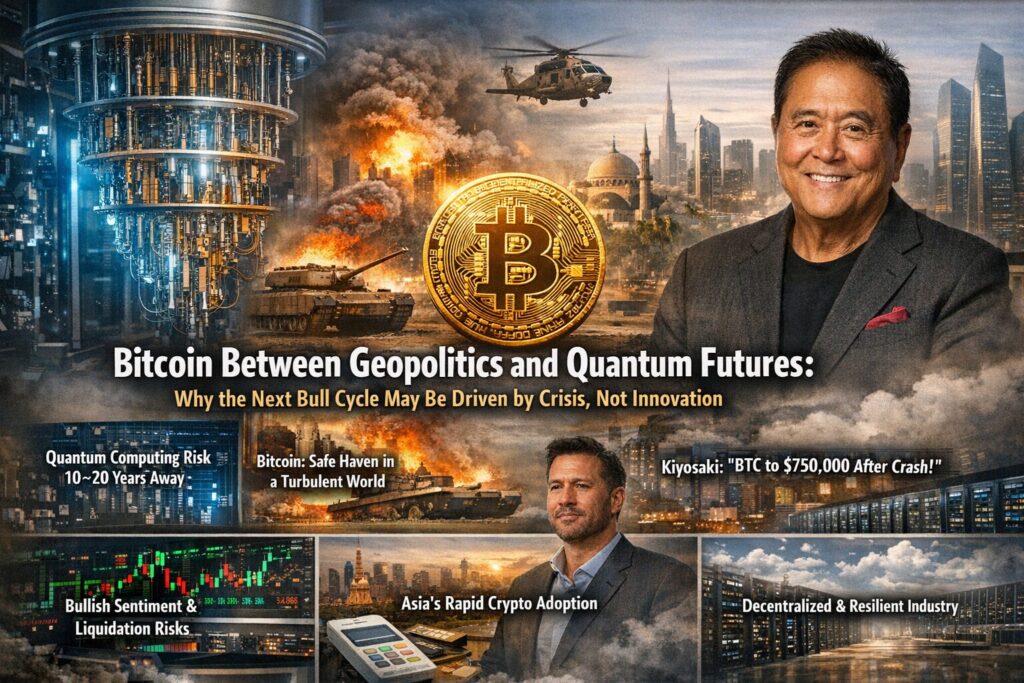
- Bitcoin’s quantum computing risk is real but likely 10–20 years away, giving time for protocol adaptation
- Macro instability—especially Middle East tensions—reinforces Bitcoin as a “stateless asset” hedge
- Influential voices like Robert Kiyosaki predict extreme upside (BTC → $750,000) after a market collapse
- Institutional and futures positioning show bullish sentiment but rising liquidation risks
- Asia is accelerating adoption via token listings, treasury strategies, and next-gen payment systems
- The crypto industry is increasingly resilient due to cloud-based, decentralized operations
1. The Quantum Threat: A Long-Term Risk, Not an Immediate Crisis
Recent analysis by Ark Invest and Unchained highlights one of the most discussed existential risks to Bitcoin: quantum computing. The concern is straightforward—if quantum computers become powerful enough, they could theoretically break the cryptographic algorithms securing Bitcoin wallets.
However, the report concludes that this threat is not imminent. Current quantum technology is still far from the computational capability required to compromise Bitcoin’s elliptic curve cryptography. The estimated timeline for such a risk ranges between 10 to 20 years, assuming exponential technological breakthroughs.
This timeline is critical. It provides developers, miners, and protocol contributors ample opportunity to implement quantum-resistant cryptography. Bitcoin has already demonstrated adaptability through upgrades such as SegWit and Taproot, suggesting that future cryptographic migrations are feasible—though politically complex.
From an investment standpoint, this reframes quantum risk from an existential threat into a long-term technical debt problem. For investors seeking yield opportunities, this means Bitcoin remains viable within current portfolio horizons.
2. Macro Chaos and Bitcoin’s Role as a “Stateless Asset”
Geopolitical instability has once again taken center stage, particularly with rising tensions in the Middle East. Ray Dalio’s warning about the strategic importance of the Strait of Hormuz underscores the fragility of global energy supply chains.
Dalio suggests that control over this narrow passage—through which a significant portion of the world’s oil flows—could determine the future balance of global power. A disruption would trigger cascading effects: oil price spikes, inflation surges, and capital flight.
In this environment, Bitcoin is increasingly viewed as a non-sovereign asset—one that is not tied to any government, currency, or central bank. This narrative has strengthened as Bitcoin rebounded toward $75,000, driven partly by fears of prolonged geopolitical instability.
Unlike gold, which is physically constrained, Bitcoin offers instant global transferability, making it particularly attractive during crises involving capital controls or sanctions.
Bitcoin Price vs Geopolitical Risk Events (2020–2026)
Suggested visualization:
- X-axis: Time
- Y-axis: BTC price ($)
- Overlay: Major geopolitical events (Ukraine war, Middle East conflict, oil shocks)
3. Extreme Bullish Forecasts: Signal or Speculation?
Robert Kiyosaki, author of Rich Dad Poor Dad, has issued one of the most aggressive forecasts in recent memory. He predicts that following an imminent market collapse, Bitcoin could reach $750,000, while Ethereum may hit $95,000.
Such predictions are not isolated. They reflect a broader narrative that the current global financial system—characterized by debt expansion and monetary easing—is approaching a breaking point.
Kiyosaki also forecasts gold at $35,000 and silver at $200, reinforcing the idea that hard assets will outperform fiat currencies in a crisis.
While these projections may appear extreme, they align with a growing institutional thesis: Bitcoin is not just a speculative asset but a monetary alternative. If global trust in fiat erodes significantly, capital could flow disproportionately into decentralized stores of value.
However, investors should approach such forecasts with caution. Price targets often serve more as sentiment indicators than actionable predictions.
4. Market Structure: Bullish Futures, Hidden Risks
On-chain analytics from CryptoQuant reveal that traders are increasingly building long positions in Bitcoin futures, indicating expectations of short-term price appreciation.
This bullish positioning has several implications:
- Increased leverage amplifies potential gains
- However, it also raises the risk of liquidation cascades
- Market volatility may spike if macro conditions shift unexpectedly
At the same time, Bitcoin experienced a temporary pullback to around $70,000, triggered by macroeconomic signals from the U.S. Federal Reserve. Chairman Jerome Powell noted rising inflation expectations due to oil price increases, dampening risk appetite.
This dynamic illustrates a key point: Bitcoin is increasingly influenced by macro liquidity cycles, not just crypto-native factors.
Bitcoin Futures Long/Short Ratio vs Price Movement
Suggested visualization:
- Line 1: BTC price
- Line 2: Long/Short ratio
- Highlight liquidation spikes
5. Asia’s Strategic Moves: Regulation, Expansion, and Innovation
Asia continues to play a pivotal role in shaping the future of crypto.
South Korea: Regulatory Pressure
The exchange Bithumb faces potential penalties exceeding $30 million for regulatory violations. This reflects tightening compliance requirements, similar to global trends under FATF frameworks.
Japan: Institutional Bitcoin Accumulation
Metaplanet announced plans to raise approximately $800 million to expand its Bitcoin treasury strategy, targeting holdings of up to 210,000 BTC. This mirrors strategies seen in companies like MicroStrategy.
Token Expansion: WILD Listing
GMO Coin’s listing of the metaverse token WILD signals continued interest in Web3 ecosystems beyond traditional assets.
Banking Infrastructure Evolution
Japan’s Zengin-Net is exploring a new payment system integrating stablecoins and tokenized deposits, potentially transforming cross-border settlement efficiency.
6. Operational Resilience: Crypto Industry Under Crisis
One of the most overlooked developments is how the crypto industry operates during conflict.
Despite ongoing military tensions involving Iran, crypto companies in the UAE continue functioning with minimal disruption. This resilience is due to:
- Cloud-based infrastructure
- Remote workforce flexibility
- Distributed operational models
This represents a fundamental shift from traditional finance, which relies heavily on physical offices and centralized systems.
Crypto is not just a new asset class—it is a new operational paradigm.
Title: Centralized vs Decentralized Operational Models
Suggested visualization:
- Diagram comparing traditional banking vs crypto companies
- Highlight dependencies vs distributed systems
7. The Bigger Picture: Bitcoin as a System-Level Hedge
When viewed collectively, this week’s developments point toward a larger narrative:
Bitcoin is evolving into a system-level hedge against multiple risks simultaneously:
- Monetary inflation
- Geopolitical instability
- Financial system fragility
- Technological disruption
Unlike previous cycles driven by retail speculation or technological hype, the next phase may be driven by macro necessity.
Conclusion
The crypto market is entering a new phase—one defined less by innovation cycles and more by structural global shifts.
Quantum computing poses a long-term challenge, but not an immediate threat. Meanwhile, geopolitical instability and macroeconomic uncertainty are actively reinforcing Bitcoin’s role as a hedge.
Institutional participation is growing, Asia is accelerating adoption, and the industry itself is proving resilient under extreme conditions.
For investors and builders alike, the key takeaway is clear:
Bitcoin is no longer just an emerging technology.
It is becoming a core component of the global financial system’s risk architecture.
