

Key Points :
- Bitcoin is trading around $68,000, entering a critical support zone between $67,000 and $68,000.
- Retail investors are accumulating, while large whales are selling recent profits after the rally toward $74,000.
- The Fear & Greed Index has dropped into “Extreme Fear”, reflecting fragile market sentiment.
- Spot Bitcoin ETFs saw approximately $349 million in net outflows, the largest in three weeks.
- Some analysts believe $60,000 may represent a structural floor, supported by Metcalfe-based valuation models.
- Liquidity dynamics suggest a possible short-term dip before the next upward move, if support fails.
1. Market Standoff: Bitcoin Defends the $68,000 Zone
(“Bitcoin Price Movement Around the $60K–$74K Range”)
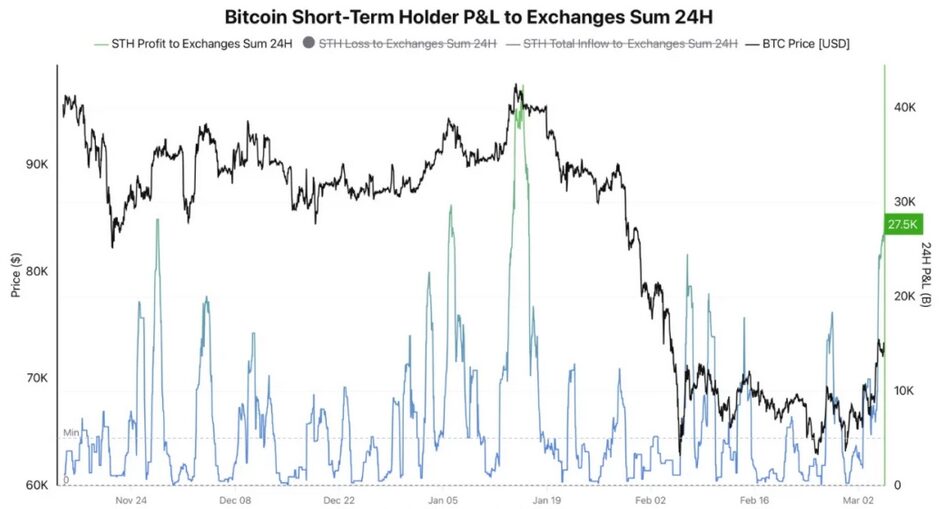
Bitcoin is once again entering a critical battlefield near $68,000, a zone that traders increasingly regard as a decisive short-term support level. After briefly climbing above $70,000 and touching $74,000, the largest cryptocurrency retreated as profit-taking accelerated among major holders.
Data from crypto sentiment platform Santiment suggests a striking divergence in market behavior. Large whale wallets, defined as those holding between 10 BTC and 10,000 BTC, accumulated substantial positions between late February and early March when Bitcoin traded between $62,900 and $69,600.
However, once the market surged above $70,000, many of these whales began selling aggressively, reportedly liquidating around 66% of the coins they had recently accumulated.
At the same time, small retail investors—particularly wallets holding less than 0.01 BTC—have increased their purchases, suggesting a classic redistribution phase where large players take profits while smaller participants buy into the market.
This divergence has historically preceded short-term corrections, as retail enthusiasm often arrives just as institutional traders lock in gains.
Nevertheless, the situation is not purely bearish. Bitcoin has maintained its position above the mid-$60,000 range, which has emerged as an important technical zone since early 2025.
2. Whale Behavior vs Retail Accumulation
(“Whales Selling vs Retail Buying Trend”)
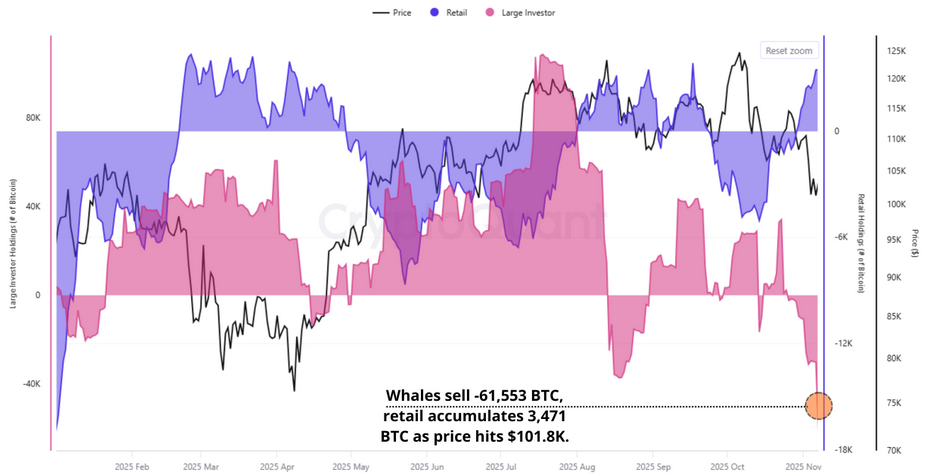
One of the most revealing insights from blockchain analytics is the contrasting behavior between large investors and retail participants.
During the latest rally:
- Whales accumulated during consolidation
- Whales sold near the $74,000 rally
- Retail investors increased buying during the pullback
Historically, this pattern has appeared repeatedly in Bitcoin cycles.
Large investors often accumulate during quiet consolidation periods when volatility is low. Once price momentum accelerates and retail enthusiasm rises, these investors distribute part of their holdings to lock in profits.
Santiment researchers note that when retail traders buy aggressively while whales sell, it frequently indicates that the correction phase is not yet finished.
However, this dynamic does not necessarily signal the start of a bear market. Instead, it may represent a healthy market reset, allowing new capital to enter before the next upward move.
Several analysts suggest that the current phase resembles mid-cycle consolidations seen in past Bitcoin bull markets, where corrections of 15%–25% occurred before new highs.
3. ETF Outflows Signal Temporary Institutional Caution
(“Spot Bitcoin ETF Net Flow Trend”)
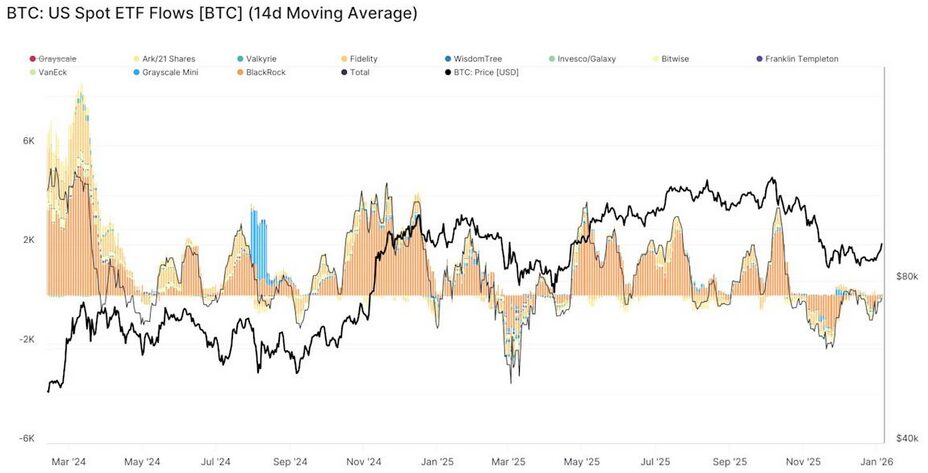
Another major factor contributing to the recent decline is institutional capital flows.
According to ETF tracking data, spot Bitcoin ETFs experienced approximately $349 million in net outflows, the largest withdrawal since February 12.
These outflows came from 11 ETF products, indicating that institutional investors temporarily reduced exposure following Bitcoin’s recent rally.
This does not necessarily indicate a long-term loss of institutional confidence. Instead, many analysts interpret these flows as portfolio rebalancing or profit-taking.
Since the approval of spot Bitcoin ETFs in major markets, these products have become a dominant source of demand for Bitcoin, often influencing short-term price movements.
When ETF inflows accelerate, Bitcoin typically rallies. When they slow or reverse, the market tends to consolidate.
Despite the recent outflows, cumulative ETF demand remains structurally strong, suggesting that institutional adoption continues to expand.
4. The $60,000 Floor Debate
One of the most discussed questions among analysts is whether $60,000 represents Bitcoin’s structural bottom for this cycle.
Economist Timothy Peterson has pointed to Bitcoin’s Metcalfe price valuation model, which measures the value of a network based on the square of its user base.
According to Peterson, this model has historically identified long-term market bottoms with remarkable accuracy.
Based on the model’s current range, he estimates that the probability of Bitcoin falling below $60,000 is only about 0.5%.
If this assessment proves correct, the recent correction may simply represent a normal consolidation within a broader bull market structure.
Bitcoin previously reached an all-time high of approximately $126,000 in October 2025, before declining to around $60,000 in early February during a market reset.
Since then, the cryptocurrency has shown gradual recovery, returning toward the upper-$60,000 range.
5. Technical Outlook: Liquidity, Support, and Possible Retest
Prominent trader Michaël van de Poppe, founder of MN Trading Capital, suggests that the next move will depend heavily on the strength of the $67,000–$68,000 support zone.
If Bitcoin fails to hold this area, the market may temporarily dip lower to capture liquidity, potentially revisiting previous lows before rebounding.
This pattern—often referred to as a liquidity sweep—is common in crypto markets.
Large players may push prices briefly downward to trigger stop-loss orders and accumulate liquidity before initiating the next rally.
From a technical perspective, the market currently sits at a decision point:
Bullish scenario
- Support holds near $67K
- ETF flows stabilize
- Whale selling slows
- Bitcoin resumes upward trend
Bearish short-term scenario
- Support breaks
- Liquidity sweep toward lower levels
- Temporary retest of the $60K region
Even in the bearish scenario, many analysts believe the broader cycle remains intact.
6. Broader Crypto Market Context
Bitcoin’s movements continue to shape the entire cryptocurrency market.
During periods of uncertainty:
- Altcoins typically underperform
- Liquidity rotates back into Bitcoin dominance
- Market sentiment becomes cautious
However, consolidation phases often prepare the ground for the next altcoin expansion cycle.
For investors seeking new crypto assets and income opportunities, such periods are often when early positioning becomes possible.
Emerging sectors currently attracting attention include:
- Layer-2 scaling solutions
- Real-world asset tokenization
- DeFi yield protocols
- AI-integrated blockchain networks
- Decentralized infrastructure projects
As Bitcoin stabilizes, capital historically begins rotating into these higher-growth segments.
Conclusion
Bitcoin’s struggle around $68,000 highlights a classic market transition phase.
Retail investors are stepping in with fresh demand, while large whales secure profits from earlier accumulation. At the same time, institutional flows through Bitcoin ETFs are temporarily cooling, adding pressure to the market.
Yet several structural indicators remain positive. The $60,000 zone appears to be a strong potential floor, supported by network valuation models and historical cycle behavior.
Whether Bitcoin briefly dips lower or rebounds from current levels, the broader trend suggests the market may simply be experiencing a mid-cycle consolidation rather than a structural downturn.
For investors focused on new crypto opportunities, yield strategies, and blockchain adoption, these consolidation periods often represent the calm before the next expansion phase.
As the cryptocurrency ecosystem continues evolving—with institutional finance, tokenized assets, and decentralized applications expanding—Bitcoin’s current battle around $68,000 may ultimately be remembered as a temporary pause in a much larger transformation of the global financial system.
