

Main Points :
- Galaxy Digital forecasts Bitcoin reaching $250,000 by the end of 2027, while warning that 2026 may be one of the most unpredictable years in Bitcoin’s history.
- Macroeconomic uncertainty—including AI-driven capital allocation, global monetary policy, and U.S. political risk—may collide with crypto-specific structural risks.
- Options markets reflect extreme uncertainty, with traders pricing both deep downside and explosive upside scenarios with similar probabilities.
- Bitcoin is transitioning from a speculative growth asset to a macro asset, increasingly comparable to equities and gold.
- Institutional participation, derivatives maturity, and volatility compression suggest long-term structural strength despite near-term chaos.
Introduction: A Bold Long-Term Vision Amid Short-Term Turbulence
Galaxy Digital’s research team has once again drawn global attention by presenting a strikingly bullish long-term forecast for Bitcoin. According to Galaxy Digital, Bitcoin could reach $250,000 by the end of 2027, even as the firm cautions that 2026 may be a year defined by confusion, sharp reversals, and conflicting signals.
This dual outlook—long-term optimism paired with short-term uncertainty—captures the current state of the digital asset market with unusual clarity. Bitcoin is no longer merely a speculative bet on future technology. Instead, it is increasingly embedded within global capital flows, macroeconomic debates, and institutional risk frameworks.
This article expands on Galaxy Digital’s thesis, integrates broader market trends, and explores what this evolving environment means for investors, builders, and institutions seeking new opportunities in the crypto economy.
1. The 2027 Target: Why $250,000 Is Not a Fantasy
The $250,000 price target for Bitcoin by 2027 was articulated by Alex Thorn, Head of Research at Galaxy Digital. While such a number may appear aggressive, the logic behind it is rooted in structural, not speculative, drivers.
Supply Constraints and Long-Term Demand
Bitcoin’s fixed supply of 21 million coins remains the foundation of its value proposition. However, what has changed significantly over the past several years is who is demanding Bitcoin and why:
- Institutional investors increasingly treat Bitcoin as a portfolio hedge rather than a short-term trade.
- Corporations and funds view BTC as protection against currency debasement and sovereign risk.
- Long-term holders continue to remove supply from circulation, tightening available liquidity.
When long-term demand grows faster than available liquid supply, price appreciation becomes a structural outcome rather than a speculative anomaly.
2. 2026: A Year of “Chaos” and Why It Matters
Despite long-term optimism, Thorn describes 2026 as a year that may be “extremely difficult to forecast.” This uncertainty arises from a convergence of macroeconomic and crypto-native risks.
Macroeconomic Risk Factors
Galaxy Digital highlights several global variables that could sharply impact Bitcoin markets in 2026:
- AI-Driven Capital Expenditure: Massive investments in artificial intelligence infrastructure may divert liquidity away from risk assets—or trigger broader productivity shocks that reshape markets.
- Monetary Policy Transitions: As central banks navigate inflation, debt servicing, and potential recessions, policy reversals could cause violent repricing across all asset classes.
- U.S. Political Uncertainty: The U.S. midterm election cycle introduces regulatory and fiscal unpredictability, particularly for digital assets.
Crypto-Specific Market Risks
From a technical and behavioral standpoint, Bitcoin faces its own challenges:
- Failure to decisively break above the $100,000–$105,000 resistance range could leave markets vulnerable to sharp corrections.
- Leverage buildup in derivatives markets could amplify volatility in either direction.
In short, 2026 is not expected to be a smooth continuation of the bull cycle, but rather a stress test for Bitcoin’s role in global markets.
3. What the Options Market Is Really Saying
One of the most compelling pieces of evidence supporting the “chaos” thesis comes from Bitcoin’s options market.
According to Thorn, traders are assigning nearly equal probabilities to drastically different outcomes:
- By mid-2026: prices clustering around $70,000 or $130,000
- By end-2026: extreme scenarios near $50,000 or $250,000
This is not normal market behavior. Such a distribution reflects deep uncertainty rather than directional conviction.
Why This Matters
Options markets aggregate the collective expectations of sophisticated participants. When traders are equally willing to hedge against collapse and explosion, it signals:
- Lack of consensus on macro direction
- Anticipation of large, regime-changing moves
- Willingness to pay higher premiums for protection
Title: Bitcoin Options Market: Implied Price Distribution for 2026
Description: A probability curve showing price clusters at $50k, $70k, $130k, and $250k
Purpose: Visualize market uncertainty and asymmetric risk
4. Bitcoin’s Evolution Into a “Macro Asset”
Perhaps the most important insight from Galaxy Digital’s report “26 Crypto, Bitcoin, DeFi, and AI Predictions for 2026” is the assertion that Bitcoin is no longer just a high-growth speculative asset.
Instead, it is increasingly behaving like a macro asset, comparable to equities or gold.
Evidence of Maturation
Several indicators support this shift:
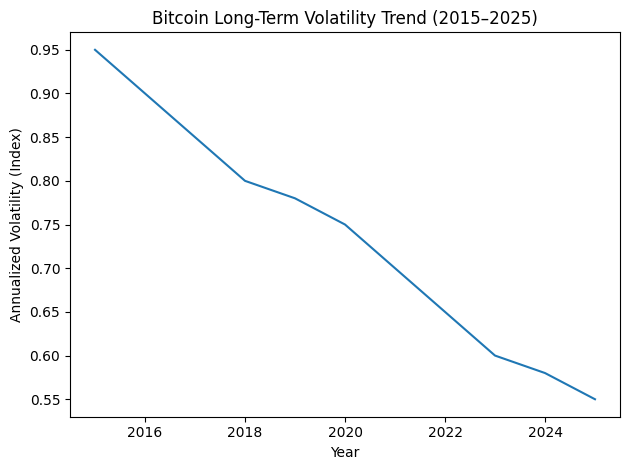
- Declining Long-Term Volatility: Bitcoin’s historical volatility has been trending downward, signaling market maturity.
- Rising Hedging Costs: The cost of downside protection via options has increased, reflecting institutional hedging demand.
- Deeper Derivatives Liquidity: Futures and options markets now absorb large trades without destabilizing spot prices.
These are characteristics of established financial markets, not experimental assets.
Title: Bitcoin Volatility Trend (2015–2025)
Description: A downward-sloping line showing reduced long-term volatility
Purpose: Illustrate Bitcoin’s maturation into a macro asset
5. Institutional Capital and the New Market Structure
Institutional investors play a central role in Galaxy Digital’s long-term bullish thesis.
Unlike retail speculation, institutions:
- Allocate capital over multi-year horizons
- Employ sophisticated hedging strategies
- Integrate Bitcoin into multi-asset portfolio construction
This behavior fundamentally changes market dynamics. Price drawdowns are increasingly met with strategic accumulation rather than panic selling.
Moreover, as geopolitical tensions and currency risks grow, Bitcoin’s role as a non-sovereign, dollar-alternative asset becomes more relevant—particularly outside the United States.
6. Why Chaos Can Be Constructive
While the word “chaos” often carries negative connotations, in financial markets it frequently precedes structural realignment.
For builders, investors, and operators in the crypto space, 2026 may offer:
- Entry points during periods of fear
- Opportunities to develop infrastructure while speculation cools
- A chance to separate durable projects from hype-driven ones
Historically, Bitcoin’s most transformative phases have followed periods of confusion and skepticism—not euphoria.
Conclusion: Navigating the Path to $250,000
Galaxy Digital’s outlook does not promise a smooth ride. Instead, it offers a realistic roadmap: volatility, uncertainty, and confusion in the medium term, followed by structural appreciation driven by adoption, scarcity, and macro relevance.
If Bitcoin does reach $250,000 by 2027, it will not be because markets moved in a straight line. It will be because Bitcoin survived another cycle of doubt—and emerged further embedded in the global financial system.
For those seeking new crypto assets, revenue models, or practical blockchain applications, the coming years may be less about timing the market and more about understanding its transformation.
