

Main Points :
- Arthur Hayes argues that Federal Reserve liquidity, not halving cycles, will dominate Bitcoin price action through 2026.
- The Fed’s Reserve Management Purchases (RMP) function as de facto quantitative easing, potentially exceeding traditional QE in flexibility.
- Hayes projects Bitcoin consolidation at $80,000–$100,000 through end-2025, followed by a sharp breakout to $200,000 by March 2026.
- Even after a peak, Bitcoin may establish a higher structural floor around $124,000, signaling regime change rather than a cyclical top.
- This thesis aligns with broader trends: sovereign debt pressure, liquidity-driven risk rallies, and Bitcoin’s role as a macro liquidity hedge.
1. Arthur Hayes’ Macro Thesis: Bitcoin as a Liquidity Barometer
Arthur Hayes, co-founder of BitMEX, has long argued that Bitcoin is not primarily driven by narratives such as “digital gold” or even the four-year halving cycle. Instead, he frames Bitcoin as the purest expression of global dollar liquidity.
In December 2025, Hayes reiterated this view, stating that Bitcoin could reach $200,000 by March 2026, largely due to renewed liquidity injections by the Federal Reserve. His argument is not based on speculative hype, but on balance-sheet mechanics, Treasury market stress, and the political reality facing U.S. monetary authorities.
From Hayes’ perspective, Bitcoin acts like a high-beta call option on fiat liquidity. When liquidity tightens, Bitcoin suffers disproportionately. When liquidity expands—even subtly or indirectly—Bitcoin responds violently to the upside.
This framework is increasingly shared among macro-oriented crypto investors, who now track Fed operations, Treasury issuance, and repo markets as closely as on-chain data.
2. What Is RMP? Why Hayes Calls It “QE in Disguise”
(“Federal Reserve liquidity programs comparison chart”)
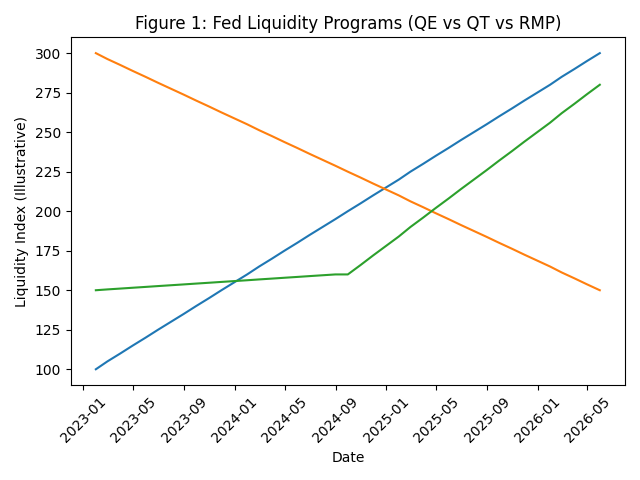
The crux of Hayes’ forecast lies in a relatively under-discussed policy tool: Reserve Management Purchases (RMP).
Under RMP, the Fed purchases short-term U.S. Treasury bills (T-bills) to manage reserve levels in the banking system. Officially, the Fed positions RMP as a technical liquidity management operation, not stimulus.
Hayes disagrees.
In his blog essay “Love Language”, he argues that RMP is functionally indistinguishable from quantitative easing, with three critical differences that make it even more powerful:
- No fixed end date
- No explicit monthly purchase cap (in principle)
- Political palatability, as it avoids the stigma of “QE”
While the Fed announced an indicative pace of roughly $40 billion per month, Hayes stresses that nothing structurally prevents the Fed from scaling RMP aggressively if Treasury market stability is threatened.
In other words, RMP allows the Fed to inject liquidity without admitting it is easing policy, a crucial distinction in an environment where inflation optics matter politically.
3. Liquidity Before Inflation: Why the Fed Is Cornered
The macro backdrop strengthens Hayes’ thesis.
By late 2025, the U.S. faces:
- Expanding fiscal deficits
- Massive Treasury refinancing needs
- Fragile demand for long-dated government bonds
If yields rise too quickly, the U.S. government’s debt servicing costs become politically untenable. This creates a structural incentive for the Fed to support Treasury markets indirectly, even if inflation remains above target.
In this environment, liquidity provision becomes a financial stability tool, not a growth stimulus. Hayes believes this distinction is critical: markets react to liquidity itself, not to the Fed’s stated intentions.
Bitcoin, as a globally liquid, non-sovereign asset, stands to benefit disproportionately from this dynamic.
4. Hayes’ Price Path: From Range-Bound to Parabolic
(“Bitcoin price projection $80k to $200k timeline”)
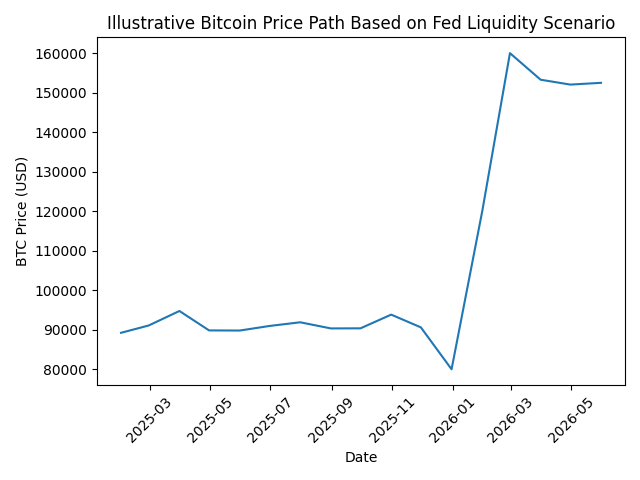
Hayes does not predict an immediate breakout. Instead, his scenario unfolds in stages:
Phase 1: Consolidation (Now–End 2025)
- Bitcoin trades sideways between $80,000 and $100,000
- Markets underestimate RMP’s impact
- Investors fear a potential RMP termination around April 2026
This period frustrates momentum traders and reinforces skepticism—historically a hallmark of accumulation phases.
Phase 2: Breakout (Early 2026)
- Liquidity effects become undeniable
- Bitcoin decisively breaks above the prior all-time high near $124,000
- Institutional flows accelerate
Phase 3: Blow-Off Rally (By March 2026)
- Bitcoin reaches $200,000
- Volatility spikes
- Media narratives shift from skepticism to inevitability
Crucially, Hayes does not describe this as the end of Bitcoin’s relevance, but rather as the first peak in a new structural valuation regime.
5. The $124,000 Floor: A Structural Shift, Not a Cycle Top
One of the most notable aspects of Hayes’ outlook is his downside expectation.
Even after peaking, he argues Bitcoin may not fall below $124,000, the prior all-time high. This challenges traditional crypto cycle models, where post-peak drawdowns of 70–80% were once considered normal.
If Hayes is correct, it would imply:
- Bitcoin is transitioning from speculative asset to macro-financial infrastructure
- Long-term holders increasingly include institutions, funds, and sovereign-adjacent entities
- Liquidity cycles replace halving cycles as the dominant driver
This aligns with other recent institutional commentary suggesting the four-year cycle framework may be breaking down.
6. 2025 Volatility: A Preview of the New Regime
(“Bitcoin volatility after all-time high 2025”)
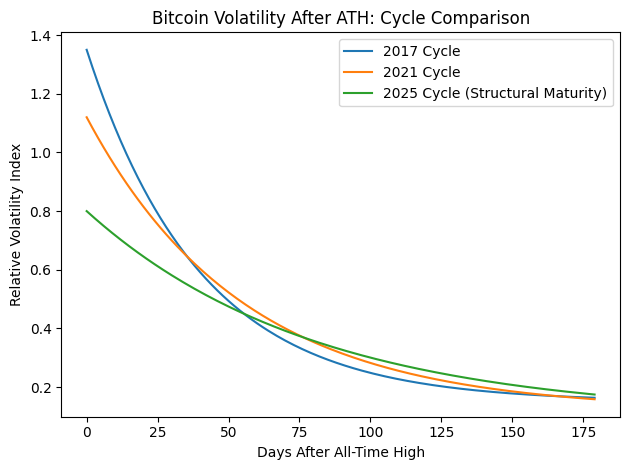
The events of 2025 provide context for Hayes’ argument.
After reaching a record high of approximately $126,000, Bitcoin fell sharply following U.S. tariff announcements and broader risk-off sentiment. By mid-December, prices briefly dipped below $85,000, before stabilizing near $88,000.
Notably, this drawdown occurred without systemic panic, exchange insolvencies, or leverage cascades comparable to earlier cycles. Instead, selling pressure appeared orderly and liquidity-driven.
This supports the view that Bitcoin’s market structure is maturing—even as volatility remains elevated.
7. Implications for Crypto Investors and Builders
For readers seeking new crypto assets, revenue opportunities, or practical blockchain applications, Hayes’ thesis carries several implications:
- Macro literacy matters more than ever
Understanding central bank operations may now outperform technical analysis alone. - Liquidity-sensitive sectors may outperform
Layer-1 blockchains, DeFi liquidity protocols, and infrastructure tokens could benefit disproportionately. - Risk management must evolve
Shallow drawdowns at high price levels require different hedging strategies than prior cycles. - Stablecoins and on-chain dollars gain strategic importance
Liquidity expansion reinforces demand for programmable dollar instruments.
8. A Balanced View: Risks to the Thesis
While compelling, Hayes’ scenario is not guaranteed.
Key risks include:
- A stronger-than-expected global recession reducing risk appetite
- Political pressure forcing the Fed to curtail liquidity operations
- Regulatory shocks targeting crypto on-ramps or stablecoins
Nonetheless, even critics increasingly concede that liquidity, not ideology, is the dominant force shaping crypto markets.
Conclusion: Bitcoin as the Shadow Balance Sheet of the Dollar System
Arthur Hayes’ $200,000 Bitcoin forecast is not merely a price call—it is a statement about the evolving structure of global finance.
If the Federal Reserve continues to supply liquidity through mechanisms like RMP, Bitcoin may increasingly function as a shadow balance sheet for the fiat system, absorbing excess liquidity that traditional assets can no longer safely contain.
Whether or not Bitcoin reaches exactly $200,000 by March 2026, the broader implication is clear:
Crypto markets are no longer peripheral—they are macro-critical.
