

Main Takeaways :
- Strive’s acquisition of Semler Scientific marks the first full M&A execution by a listed Bitcoin-focused treasury (DAT) company.
- Post-merger, Strive will hold 12,797.9 BTC, ranking 11th globally among corporate Bitcoin holders, surpassing Tesla and Trump Media & Technology Group.
- The deal highlights a shift from Bitcoin accumulation strategies to Bitcoin-native corporate structuring.
- Preferred equity, leverage discipline, and monetization of operating subsidiaries are emerging as core financial engineering tools.
- This trend offers investors exposure not just to Bitcoin price appreciation, but to yield, structure, and balance-sheet arbitrage.
1. Strive and Semler: A Milestone in Bitcoin Treasury M&A
On January 13, Strive, a Nasdaq-listed U.S. investment company, announced that shareholders of Semler Scientific had approved its acquisition. The transaction is structured as an all-share exchange, through which Strive will acquire 5,048.1 BTC held by Semler.
This deal is historically significant. While many public companies have accumulated Bitcoin as a reserve asset, this represents the first acquisition explicitly executed by a Bitcoin-focused public treasury company, often referred to as a Digital Asset Treasury (DAT) company.
Rather than treating Bitcoin as a passive hedge, Strive is positioning it as core corporate infrastructure—a balance-sheet anchor around which capital structure, financing, and M&A strategy are built.
2. Aggressive Bitcoin Accumulation Before Closing
Between January 1 and January 12, Strive independently acquired an additional 123 BTC at an average price of $91,561 per BTC, for a total cost of $11.264 million including fees and expenses.
This brought Strive’s standalone holdings to 7,749.8 BTC prior to the Semler acquisition.
Such timing is not accidental. By accumulating Bitcoin ahead of closing, Strive effectively front-runs balance-sheet expansion, ensuring that post-merger capital ratios and BTC-per-share metrics remain attractive to investors.
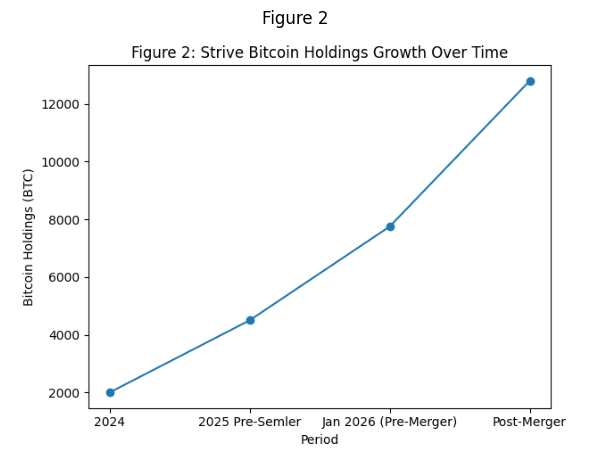
This mirrors strategies seen among leading Bitcoin treasury firms, where timing, accounting treatment, and capital structure optimization matter as much as raw BTC accumulation.
3. Post-Merger Scale: Entering the Top Tier of Corporate Bitcoin Holders
After the acquisition closes, the combined entity will hold 12,797.9 BTC, placing it 11th globally among publicly known corporate Bitcoin holders, surpassing companies such as Tesla and Trump Media & Technology Group.
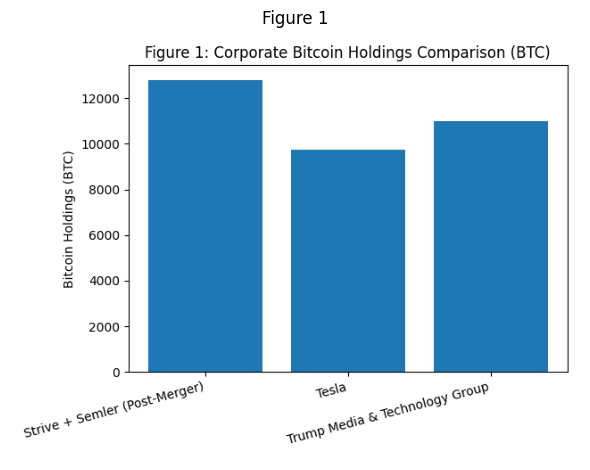
This scale matters.
At this level, Bitcoin holdings begin to function less like a speculative asset and more like strategic monetary capital, enabling:
- Structured leverage
- Preferred equity issuance
- Collateralized financing
- Yield-generating treasury operations
The market is increasingly pricing these companies not just on net asset value (NAV), but on how efficiently they transform Bitcoin into financial optionality.
4. DAT Companies and the Consolidation Trend
The Strive–Semler transaction exemplifies a broader consolidation trend among DAT companies.
Initially, corporate Bitcoin adoption followed a simple narrative: buy BTC, hold BTC, benefit from price appreciation. That phase is ending.
We are now entering a second phase where companies:
- Acquire operating businesses with existing BTC reserves
- Monetize cash-flow businesses to service debt and expand BTC holdings
- Use Bitcoin as collateral rather than inventory
This mirrors early gold-standard banking structures, where hard assets underpinned increasingly sophisticated financial instruments.
5. Monetization Strategy and Liability Management
Strive has stated that within 12 months of closing, it intends to monetize Semler Scientific’s operating divisions and evaluate repayment of:
- $100 million in existing convertible notes
- $20 million loan from Coinbase
Crucially, these actions are conditional on market conditions. This signals disciplined capital management rather than forced deleveraging.
Strive has emphasized maintaining a leveraged corporate structure funded primarily through preferred equity, rather than excessive common-share dilution or unsecured debt.
This is a critical distinction for investors evaluating downside risk.
6. Preferred Equity as a Bitcoin-Native Financial Tool
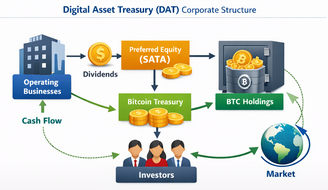
In November 2025, Strive conducted an IPO of its preferred shares, SATA, initially targeting $125 million but ultimately upsizing to $200 million due to more than 2x oversubscription.
Following the IPO, Strive received demand for over $100 million in additional preferred issuance and plans to expand SATA issuance over the next 12 months.
Preferred equity is emerging as a Bitcoin-native financing layer:
- Senior to common equity
- Flexible dividend structures
- Less dilution of BTC-per-share metrics
This structure allows Strive to scale Bitcoin exposure while maintaining institutional-grade capital discipline.
7. Stock Consolidation and Institutional Accessibility
Upon completion of the merger, Strive’s board approved a 1-for-20 reverse stock split across its Class A and Class B common shares.
According to CIO Ben Workman, this adjustment aligns share pricing with institutional participation thresholds, expanding eligibility among funds with minimum price constraints.
This move highlights a key insight: Bitcoin treasury strategy must be paired with market microstructure awareness to unlock real capital inflows.
8. Implications for Investors Seeking Yield and Structure
For investors, DAT companies like Strive offer exposure beyond simple Bitcoin price appreciation:
- Embedded leverage without margin liquidation risk
- Exposure to preferred dividends funded by operating cash flows
- Optionality on M&A-driven BTC accumulation
This represents a hybrid asset class—part Bitcoin proxy, part financial engineering vehicle.
9. What This Means for the Broader Crypto Market
The Strive–Semler deal signals maturation.
Bitcoin is no longer merely an asset on the balance sheet. It is becoming:
- A corporate reserve standard
- A financing substrate
- A strategic M&A catalyst
As more DAT companies emerge, we can expect:
- Competition for BTC-rich acquisition targets
- Innovation in Bitcoin-backed securities
- Convergence between traditional finance and crypto-native balance sheets
Conclusion: From Holding Bitcoin to Building With Bitcoin
Strive’s acquisition of Semler Scientific is not just about adding 5,048 BTC.
It represents a structural shift—from owning Bitcoin to operating with Bitcoin.
For readers seeking the next generation of crypto-related opportunities, DAT companies offer a compelling lens: they transform Bitcoin volatility into structured yield, leverage, and long-term strategic value.
This is not a trade.
It is infrastructure.
