
Main Points :
- Historically, Bitcoin and equity markets tend to weaken during U.S. midterm election years due to political uncertainty.
- Bitcoin has fallen an average of about 56% during midterm years since 2014.
- However, the 12 months following midterm elections have historically delivered strong recoveries for both equities and Bitcoin.
- After the last three midterm elections, Bitcoin recorded positive returns averaging roughly 54%.
- Despite this historical pattern, current macroeconomic risks—including inflation, geopolitical tensions, and leverage in crypto markets—may disrupt the cycle.
1. The U.S. Political Cycle and Its Influence on Crypto Markets
Financial markets have long been influenced by political cycles, particularly in the United States, where policy shifts, fiscal debates, and regulatory changes can reshape investor sentiment. According to a recent analysis by Binance Research, the U.S. midterm election cycle has historically been one of the most volatile phases in the four-year presidential market cycle.
Midterm elections occur every four years in the middle of a U.S. presidential term. During these elections, all seats in the House of Representatives and roughly one-third of Senate seats are contested. Because these elections often reshape the balance of power in Washington, they tend to introduce uncertainty regarding taxation, fiscal policy, regulation, and government spending.
For traditional financial markets, this uncertainty has historically translated into weaker performance. Binance Research notes that the S&P 500 index has experienced an average decline of approximately 16% during midterm election years. Among the past ten midterm cycles, seven saw corrections exceeding 10%, making midterm years the weakest period within the broader presidential market cycle.
Cryptocurrency markets appear to have inherited similar macro-sensitivity in recent years. Since 2014, Bitcoin has increasingly moved in correlation with risk assets such as technology stocks. During midterm election years within this period, Bitcoin experienced average drawdowns of about 56%, highlighting how digital assets can behave similarly to high-beta equities when macroeconomic uncertainty rises.
Historical Bitcoin Price Performance During U.S. Midterm Election Years (2014–2024)

The chart should illustrate Bitcoin price declines during midterm election periods and the subsequent recovery phase in the following year.
2. Why Markets Often Recover After Midterm Elections
Despite the volatility that often precedes them, midterm elections historically mark a turning point for financial markets. Once the election outcome becomes clear, political uncertainty diminishes, allowing investors to refocus on economic fundamentals.
Historical data supports this pattern strongly.
According to Binance Research, the S&P 500 has produced an average return of approximately 19% during the 12 months following midterm elections. Even more remarkably, the index has not recorded a negative return during this period since 1939.
Bitcoin has shown a similar pattern—albeit over a shorter history. In the three midterm cycles since 2014, Bitcoin posted positive returns in the 12 months following the election, with an average gain of about 54%.
Several factors help explain this phenomenon.
First, once election uncertainty fades, policy direction becomes clearer, which tends to improve investor confidence. Governments often move toward more accommodative economic policies after elections, including fiscal stimulus or regulatory clarity.
Second, midterm election years often coincide with monetary policy shifts. Central banks frequently adopt looser financial conditions when economic growth slows during politically sensitive periods.
Third, market positioning plays a role. If investors reduce exposure during uncertain periods, markets can become oversold, creating conditions for strong rebounds once sentiment stabilizes.
For cryptocurrency markets, the effect can be amplified. Because digital assets are still relatively small compared with traditional financial markets, capital inflows can trigger disproportionately large price movements.
Average Asset Returns in the 12 Months After U.S. Midterm Elections
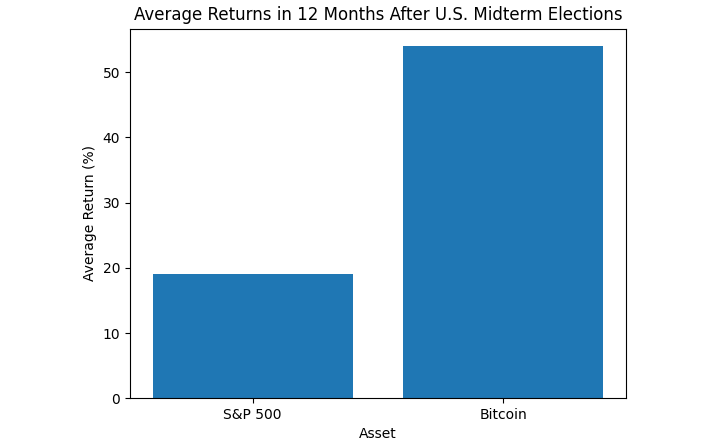
The chart should compare average returns for the S&P 500 and Bitcoin following midterm elections.
3. Why Bitcoin Has Become Sensitive to Macroeconomic Events
In its early years, Bitcoin was often described as an asset largely independent from traditional financial markets. However, the past decade has seen a transformation.
Institutional investors—including hedge funds, asset managers, and even pension funds—have increasingly entered the crypto market. As a result, Bitcoin has become more integrated into the global financial system.
This integration has had several consequences.
First, Bitcoin now reacts strongly to global liquidity conditions. When interest rates rise or financial conditions tighten, risk assets—including cryptocurrencies—tend to decline.
Second, Bitcoin has become influenced by macro narratives such as inflation hedging, monetary policy expectations, and geopolitical risk.
For example, during periods of aggressive monetary expansion, Bitcoin has often rallied alongside other speculative assets. Conversely, during tightening cycles—such as the global interest rate hikes seen in 2022 and 2023—Bitcoin has struggled.
This growing correlation explains why political events such as the U.S. midterm elections now have measurable effects on cryptocurrency markets.
4. The Fragile Balance Facing the Current Market
Although historical data suggests that markets often rebound after midterm elections, Binance Research warns that the current macroeconomic environment may complicate the pattern.
Several risk factors are currently converging.
4.1 Energy Market Volatility
Geopolitical tensions—particularly involving Iran and the Middle East—have contributed to significant fluctuations in global energy prices. Because energy costs influence inflation, they indirectly affect interest rate policy and financial market liquidity.
If energy prices surge again, central banks may be forced to maintain higher interest rates, which would place pressure on risk assets such as Bitcoin.
4.2 Inflation Concerns
Although inflation has moderated in some regions, persistent price pressures remain a major concern for policymakers. If inflation proves more stubborn than expected, monetary policy could remain restrictive longer than markets anticipate.
Higher interest rates typically reduce liquidity in financial markets, which historically has weighed on crypto asset valuations.
4.3 Elevated Leverage in Crypto Markets
Another concern highlighted by Binance Research is the high level of leverage currently present in cryptocurrency derivatives markets.
Crypto traders frequently use futures contracts and perpetual swaps with significant leverage. While leverage can amplify gains during bull markets, it also increases the risk of cascading liquidations during downturns.
Periods of high leverage can therefore create fragile market structures, where relatively small price movements trigger large forced sell-offs.
Crypto Market Leverage and Liquidation Events
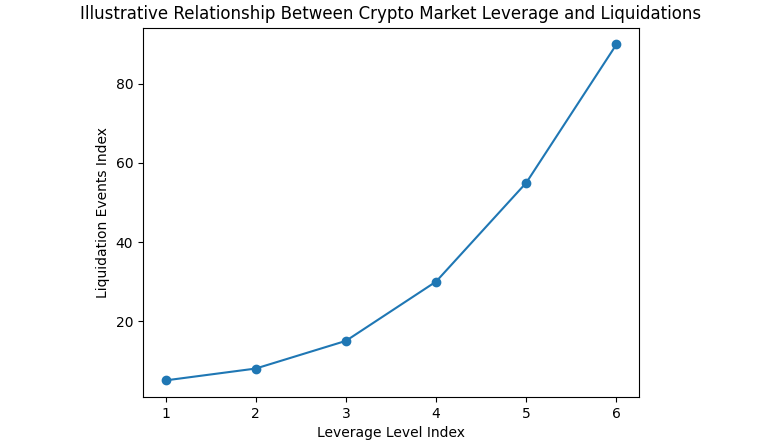
This chart should visualize the relationship between leverage levels and major liquidation events in cryptocurrency markets.
5. How Institutional Adoption Is Reshaping the Crypto Cycle
Another factor influencing the crypto market’s behavior during political cycles is the rapid growth of institutional participation.
Over the past several years, major financial institutions—including global asset managers, banks, and hedge funds—have entered the digital asset market. This trend accelerated following the launch of spot Bitcoin exchange-traded funds (ETFs) in the United States.
Institutional participation introduces both stability and complexity.
On one hand, institutions bring large pools of capital and long-term investment frameworks, which can stabilize markets. On the other hand, institutional investors tend to react strongly to macroeconomic signals, including interest rates, inflation expectations, and political developments.
This means Bitcoin is increasingly influenced by the same macroeconomic forces that drive global equity markets.
For investors searching for new crypto opportunities, this shift has an important implication: understanding macroeconomic trends is becoming just as important as analyzing blockchain technology itself.
6. Opportunities for Crypto Investors in the Next Cycle
Despite the uncertainties facing the market, the historical pattern surrounding U.S. midterm elections still suggests the potential for significant opportunities.
For long-term investors, periods of macroeconomic uncertainty can offer attractive entry points.
Several sectors within the cryptocurrency ecosystem are currently attracting attention:
- Real-world asset tokenization (RWA) platforms that bring traditional financial assets onto blockchains.
- Layer-2 scaling networks that improve transaction efficiency and reduce costs.
- Decentralized physical infrastructure networks (DePIN) that connect blockchain technology with real-world hardware systems.
- AI-blockchain integration, where decentralized networks provide infrastructure for artificial intelligence applications.
If the historical post-midterm recovery pattern holds, these sectors could experience strong growth alongside Bitcoin.
However, investors should remain aware that macro risks can delay or disrupt market cycles, particularly when geopolitical tensions and monetary policy shifts intersect.
Conclusion
Historical market data suggests a consistent pattern surrounding U.S. midterm elections: financial markets often struggle during the election year but recover strongly afterward.
Bitcoin has followed a similar trajectory in recent cycles, declining during periods of political uncertainty but delivering strong gains in the year following the election.
However, the current market environment is unusually complex. Geopolitical tensions, energy price volatility, persistent inflation concerns, and elevated leverage within crypto markets all contribute to a fragile equilibrium.
For investors and builders within the blockchain industry, this means the coming cycle may not perfectly mirror past patterns. While history suggests a recovery could follow the next midterm election, the path toward that recovery may be volatile.
Understanding the interaction between macro politics, institutional capital, and blockchain innovation will therefore be essential for anyone seeking to identify the next wave of opportunities in the cryptocurrency market.
