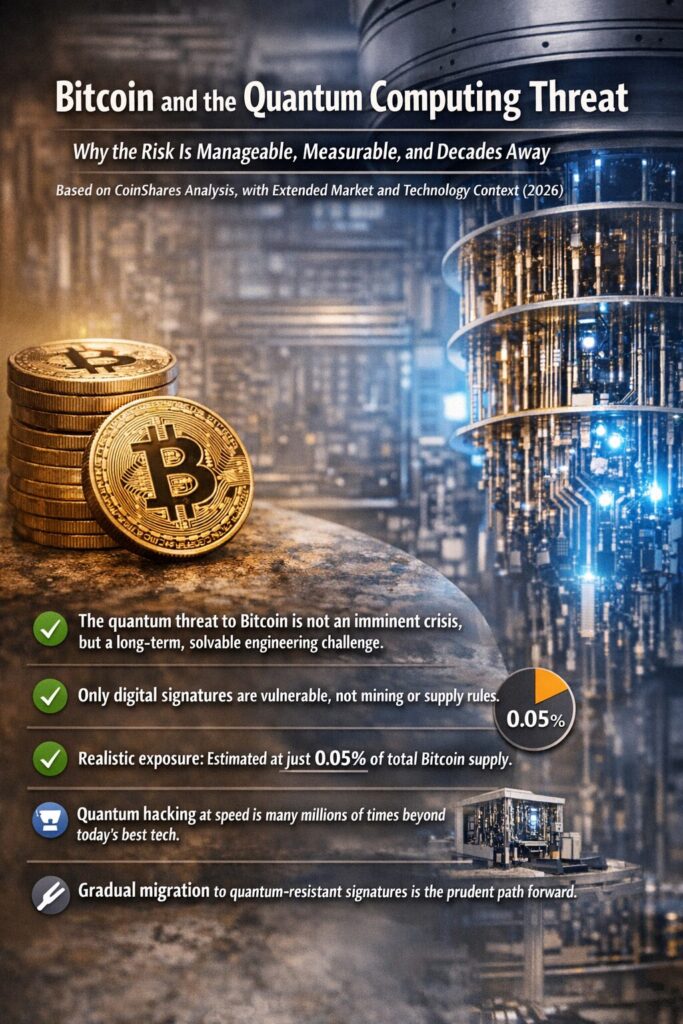
The quantum threat to Bitcoin is not an imminent crisis, but a long-term, solvable engineering challenge.
Only digital signatures (not mining or supply rules) are theoretically affected by future quantum computers.
The realistic exposure is estimated at about 0.05% of total Bitcoin supply, far smaller than commonly claimed.
Breaking Bitcoin cryptography at transaction speed would require quantum computers millions of times more powerful than today’s best machines.
Premature or aggressive protocol intervention (forced burns, rushed hard forks) could damage Bitcoin’s core principles more than the quantum threat itself.
A gradual, opt-in migration to quantum-resistant signatures via soft forks is the most rational path forward.
1. The Quantum Narrative: Fear Versus Reality
In recent years, headlines warning that “quantum computers will break Bitcoin” have periodically resurfaced, often amplified by breakthroughs in quantum research or announcements from major technology firms. According to a comprehensive new analysis released by CoinShares, one of the world’s largest digital asset investment firms, this narrative is significantly exaggerated.
CoinShares’ conclusion is unambiguous: quantum computing does not pose a near-term existential threat to Bitcoin. Instead, it represents a foreseeable technical challenge—one for which the Bitcoin network has ample time, tools, and governance mechanisms to adapt.
The report directly challenges the idea that quantum computers could “destroy the entire crypto ecosystem overnight.” Such claims, CoinShares argues, misunderstand both the structure of Bitcoin’s cryptography and the current trajectory of quantum hardware development.
2. What Quantum Computers Can — and Cannot — Break in Bitcoin
Bitcoin’s security rests on two distinct cryptographic pillars:
Mining Security Based on SHA-256 hashing, which protects Proof-of-Work and block production.
Transaction Authenticity Based on elliptic curve digital signatures (ECDSA, secp256k1), which prove ownership of coins.
Crucially, only the second pillar is theoretically vulnerable to sufficiently powerful quantum computers. Even then, the impact is narrow.
Quantum algorithms such as Shor’s algorithm could, in theory, derive a private key from a known public key. However:
They cannot alter Bitcoin’s 21 million supply cap.
They cannot invalidate Proof-of-Work.
They cannot rewrite consensus rules.
Mining would remain secure, as SHA-256 is believed to be quantum-resistant except for modest speedups that do not undermine network security.
3. How Much Bitcoin Is Actually at Risk?
One of the most important contributions of the CoinShares report is its quantitative breakdown of exposure.
Vulnerable Coins in Theory
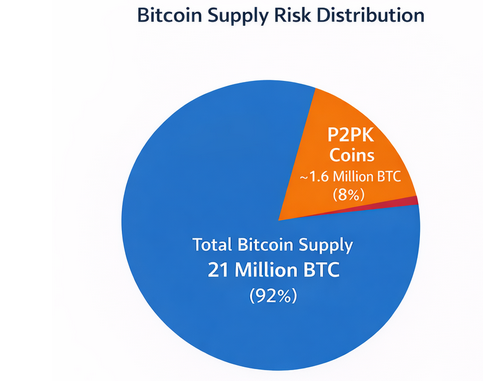
Approximately 1.6 million BTC (around 8% of total supply) reside in very old P2PK (Pay-to-Public-Key) addresses where the public key is permanently exposed.
However, this figure is misleading without context.
Vulnerable Coins in Practice
CoinShares estimates that only about 10,200 BTC are concentrated in a way that could realistically cause market-level disruption if compromised. That represents roughly:
0.05% of total Bitcoin supply
The remaining coins are fragmented across more than 30,000 individual UTXOs, making coordinated theft computationally infeasible even under extremely optimistic assumptions about quantum progress.
Total BTC supply vs. P2PK coins vs. realistically exploitable BTC (0.05%)
4. Why Modern Bitcoin Addresses Are Still Safe
Most Bitcoin today uses address formats such as:
P2PKH
P2SH
SegWit (Bech32)
In these formats, the public key is not revealed until the moment of spending. Until a transaction is broadcast, only a hash of the public key is visible, which remains safe from quantum attacks.
This means a quantum attacker would need to:
Detect a transaction in the mempool.
Derive the private key from the revealed public key.
Create and broadcast a conflicting transaction.
Get it confirmed before the original transaction.
All within minutes or seconds.
As CoinShares emphasizes, this is orders of magnitude beyond foreseeable quantum capabilities.
Claims that “25% of Bitcoin is vulnerable” often stem from address reuse practices, especially by exchanges. These risks are operational, not structural, and can be mitigated today by following established best practices.
5. The Quantum Hardware Reality Check
To understand the timeline, CoinShares examined what it would take to break Bitcoin’s secp256k1 signatures.
Current State of Quantum Computing
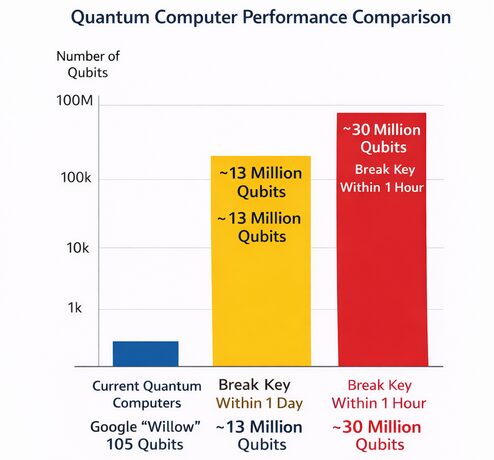
Google’s latest quantum chip, Willow, operates at 105 logical qubits.
It lacks full fault tolerance and long-duration coherence.
Requirements to Break Bitcoin
To break a public key within one day:
Approximately 13 million physical qubits
Full fault tolerance and advanced error correction
To break a key within one hour:
Performance equivalent to 3 million times today’s best systems
In other words, quantum computers capable of real-time Bitcoin attacks would need to be 10,000–100,000× more powerful than current systems.
Bar chart comparing current quantum computers vs. required qubits for 1-day and 1-hour Bitcoin key attacks
6. Timeline Scenarios: Short-Term vs Long-Term Attacks
CoinShares distinguishes between two categories of attacks:
Long-Term Attacks (Years to Execute)
Target dormant coins
Might become theoretically possible within 10–20 years
Still face enormous economic and technical barriers
Short-Term Attacks (Minutes to Execute)
Target mempool transactions
Require breaking keys in under 10 minutes
Effectively impossible for several decades
This distinction is critical. Bitcoin’s real-time security depends on the second category, not the first.
7. Why Aggressive Intervention Could Be More Dangerous Than Quantum Risk
Some commentators have proposed drastic responses, including:
Forcing vulnerable coins to be burned
Emergency hard forks to new cryptography
Invalidating old address types
CoinShares strongly warns against these approaches.
Key Risks of Overreaction
Property rights violations: There is no reliable way to distinguish lost coins from dormant holdings.
Centralization of decision-making: Forced interventions undermine Bitcoin’s neutrality.
Technical fragility: Rushed cryptography can introduce fatal bugs.
Loss of trust: Arbitrary changes threaten Bitcoin’s immutability narrative.
In short, a premature fix could damage Bitcoin more than the hypothetical attack it seeks to prevent.
8. The Rational Path Forward: Gradual Quantum Resistance
Rather than panic-driven action, CoinShares advocates a measured strategy:
Develop quantum-resistant signature schemes
Introduce them via soft forks, preserving backward compatibility
Allow voluntary migration by users and institutions
Educate the ecosystem on best practices
This mirrors Bitcoin’s historical evolution, such as the transition to SegWit and Taproot—incremental, opt-in, and extensively tested.
9. Implications for Investors, Builders, and Institutions
For readers seeking new assets, revenue opportunities, or practical blockchain applications, the implications are clear:
Quantum risk is a known variable, not a black swan
Infrastructure providers should begin research and tooling, not emergency action
Exchanges and custodians can reduce exposure today through address hygiene
The broader lesson extends beyond Bitcoin: cryptographic agility will become a competitive advantage across blockchain systems.
10. Conclusion: A Solvable Problem, Not an Existential Crisis
The CoinShares analysis reframes the quantum debate from fear to engineering reality. Bitcoin is not facing an imminent collapse. Instead, it faces a decades-long transition window, during which cryptography, governance, and market incentives can align.
Quantum computing will eventually reshape digital security—but Bitcoin, by design, has the time and adaptability to meet that future on its own terms.
About Us and Media
Blockchain and cryptocurrency media covering and exposing the practical application development on the blockchain industry and undiscovered coins.
Click edit button to change this text. Lorem ipsum dolor sit amet, consectetur adipiscing elit
Manage Consent
To provide the best experiences, we use technologies like cookies to store and/or access device information. Consenting to these technologies will allow us to process data such as browsing behavior or unique IDs on this site. Not consenting or withdrawing consent, may adversely affect certain features and functions.
Functional Always active
The technical storage or access is strictly necessary for the legitimate purpose of enabling the use of a specific service explicitly requested by the subscriber or user, or for the sole purpose of carrying out the transmission of a communication over an electronic communications network.
Preferences
The technical storage or access is necessary for the legitimate purpose of storing preferences that are not requested by the subscriber or user.
Statistics
The technical storage or access that is used exclusively for statistical purposes.The technical storage or access that is used exclusively for anonymous statistical purposes. Without a subpoena, voluntary compliance on the part of your Internet Service Provider, or additional records from a third party, information stored or retrieved for this purpose alone cannot usually be used to identify you.
Marketing
The technical storage or access is required to create user profiles to send advertising, or to track the user on a website or across several websites for similar marketing purposes.