
Main Points :
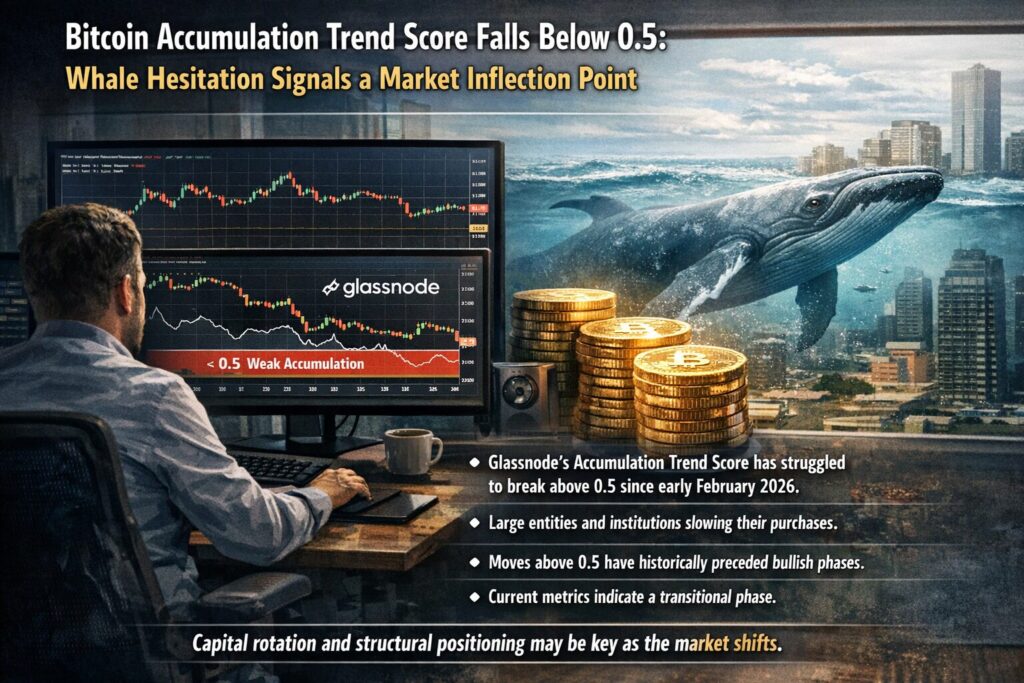
- Glassnode’s Accumulation Trend Score has struggled to break above 0.5 since early February 2026.
- The weakness is driven primarily by large entities (“whales”) and institutional investors slowing their purchases.
- Historically, sustained moves above 0.5 have preceded bullish continuation phases.
- Current on-chain metrics suggest a transitional phase rather than full capitulation.
- For investors seeking new crypto opportunities and revenue streams, capital rotation and structural positioning may be more important than short-term price action.
1. Understanding the Accumulation Trend Score
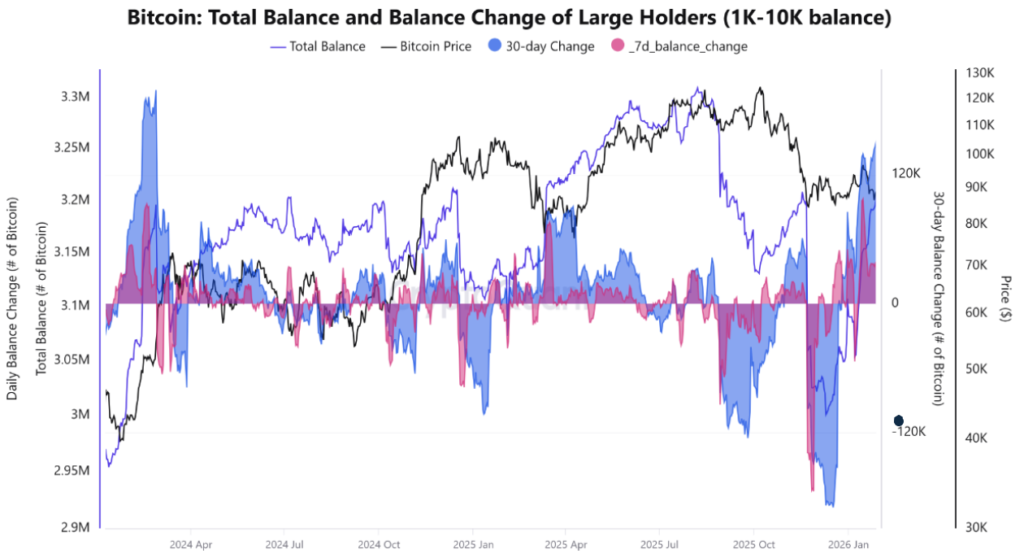
According to recent analysis by on-chain analytics firm Glassnode, Bitcoin’s Accumulation Trend Score has struggled to remain above the key 0.5 threshold since early February 2026. This metric quantifies whether entities across the network are increasing or decreasing their Bitcoin holdings, assigning a value between 0 and 1. A score close to 1 signals strong accumulation, while a value near 0 reflects distribution or stagnation.
[Accumulation Trend Score Visualization]
What makes this metric particularly powerful is that it does not merely count transactions; it weighs them based on the size and behavior of entities. In other words, it captures conviction. When large holders increase their balances over time, the score rises meaningfully. When they pause or distribute, the metric softens.
Since early February, the score’s inability to sustain levels above 0.5 suggests that accumulation pressure is weak. The threshold of 0.5 is psychologically and structurally important: above it, net accumulation dominates; below it, distribution or hesitation dominates.
This development comes at a time when market participants are carefully evaluating macroeconomic signals, ETF flows, and global liquidity conditions. While retail investors often react emotionally to short-term price swings, this metric focuses on structural capital movement.
2. Whale Behavior: The Core Driver of the Slowdown
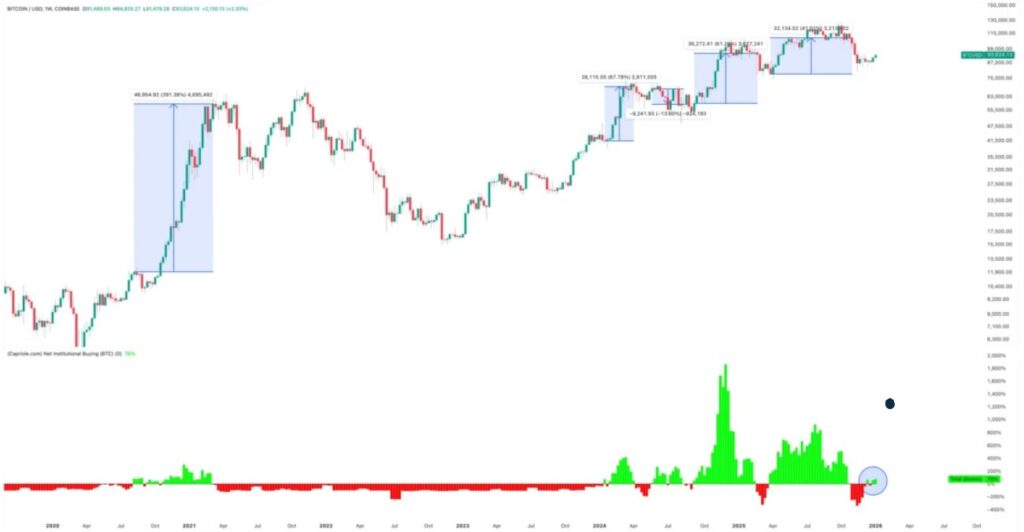
The current stagnation is primarily attributed to large entities—commonly referred to as “whales”—and institutional investors reducing or pausing their buying activity.
[Whale Balance Trend Chart]
Whales matter disproportionately in Bitcoin markets because:
- Their capital size can absorb supply shocks.
- Their buying often signals long-term strategic positioning.
- Their inactivity can create psychological fragility in leveraged markets.
In previous cycles, strong whale accumulation during price consolidation phases laid the foundation for subsequent rallies. For example, during the 2020–2021 cycle, whale addresses expanded holdings significantly during sideways periods before major upward expansions.
In contrast, today’s on-chain data shows a flattening or slight contraction in large-holder net position change. This does not necessarily indicate aggressive selling; rather, it reflects hesitation. For leveraged traders maintaining long positions, whale conviction acts as a stability anchor. When that anchor weakens, volatility tends to increase.
Institutional investors—particularly those managing spot Bitcoin ETFs—also contribute to accumulation dynamics. Flows into and out of these vehicles can significantly impact overall supply absorption. Although ETF participation remains structurally supportive, recent inflow momentum has moderated compared to earlier phases.
3. Market Structure: Transition or Distribution?
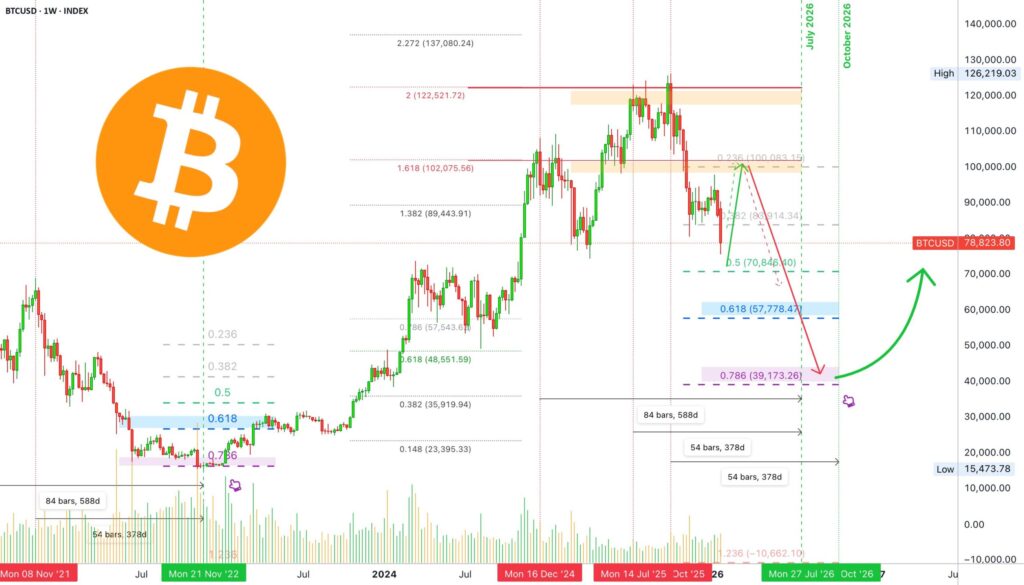
To interpret the sub-0.5 reading properly, we must contextualize it within broader market structure.
[Bitcoin Price vs Accumulation Overlay]
There are generally three phases in Bitcoin accumulation dynamics:
- Capitulation Accumulation: Smart money accumulates aggressively while retail sells.
- Expansion Accumulation: Whales continue buying as price trends upward.
- Distribution / Transition: Accumulation slows as price matures or macro uncertainty rises.
Current data suggests we are in a transitional environment rather than outright distribution. The absence of aggressive distribution implies that whales are not exiting en masse; they are waiting.
Several macro variables may explain this pause:
- Uncertainty regarding global monetary policy.
- Regulatory developments in the United States and Asia.
- Capital rotation toward high-beta altcoins during short speculative windows.
- Positioning adjustments following strong ETF-driven rallies in prior quarters.
For investors focused on practical blockchain applications and new revenue streams, this period may offer structural opportunities rather than directional certainty.
4. Implications for Investors Seeking New Opportunities
For readers actively searching for new digital assets and income-generating strategies, the Accumulation Trend Score offers more than a directional signal—it provides timing insight.
4.1 Spot Accumulation Strategy
If the score begins to trend sustainably above 0.5, historically that has marked the return of institutional conviction. Accumulating during early re-accumulation phases often improves risk-adjusted returns.
4.2 Derivatives and Yield Opportunities
Periods of whale hesitation frequently coincide with range-bound price action. In such environments:
- Options selling strategies may benefit from implied volatility compression.
- Funding rate arbitrage can generate yield.
- Structured products built on neutral positioning may outperform directional bets.
4.3 Capital Rotation Into Infrastructure Projects
When Bitcoin consolidation persists, capital often rotates into infrastructure tokens, scaling solutions, and ecosystem platforms. Investors interested in practical blockchain deployment should monitor:
- Layer-2 scaling ecosystems.
- Tokenized real-world asset (RWA) platforms.
- Institutional custody and compliance infrastructure tokens.
Such sectors often benefit indirectly from Bitcoin stabilization phases.
5. Risk Considerations: What If 0.5 Is Not Reclaimed?
If the Accumulation Trend Score continues to fail reclaiming 0.5, several scenarios emerge:
- Prolonged consolidation below key resistance levels.
- Increased downside volatility if leveraged longs unwind.
- Capital migration into alternative narratives (AI tokens, DeFi 2.0, real-world asset tokenization).
However, absent strong distribution signals, a full structural bear reversal remains less probable. Long-term holders (LTHs) still demonstrate relatively resilient holding patterns, according to on-chain cost-basis metrics.
This suggests that the current weakness is a pause—not necessarily a collapse.
6. Broader Context: Institutionalization and Market Maturity
Bitcoin’s market structure in 2026 differs fundamentally from earlier cycles. With institutional participation, spot ETFs, corporate treasury allocations, and sovereign-level discussions, accumulation behavior is more complex.
Whales today include:
- ETF custodians.
- Hedge funds executing basis trades.
- Corporate treasury managers.
- Sovereign wealth participants.
Therefore, interpreting accumulation metrics requires acknowledging derivatives markets, OTC desks, and off-exchange settlements.
As the asset matures, accumulation may appear slower but more strategic. Volatility compression and gradual capital formation may replace explosive parabolic spikes.
For revenue-focused investors, this maturation can mean:
- More predictable yield structures.
- Greater integration with traditional finance.
- Expansion of tokenized asset ecosystems.