

Main Points :
- Bitcoin wallets holding 100+ BTC have surpassed 20,000, marking a major structural milestone
- Whale ownership is expanding across more entities, not just concentrating
- Persistent accumulation despite weak price action suggests redistribution from retail to institutions
- On-chain behavior indicates a long-term bullish cycle formation
- Institutional adoption, ETFs, and macro trends reinforce Bitcoin’s evolving role as a financial asset
1. A Historic Milestone: The Rise of 20,000 Whale Wallets
[Whale Wallet Growth Trend]
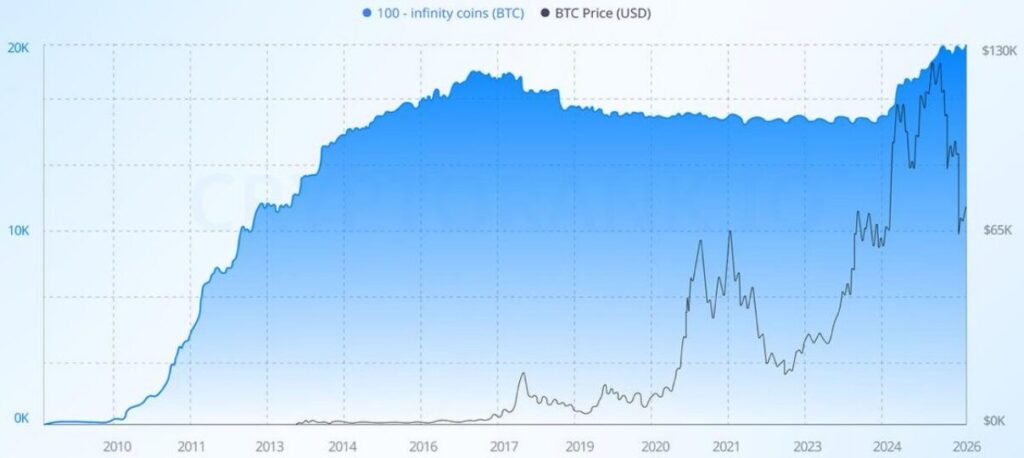
The Bitcoin market has quietly reached one of its most significant structural milestones in recent years: the number of wallets holding at least 100 BTC—commonly referred to as “whale wallets”—has now exceeded 20,000.
At current market levels, each of these wallets represents a minimum holding of approximately $6–7 million, placing them firmly within the domain of high-net-worth individuals, hedge funds, institutional custodians, and long-term strategic holders.
This metric is more than just a numerical achievement. Historically, the growth of large-holder wallets has been one of the most reliable indicators of accumulation phases in Bitcoin cycles. The current expansion suggests that large capital players are not only active—but increasingly dominant.
What makes this milestone particularly notable is that it reflects breadth, not just depth. Instead of a few mega-whales consolidating supply, more independent entities are reaching whale status. This indicates a structural broadening of large-scale ownership rather than simple concentration.
2. Redistribution Dynamics: Retail Exit, Institutional Entry
One of the most fascinating aspects of the current cycle is the apparent contradiction between price stagnation and accumulation.
Despite significant inflows into whale wallets, Bitcoin’s price has not exhibited a proportional upward breakout. This divergence strongly suggests a redistribution process:
- Retail investors are exiting positions
- Institutions and high-conviction players are absorbing supply
On-chain data supports this interpretation. Coins are increasingly moving off exchanges into cold storage, a pattern traditionally associated with long-term holding rather than speculative trading.
This phase resembles prior cycle bottoms where “weak hands” sell into strength or uncertainty, while “strong hands” accumulate quietly.
From a market microstructure perspective, this is a liquidity transfer event—one that typically precedes large directional moves once supply becomes constrained.
3. Whale Behavior as a Leading Indicator
[Whale Accumulation vs Price Divergence]
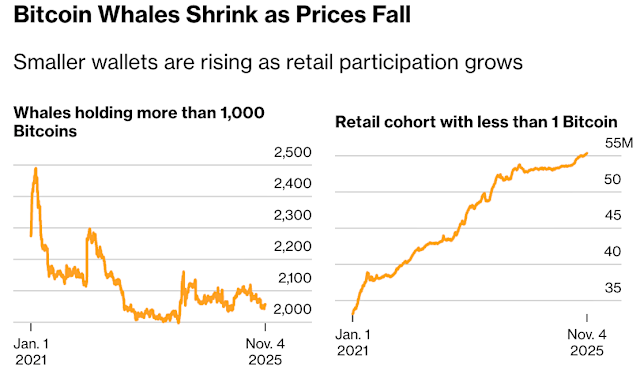
Whales have long been considered “smart money” in crypto markets. Their behavior often precedes major price trends.
Recent data highlights several important patterns:
- Wallets with 1,000+ BTC have been actively increasing holdings, adding significant supply during recent periods
- Large transactions exceeding $1 million have surged, indicating renewed high-value activity
- Dormant wallets occasionally reactivating signals long-term capital repositioning
Historically, similar patterns emerged before major bull cycles, including the 2016–2017 and 2020–2021 runs.
However, the current cycle differs in one critical way:
This time, whales are not just early adopters—they increasingly represent regulated institutions, ETFs, and corporate treasuries.
4. The Institutional Layer: A New Market Structure
The expansion of whale wallets cannot be fully understood without considering the institutional transformation of Bitcoin.
Several macro trends are converging:
4.1 Bitcoin ETFs and Capital Inflows
Spot Bitcoin ETFs have opened the door for traditional capital markets to access BTC exposure. This has led to:
- Increased demand from pension funds and asset managers
- Structured accumulation strategies
- Reduced reliance on retail-driven cycles
4.2 Corporate and Treasury Adoption
Companies are increasingly treating Bitcoin as:
- A hedge against inflation
- A reserve asset
- A strategic treasury allocation
4.3 Financialization of Bitcoin
New financial products—such as Bitcoin-denominated insurance and structured yield products—are emerging, signaling a deeper integration into global finance.
For example, firms are now offering Bitcoin-native financial services, including insurance products fully denominated in BTC, reflecting long-term conviction in the asset’s value structure.
5. Why Price Lags Behind Accumulation
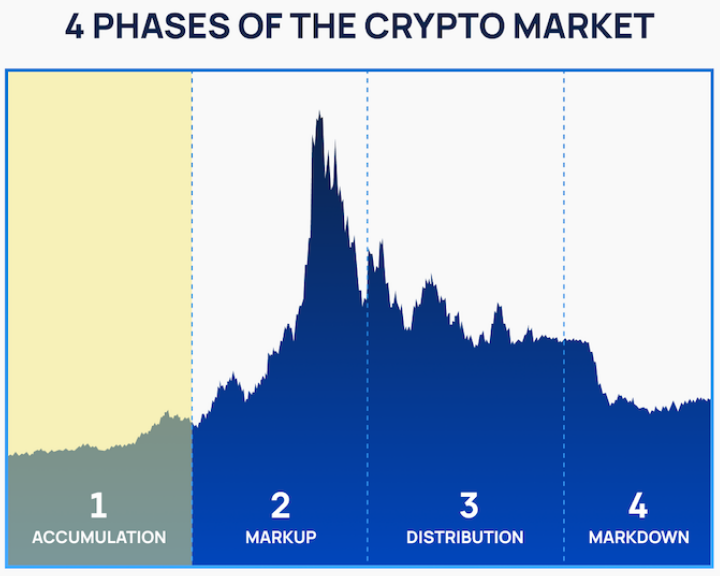
[Accumulation → Supply Shock → Bull Cycle]
A common question arises:
If whales are accumulating aggressively, why isn’t the price rising faster?
There are several structural reasons:
5.1 OTC and Hidden Liquidity
Large players often accumulate through over-the-counter (OTC) markets, minimizing price impact.
5.2 Market Absorption Phase
Markets require time to absorb supply redistribution. This creates a sideways consolidation phase.
5.3 Derivatives and Hedging
Institutional players frequently hedge positions via futures, suppressing short-term volatility.
5.4 Macro Uncertainty
Interest rates, geopolitics, and regulatory developments can delay price discovery.
However, once accumulation reaches a critical threshold, the market often enters a supply shock phase, where:
- Available BTC supply becomes scarce
- Demand accelerates
- Price moves rapidly upward
6. Implications for Investors and Builders
For readers seeking new crypto opportunities and practical blockchain applications, this shift carries important implications.
6.1 Bitcoin as a Strategic Asset
Bitcoin is increasingly behaving like:
- Digital gold
- Collateral layer for financial systems
- Institutional-grade store of value
6.2 Opportunity Beyond Bitcoin
As capital flows into BTC, secondary effects emerge:
- Liquidity rotation into altcoins
- Infrastructure demand (custody, compliance, analytics)
- Growth in DeFi and tokenized assets
6.3 Practical Business Opportunities
Builders should focus on:
- Compliance infrastructure (Travel Rule, AML systems)
- Institutional custody solutions
- Payment rails integrating crypto and fiat
- Risk management and hedging tools
Given your context (EMI/VASP operations), this trend strongly supports:
- Treasury hedging models using BTC
- Hybrid fiat-crypto settlement systems
- Institutional onboarding pipelines
7. The Bigger Picture: A Structural Financial Transition
The crossing of 20,000 whale wallets is not just a statistic—it represents a paradigm shift.
Bitcoin is evolving from:
- A retail-driven speculative asset
into:
- A globally integrated financial instrument
This transition mirrors earlier phases in financial history:
- Gold → Central bank reserve asset
- Bonds → Institutional capital backbone
- Bitcoin → Digital reserve layer
The increasing distribution among whales suggests that control over Bitcoin is becoming institutionally networked, rather than individually concentrated.
Conclusion: Quiet Accumulation Before the Next Expansion
The current Bitcoin market is defined by a paradox:
strong accumulation, weak price action.
But history suggests that this is precisely how major bull cycles begin.
- Whale wallets surpassing 20,000 confirms structural demand
- Redistribution indicates a shift toward long-term holders
- Institutional participation is redefining market dynamics
For investors, this phase represents:
- Accumulation opportunity
- Strategic positioning window
For builders, it represents:
- Infrastructure demand
- Financial system redesign
In short, Bitcoin is no longer just a trade.
It is becoming the foundation layer of a new financial architecture.
