

Key Points :
- Bitcoin has decisively broken above $70,000, entering a low-resistance “air pocket” toward $82,000
- Market structure is supported by spot demand and ETF inflows, not excessive leverage
- On-chain indicators suggest early-stage recovery, not full bullish confirmation
- Short-term holder profit-taking continues to create overhead resistance
- Derivatives markets show short dominance and declining hedging demand, enabling squeezes
- Sustained bull trend requires stronger conviction and broader capital inflow
1. Breaking Through Resistance: Entering the “Air Pocket” Zone
Bitcoin’s recent surge above $70,000 marks a technically significant milestone, but according to Glassnode’s latest on-chain analysis, this move should be interpreted with cautious optimism rather than outright bullish certainty.
The breakthrough above the $59,000–$72,000 range is particularly important because this zone represented a dense supply cluster. Using the UTXO Realized Price Distribution (URPD) metric, Glassnode identified that a large proportion of Bitcoin supply had been accumulated within this band during February and March. This created a strong resistance level, as many holders in this range could potentially sell once prices recovered to their cost basis.
Now that Bitcoin has fully cleared this region, it has entered what analysts describe as a “low-liquidity zone” between $72,000 and $82,000. In this range, historical accumulation is thin, meaning fewer investors are waiting to sell. This creates a structural “air pocket” where price can move more freely upward with limited resistance.
[URPD Distribution Showing Thin Supply Zone Between $72K–$82K]
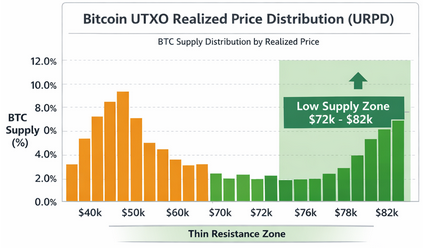
However, Glassnode emphasizes that a single breakout does not confirm a trend reversal. Markets often produce sharp upward moves during early recovery phases that later stall or retrace. Therefore, while the current structure is encouraging, it does not yet confirm the beginning of a sustained bull market.
2. Profitability Metrics: A Recovery, Not a Full Bull Market
Another critical indicator is the Percent Supply in Profit (PSP), which has now recovered to approximately 60%. This means that 60% of circulating Bitcoin supply is currently held at an unrealized profit.
Historically, this level often marks the first major resistance point during recovery cycles. In previous market cycles, Bitcoin frequently stalled around this level as investors who had endured losses used the opportunity to exit at breakeven or modest profits.
Glassnode suggests that a true bull market confirmation would require PSP to rise above 75% and sustain that level. This would indicate broad market confidence and reduced selling pressure from previously underwater holders.
Until then, the market remains in a transitional phase—no longer in deep bearish territory, but not yet in a confirmed expansion phase.
3. The Role of Short-Term Holders: A Persistent Headwind
Short-term holders (STHs) continue to play a critical role in shaping near-term price action. When Bitcoin briefly exceeded $74,000, realized profits from these participants surged to approximately $18.4 million per hour.
This pattern mirrors behavior observed earlier in February, when Bitcoin first crossed $70,000. Each breakout attempt triggered waves of profit-taking, effectively capping upward momentum.
This behavior is typical of early recovery environments. Investors who entered during recent volatility are more likely to sell quickly to secure gains, especially in uncertain macro conditions.
For Bitcoin to sustain higher levels, the market must absorb this sell-side pressure efficiently. If prices can hold above $70,000 for several weeks, it would signal strengthening demand and open the path toward $78,000 (market average price) and ultimately $82,000 (top of the low-resistance zone).
4. Spot Demand and ETF Inflows: The Backbone of the Rally
One of the most encouraging aspects of the current rally is its foundation in spot demand rather than leverage.
Over the past 30 days, U.S.-based Bitcoin ETFs have seen a sharp recovery in inflows, indicating renewed institutional interest. This suggests that capital is returning to Bitcoin not for short-term speculation, but for long-term allocation.
At the same time, CME futures open interest remains relatively subdued. This is a crucial distinction. In previous cycles, rapid price increases were often driven by leveraged positions, making them fragile and prone to liquidation cascades.
In contrast, the current environment reflects a healthier market structure, where price appreciation is supported by actual capital inflows into spot markets.
Additionally, the Cumulative Volume Delta (CVD) across major exchanges has shifted from prolonged selling dominance to emerging buying pressure. On platforms like Binance, sell pressure has significantly weakened, while institutional-focused exchanges such as Coinbase are showing consistent buying trends.
[ETF Inflows vs CME Open Interest Comparison Chart]
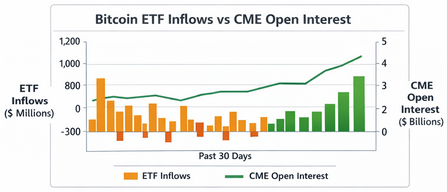
This transition suggests that the market is rebalancing toward genuine demand, which is essential for sustainable growth.
5. Derivatives Market Dynamics: Short Squeeze Fuel
Despite the strength in spot markets, derivatives data reveals a contrasting picture. Funding rates in perpetual futures markets remain negative, indicating that short positions are dominant.
This imbalance creates conditions ripe for short squeezes. When prices rise unexpectedly, short sellers are forced to buy back positions, accelerating upward momentum.
The recent move toward $74,000 appears to have been driven in part by such forced liquidations. While this can amplify gains in the short term, it does not necessarily reflect organic demand.
In the options market, implied volatility (IV) has been declining across all maturities. This suggests a reduction in hedging demand and a normalization of market conditions. Traders are gradually stepping away from panic-driven risk protection, indicating improved sentiment stability.
[Funding Rates vs Price Movement and Short Liquidations]
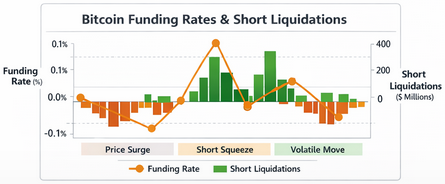
However, this also implies that the market is not yet pricing in extreme upside volatility, reinforcing the idea that conviction remains moderate.
6. Broader Market Context: Macro and Structural Trends
Beyond on-chain and derivatives data, broader macro trends are also influencing Bitcoin’s trajectory.
Institutional adoption continues to expand, with ETFs acting as a gateway for traditional capital. At the same time, global liquidity conditions and interest rate expectations remain key variables. Any shift toward monetary easing could further accelerate capital inflows into risk assets like Bitcoin.
Additionally, the narrative around Bitcoin as a store of value and hedge against fiat instability continues to gain traction, particularly in regions experiencing currency volatility.
However, risks remain. External factors such as central bank policy, geopolitical tensions, and commodity price fluctuations (e.g., rising oil prices) can introduce sudden volatility.
7. What Comes Next: Conditions for a True Bull Market
Glassnode concludes that while the current setup supports further upside in the short term, a sustainable bull market requires several conditions:
- Continued ETF inflows and institutional participation
- PSP rising above 75% and holding
- Reduction in short-term holder sell pressure
- Expansion of leverage in a controlled manner
- Broader market confidence and participation
Without these elements, the market risks remaining in a range-bound or fragile uptrend.
Conclusion: Strength Without Conviction
Bitcoin’s move above $70,000 is undeniably a strong signal, supported by improving fundamentals and renewed institutional demand. The presence of a low-resistance zone up to $82,000 creates a favorable environment for further gains.
However, the data also reveals a market still searching for conviction. Profit-taking, moderate profitability levels, and cautious derivatives positioning all point to an early-stage recovery rather than a fully established bull market.
For investors and builders in the crypto space, this phase presents both opportunity and risk. The structural improvements suggest that the foundation for a new cycle is forming—but confirmation will require patience, sustained capital inflows, and broader market alignment.
