
Key Points :
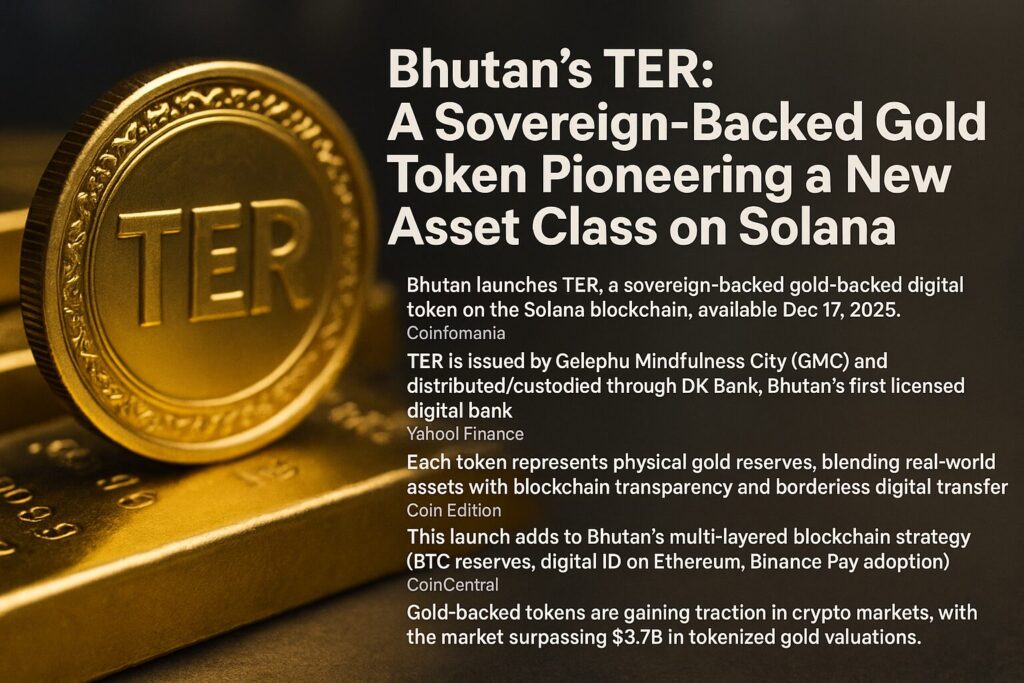
- Bhutan launches TER, a sovereign-backed gold-backed digital token on the Solana blockchain, available Dec 17, 2025.
- TER is issued by Gelephu Mindfulness City (GMC) and distributed/custodied through DK Bank, Bhutan’s first licensed digital bank.
- Each token represents physical gold reserves, blending real-world assets with blockchain transparency and borderless digital transfer.
- This launch adds to Bhutan’s multi-layered blockchain strategy (BTC reserves, digital ID on Ethereum, Binance Pay adoption).
- Gold-backed tokens are gaining traction in crypto markets, with the market surpassing $3.7B in tokenized gold valuations.
- Solana remains a key chain for stableassets and tokenization with high throughput and low fees.
Introduction: Bhutan’s Bold Step into Tokenized Gold
In a landmark move for national digital finance, the Kingdom of Bhutan is set to launch TER, a gold-backed digital token on the Solana blockchain, scheduled for public rollout on December 17, 2025. This initiative places Bhutan among a small number of countries experimenting with sovereign-supported digital assets that represent real physical reserves on-chain.
The idea of marrying physical gold with blockchain isn’t entirely new in financial innovation communities, but TER is distinct — it represents a state-backed bridge between centuries-old stores of value and next-generation digital finance. As investors seek assets that combine safety and digital liquidity, sovereign asset-backed tokens point to a hybrid future where digital markets and real-world assets intersect.
Gelephu Mindfulness City: Vision Meets Innovation
A Strategic Region for Digital Finance
Gelephu Mindfulness City (GMC) is a special administrative region in southern Bhutan conceived as a global hub for sustainable innovation, economic diversification, and technology-forward financial systems. Initially announced in December 2023, GMC combines Bhutan’s cultural values with forward-looking legal and economic frameworks designed to attract foreign investment and digital asset innovation.
Viewed as both an economic development project and an experiment in regulatory design, GMC has prioritized blockchain integration across public infrastructure, leveraging:
- Renewable energy resources for Bitcoin mining operations.
- Integration of national digital identity systems on the Ethereum blockchain.
- Adoption of Binance Pay for tourism and local commerce.
- Expansion into tokenized real-world assets with TER.
This technocratic but culturally grounded approach seeks not only to attract capital but also to create a model for ethical, sustainable digital adoption.
Understanding TER: Token Economics and Structure
What is TER and How Does It Work?
TER is a digital token fully backed by physical gold reserves held in custody and represented on Solana’s high-throughput blockchain. Each token can be thought of as a digitized certificate of ownership of allocated gold that remains physically safeguarded under institutional custody.
Key Protocol Features
- Chain: Solana
- Backing: 100% physical gold reserves
- Custody & Distribution: DK Bank (Licensed by Royal Monetary Authority of Bhutan)
- Tokenization Infrastructure: Matrixdock (licensed financial services provider)
In practical terms, investors purchasing TER are buying a tradable, blockchain-native claim on gold without the logistical challenges of physical storage or verification. This enables borderless transferability, near-instant settlement, and transparent proof of reserve through on-chain data.
Analogies to Traditional Markets
In traditional finance, gold ownership usually involves holding bullion, certificates, or gold ETFs. TER brings this into a programmable paradigm — offering the safety and intrinsic value of gold while leveraging blockchain’s interoperability and global liquidity.
Broader Market Context: Gold-Backed Tokens in 2025
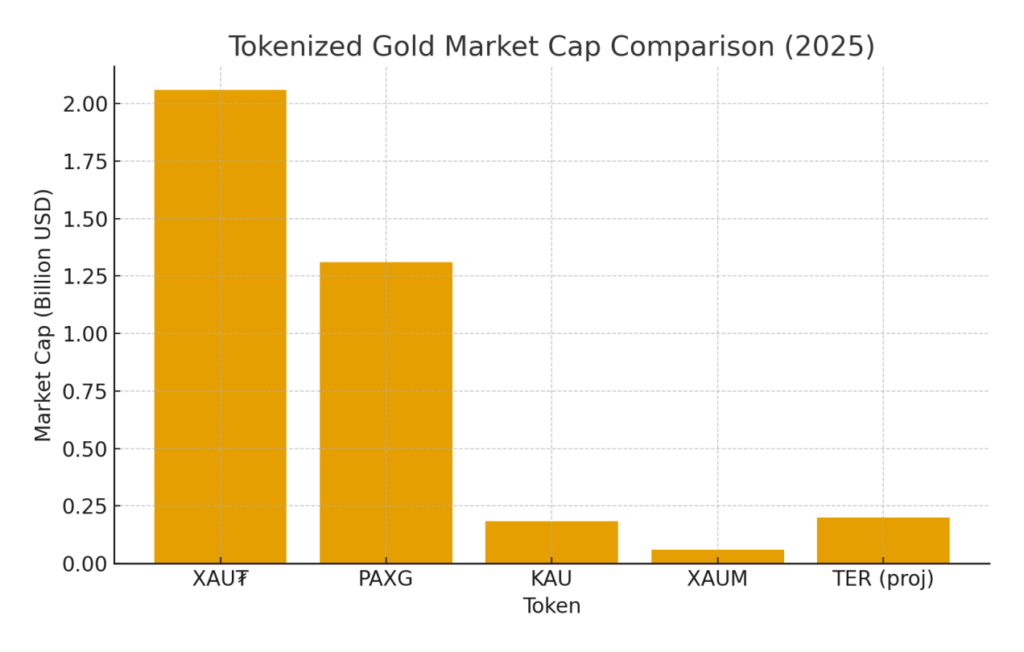
TER’s launch is part of a broader trend where digital tokens backed by physical assets are gaining traction in the crypto ecosystem. According to recent research, the market capitalization of gold-backed crypto tokens has surged to over $3.7 billion as of late 2025, buoyed by spot gold prices and increased market demand for asset-secured digital instruments.
Top Tokenized Gold Projects (2025)
| Token | Representative Asset | Approx. Market Cap (Oct 2025) |
|---|---|---|
| Tether Gold (XAU₮) | LBMA-standard physical gold | $2.06B |
| PAX Gold (PAXG) | London Good Delivery bars | $1.31B |
| Kinesis Gold (KAU) | Yield-bearing tokenized gold | $183M |
| Matrixdock Gold (XAUM) | Institutional gold token | $59.8M |
These assets demonstrate various approaches to gold tokenization — from liquid exchange-listed tokens to institutional-grade reserve representations.
Why Solana? Chain Choice Matters
TER’s issuance on Solana reflects strategic technological considerations:
- High Throughput: Scales to tens of thousands of transactions per second.
- Low Fees: Enables micro-transactions and frictionless settlement.
- Developer Adoption: Rapid growth in stableassets and Real-World Asset (RWA) tokenization.
In 2025, Solana and Base have emerged as leading chains for stablecoin and tokenized asset volumes, with Solana alone seeing stablecoin usage grow dramatically year-over-year.
This positions Solana as a premier infrastructure layer for future sovereign, institutional, and retail digital assets.
Investor Opportunities and Challenges
Why TER Could Matter to Investors
For investors seeking stable, asset-linked returns in crypto, gold-backed tokens like TER present several advantages:
- Hedge against volatility: Gold historically offers resistance to inflation and macroeconomic turmoil.
- Digital liquidity: Ability to transfer value globally without physical barriers.
- Sovereign backing: Government association may provide added trust signals.
This hybrid model could appeal to both traditional gold holders and crypto natives seeking a “best of both worlds” exposure.
Risks and Considerations
- Regulatory environment: State-backed tokens may face scrutiny outside their jurisdictions.
- Redemption policies: Terms for redeeming digital tokens for physical gold may vary by issuer.
- Market adoption: While tokenized gold markets are growing, they are smaller than fiat stablecoins.
Implications for Blockchain Adoption and Sovereign Finance
Bhutan’s TER token is more than a new crypto asset — it’s a policy experiment that could influence how nations think about digital finance. By leveraging blockchain for sovereign financial instruments, Bhutan demonstrates:
- Digital sovereignty in practice
- Bridging traditional assets with programmable finance
- Providing real utility to global investors
If successful, this could pave the way for other countries or economic zones to issue state-backed tokenized commodities spanning silver, rare stones, or cultural assets, as industry experts have suggested.
Conclusion: A New Chapter in Asset Tokenization
TER represents a fusion of legacy value and futuristic finance. It signals that sovereign actors can play a meaningful role in evolving digital markets, especially where traditional assets like gold meet blockchain’s capabilities.
For investors and practitioners in blockchain, TER is a case study in applied tokenization, one that invites exploration of:
- How sovereign tokens differ from private stablecoins
- The implications of asset-backed digital issuance on global capital flows
- The expanding realm of tokenized real-world assets beyond stablecoin paradigms
As the line between digital and physical value continues to blur, projects like TER might define the next era of financial innovation.
