
Main Points :
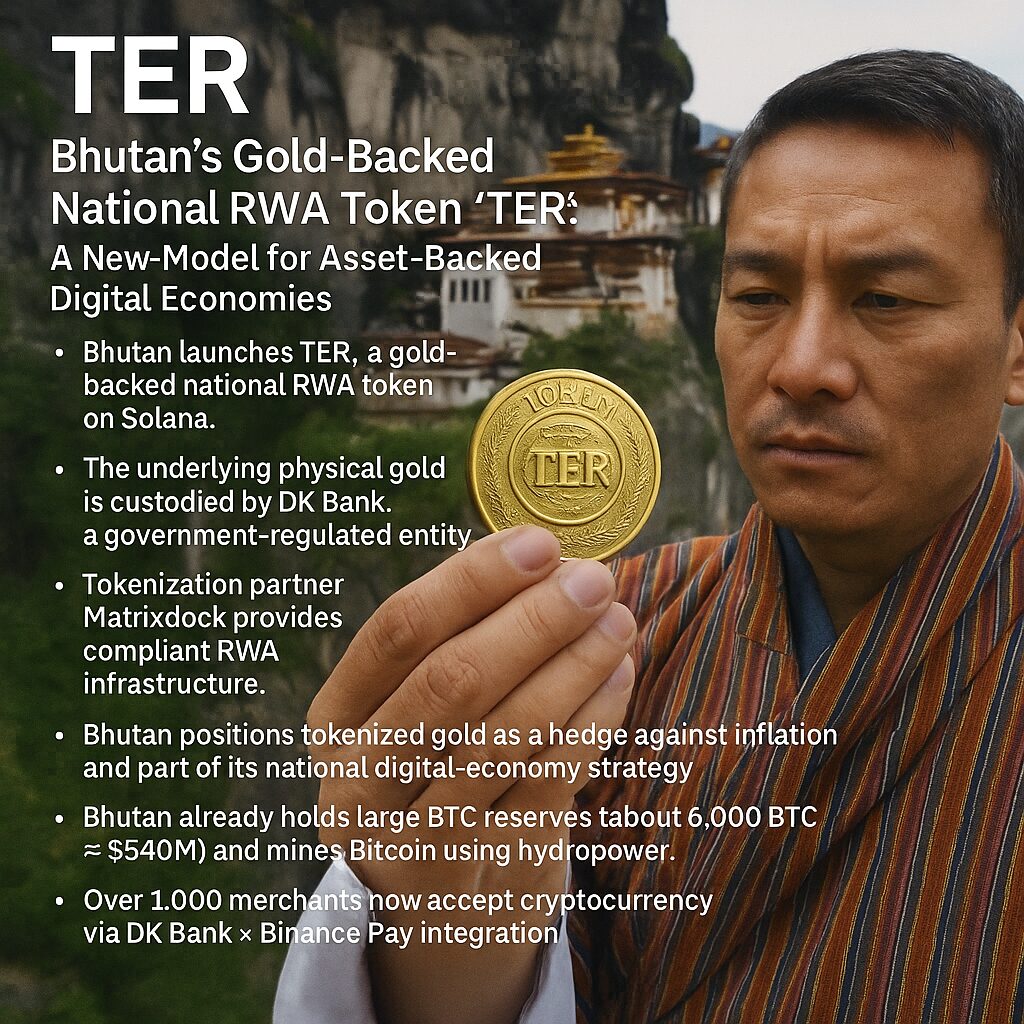
- Bhutan launches TER, a gold-backed national RWA (real-world asset) token on Solana.
- The underlying physical gold is custodied by DK Bank, a government-regulated entity.
- Tokenization partner Matrixdock provides compliant RWA infrastructure.
- Bhutan positions tokenized gold as a hedge against inflation and part of its national digital-economy strategy.
- Bhutan already holds large BTC reserves (about 6,000 BTC ≈ $540M) and mines Bitcoin using hydropower.
- Over 1,000 merchants now accept cryptocurrency via DK Bank × Binance Pay integration.
- Bhutan aims to build a sustainable, blockchain-driven financial system attracting tourism, capital, and innovation.
Introduction: Why Bhutan’s TER Token Matters
Bhutan’s announcement of a state-backed, gold-pegged digital token marks one of the most significant steps in the evolution of real-world asset (RWA) tokenization. The project, initiated by the Gelephu Mindfulness City (GMC) special administrative zone, seeks to offer investors a stable, inflation-resistant store of value while showcasing how national governments can adopt blockchain technology in a tightly regulated way.
The token, called TER, is fully backed by physical gold stored in custody by DK Bank, a digital asset bank operating under Bhutanese regulation. The token will launch on the Solana blockchain, chosen for its speed, low fees, and developer ecosystem.
Before diving into Bhutan’s strategy, it is useful to understand how the global tokenized-commodity market has evolved—especially the leading role played by tokenized gold products.
Tokenized Gold and the RWA Market Landscape
Tokenized commodities—especially tokenized gold—have emerged as one of the fastest-growing RWA sectors. Their appeal lies in offering:
- Strong inflation hedge
- 24/7 global liquidity
- Verifiable on-chain proof of reserves
- Lower cost and easier movement compared to physical commodities
Below is an illustrative breakdown of the tokenized commodity market, where gold dominates the sector.

Even though the numbers above are conceptual, they reflect a real trend: tokenized gold consistently outperforms other RWAs in adoption, particularly during periods of global inflation or macro uncertainty. Platforms such as Paxos Gold (PAXG) and Tether Gold (XAUt) have demonstrated continuous market growth, signaling strong investor appetite.
Bhutan’s TER token fits directly into this trend, but with a major difference: it is backed and issued at the national level, not by a private entity.
How TER Works: Custody, Compliance, and Accessibility
According to GMC, the TER token will be backed 1:1 by physical gold, which will remain in custody within DK Bank’s vaults. The project emphasizes institutional-grade security, transparency, and regulatory oversight. Key structural features include:
1. Custody Model
Physical gold remains within Bhutan and is fully regulated. This ensures:
- Sovereign control over reserves
- Clear legal backing
- Minimization of counterparty risk
2. Solana as the Issuance Layer
Solana allows:
- High throughput for retail and institutional transactions
- Low fees that enable global micropayments
- Broader DeFi integration
3. Matrixdock for RWA Token Standardization
Matrixdock has already tokenized treasuries and gold products globally. Its platform ensures:
- Proof-of-reserve verification
- Transparent audit trails
- Institutional compliance frameworks
Together, these components create an ecosystem that can eventually support futures, lending markets, remittances, or cross-border settlement.
Bhutan’s Strategic Vision: Blockchain as National Infrastructure
Bhutan is not entering crypto blindly—it has built a multi-year, multi-layered digital asset strategy driven by both economic and developmental goals.
1. Hydropower-Backed Bitcoin Mining
Bhutan has been quietly mining Bitcoin since 2019, leveraging its abundant hydroelectric power—clean, renewable, and low-cost.
Arkham Intelligence estimates Bhutan’s holdings to be about:
- 6,000 BTC (≈ $540M)
The growth of these strategic BTC reserves can be illustrated as follows (hypothetical trend):

Mining serves multiple purposes:
- Converts electricity surplus into a scalable financial asset
- Establishes sovereign crypto reserves
- Supports national economic diversification
2. Digital Asset Reserve Expansion
In January, GMC publicly disclosed reserves of:
- BTC
- ETH
- BNB
- Smaller allocations to memecoins and altcoins
This reserve diversification demonstrates Bhutan’s intention to participate fully in digital financial markets, not just as an observer.
3. Crypto Payments for Tourism
Tourism is one of Bhutan’s most important economic sectors. By integrating Binance Pay and DK Bank, the government enabled tourists to pay at:
- Hotels
- Travel guides
- Tourism services
- Ticketing offices
More than 1,000 merchants in Bhutan now accept cryptocurrency—an extraordinary density for a small nation.
This solves long-standing problems:
- Limited global card acceptance
- High foreign transaction fees
- Difficulty receiving payments from certain regions
Tourism officials report that crypto payments have significantly improved the visitor experience and reduced operational friction.
Why a Gold-Backed Token Now? Bhutan’s Inflation and Currency Strategy
Global inflationary pressure has made gold increasingly relevant again. For Bhutan, linking a token to gold offers:
1. A Digital Inflation Hedge
Investors can hold TER like digital gold, but with:
- Lower custody costs
- Instant liquidity
- Blockchain transparency
2. Non-Correlated National Asset Base
This moves Bhutan toward a diversified financial reserve strategy that is not purely dependent on:
- FX markets
- USD liquidity conditions
- Foreign aid flows
3. Alignment with Global RWA Market Growth
Tokenized assets—especially gold, treasuries, and real estate—are expected to surpass $10 trillion in the next decade according to multiple industry forecasts.
By entering early, Bhutan can position itself as:
- A regional RWA innovation hub
- A compliant gateway between traditional finance and digital assets
- An issuer of sovereign-grade digital assets
Implications for Investors Seeking New Crypto Assets and Income Streams
For readers interested in new tokens, yield opportunities, RWAs, or practical blockchain usage, Bhutan’s TER initiative offers several points of relevance.
1. New RWA Exposure with Sovereign Backing
Most RWA tokens today are issued by private firms. Bhutan’s TER stands out because:
- It is fully backed by a government
- Its custodian is a regulated bank
- Auditability and legitimacy are stronger
2. Potential Integration Into DeFi
Solana’s growing RWA ecosystem includes:
- Lending markets
- Liquidity pools
- Institutional credit protocols
If TER becomes composable in these systems, investors may gain:
- Yield opportunities
- Collateralized borrowing
- Hedging products
3. Blue-Ocean Market: State-Backed RWAs
Bhutan’s move may inspire other countries—especially smaller economies—to tokenize:
- Gold reserves
- Natural resources
- Treasury instruments
- Energy-backed tokens
This opens entirely new categories for early-stage investment.
Comparison With Other Tokenized Gold Projects
| Token | Backing | Issuer Type | Chain | Notes |
|---|---|---|---|---|
| PAXG | Physical gold | Private (Paxos) | Ethereum | NY-regulated, high liquidity |
| XAUt | Physical gold | Private (Tether) | Ethereum/TRON | Largest market cap |
| GLC (various) | Mixed | Private | Multi-chain | Often low-regulation |
| TER (Bhutan) | Physical gold | Government-backed | Solana | Sovereign-grade RWA |
The sovereign nature of TER may give it a credibility advantage, especially in conservative markets.
The Outlook for Bhutan’s Digital Economy
Bhutan is creating a digital economy with five pillars:
1. State-Backed Crypto Infrastructure
Blockchain becomes part of national infrastructure rather than an external niche industry.
2. Sovereign Digital Reserves
BTC, ETH, and gold-backed tokens create a diversified, modern reserve structure.
3. Tourism Powered by Crypto Payments
Solves long-standing payment limitations.
4. Attracting Global Investors and Innovators
GMC aims to be a “mindfulness city” blending economic, environmental, and technological frameworks.
5. Positioning Itself as a Regional RWA Leader
Early adoption gives Bhutan first-mover advantage in Asia.
Conclusion
Bhutan’s launch of the TER token represents more than a technical upgrade—it signals the emergence of sovereign RWA tokenization as a new financial paradigm. With physical gold backing, regulated custody, Solana-based issuance, and a nationally coordinated digital-asset strategy, Bhutan demonstrates how small nations can leverage blockchain not only for economic diversification but also for a more stable and inclusive financial future.
For crypto investors, builders, and institutions seeking new opportunities, TER may become one of the most compelling RWA assets in the global digital-asset landscape. Combined with Bhutan’s mining reserves, tourism crypto payments, and multi-chain innovation strategy, the country stands as a model for how blockchain can integrate with real-world national development.
