
Main Points :
- India’s central bank has formally proposed linking BRICS central bank digital currencies (CBDCs) to facilitate cross-border trade, tourism payments, and financial settlement.
- The initiative aims to reduce structural dependence on the U.S. dollar, potentially reshaping global payment flows.
- All major BRICS members are already running CBDC pilot programs, with India and China leading in scale and experimentation.
- Interoperability, governance, FX imbalance settlement, and geopolitical pressure remain the biggest hurdles.
- For crypto-native and blockchain-focused readers, this proposal signals both competition and opportunity for private stablecoins, DeFi rails, and enterprise blockchain infrastructure.
1. India’s Proposal: A Strategic Move Beyond Domestic CBDC
According to a Reuters report dated January 19, 2026, the Reserve Bank of India (RBI) has formally proposed the creation of a linked CBDC framework among BRICS nations. The goal is not merely technological experimentation, but a structural rethinking of how cross-border value moves between emerging economies.
The RBI has recommended that the Indian government include this proposal on the official agenda of the 2026 BRICS Summit, which India is scheduled to host later this year. If accepted, this would mark the first formal, multilateral proposal to interconnect national CBDCs within the BRICS bloc.
Unlike earlier CBDC discussions that focused mainly on domestic efficiency—such as reducing cash handling costs or improving retail payment speed—this proposal is explicitly international and geopolitical in nature. It targets trade finance, tourism payments, and intergovernmental settlements, areas traditionally dominated by correspondent banking and dollar-denominated rails.
From a strategic standpoint, India is positioning itself not only as a large emerging market, but as a payments architect for the Global South.
2. The BRICS Context: Payments, Power, and the Dollar Question
BRICS—BRICS (Brazil, Russia, India, China, and South Africa)—has long discussed reducing reliance on the U.S. dollar. However, until recently, most initiatives remained conceptual or politically symbolic.
This proposal builds directly on the 2025 Rio de Janeiro BRICS Summit Declaration, which emphasized:
- Interoperability between national payment systems
- Local-currency settlement in trade
- Technological cooperation in financial infrastructure
CBDCs offer something previous efforts lacked: a programmable, sovereign settlement layer that does not require U.S. correspondent banks, SWIFT messaging dominance, or dollar liquidity pools.
From a macro perspective, this is not about replacing the dollar overnight. Instead, it is about incrementally rerouting specific corridors—for example:
- India–China trade settlement
- Tourism payments between BRICS countries
- Energy and commodity trade invoicing
Each corridor moved off USD rails reduces friction, costs, and exposure to sanctions risk.
3. A Potential Flashpoint with the United States
The geopolitical implications are hard to ignore.
Former U.S. President Donald Trump has previously characterized BRICS as “anti-American” and warned that member states attempting to undermine the dollar could face punitive tariffs or trade retaliation.
While the RBI proposal is framed in neutral, technical language, its implications align with a broader trend: monetary multipolarity.
For the United States, the concern is not just about lost influence, but about:
- Reduced visibility into cross-border flows
- Weakened sanction enforcement mechanisms
- Competition with U.S.-regulated stablecoins
Ironically, aggressive U.S. regulatory pressure on private stablecoins may accelerate interest in state-backed digital alternatives abroad.
4. Current State of BRICS CBDCs: From Pilot to Practice
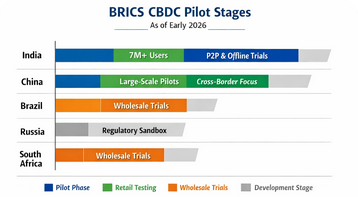
All five major BRICS members are already running CBDC pilot programs, though none have reached full national rollout.
India: Digital Rupee (e-Rupee)
India launched its retail digital rupee in December 2022. As of early 2026:
- Over 7 million individual users
- Active pilots in retail payments, P2P transfers, and merchant settlement
- Increasing experimentation with offline payments and programmable features
China: Digital Yuan (e-CNY)
China has been the most vocal about internationalizing its CBDC:
- Large-scale domestic pilots across multiple cities
- Integration with transport, retail, and government services
- Explicit statements supporting cross-border usage
Others (Brazil, Russia, South Africa)
These countries are at varying pilot stages, focusing on:
- Wholesale settlement
- Interbank use cases
- Regulatory sandboxes
[Comparative chart of BRICS CBDC pilot stages]
5. Interoperability: The Hard Problem No One Can Skip
While the vision is compelling, the execution is complex.
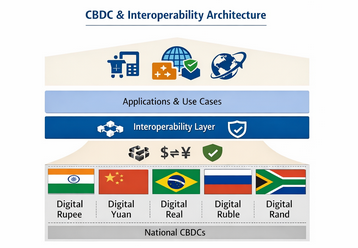
For a BRICS-wide CBDC network to function, at least four layers must align:
- Technical Interoperability
- Messaging standards
- Settlement finality rules
- Identity and wallet compatibility
- Governance and Trust
- Who operates shared infrastructure?
- How disputes are resolved
- Audit and compliance oversight
- FX and Trade Imbalance Settlement
- Persistent trade surpluses (e.g., China) vs. deficits (e.g., others)
- Need for netting, collateral, or synthetic liquidity pools
- Regulatory Harmonization
- AML/CFT standards
- Data localization requirements
- Capital controls
One major political hurdle is that countries may be reluctant to adopt another nation’s technical platform, particularly if it implies dependency or surveillance risk.
This suggests that the final architecture is more likely to resemble a federated network than a single shared ledger.
6. Implications for Crypto, Stablecoins, and Blockchain Builders
For readers interested in new crypto assets, revenue opportunities, and practical blockchain use, this development matters deeply.
Competitive Pressure on Stablecoins
If BRICS CBDCs succeed in cross-border settlement:
- Demand for USD-backed stablecoins in these corridors may decline
- Yield-based stablecoin models could face regulatory headwinds
This concern has already been echoed by industry figures such as Anthony Scaramucci, who warned that restricting stablecoin yields could weaken competitiveness against state-backed digital currencies like the e-CNY.
New Infrastructure Opportunities
At the same time, CBDC interoperability creates demand for:
- Middleware and routing layers
- FX netting and liquidity optimization protocols
- Compliance-as-code solutions
- Wallet UX abstraction
Private blockchain companies may not issue the money—but they can build the rails, tooling, and interfaces.
[Layered architecture diagram—CBDCs, interoperability layer, applications]
7. Tourism, Trade Finance, and Real-World Adoption
One underappreciated aspect of the RBI proposal is its focus on tourism and trade finance, not just interbank settlement.
Imagine:
- A Brazilian tourist paying in digital reais in India, instantly converted to e-rupees
- Indian exporters settling invoices with South African partners without USD conversion
- Smart-contract-based trade finance triggering payment on delivery
These are high-volume, real-economy use cases, far removed from speculative crypto trading.
If successful, CBDC linkages could normalize digital sovereign money in daily cross-border life—something crypto has long promised but rarely achieved at scale.
8. Risks and Open Questions
Despite the optimism, several risks remain:
- Political risk: A change in government priorities could stall momentum
- Fragmentation risk: Competing standards could limit scale
- Privacy concerns: Users may resist state-level transaction visibility
- U.S. response: Trade or regulatory countermeasures remain possible
None of these are trivial. Yet, the fact that such risks are now being debated seriously suggests that CBDCs have moved from theory to strategy.
Conclusion: A Quiet Turning Point in Global Finance
India’s proposal to link BRICS CBDCs is more than a technical experiment—it is a signal of intent.
It reflects a world where:
- Monetary power is increasingly multipolar
- Digital infrastructure defines economic sovereignty
- Blockchain principles are being adopted by states, not just startups
For crypto-native builders and investors, this is not a death knell—it is a transition phase. The future may belong neither to purely private money nor purely state money, but to hybrid systems where public and private infrastructure coexist.
Those who understand this shift early will be best positioned to build, invest, and operate in the next generation of global finance.
