
Main Points :
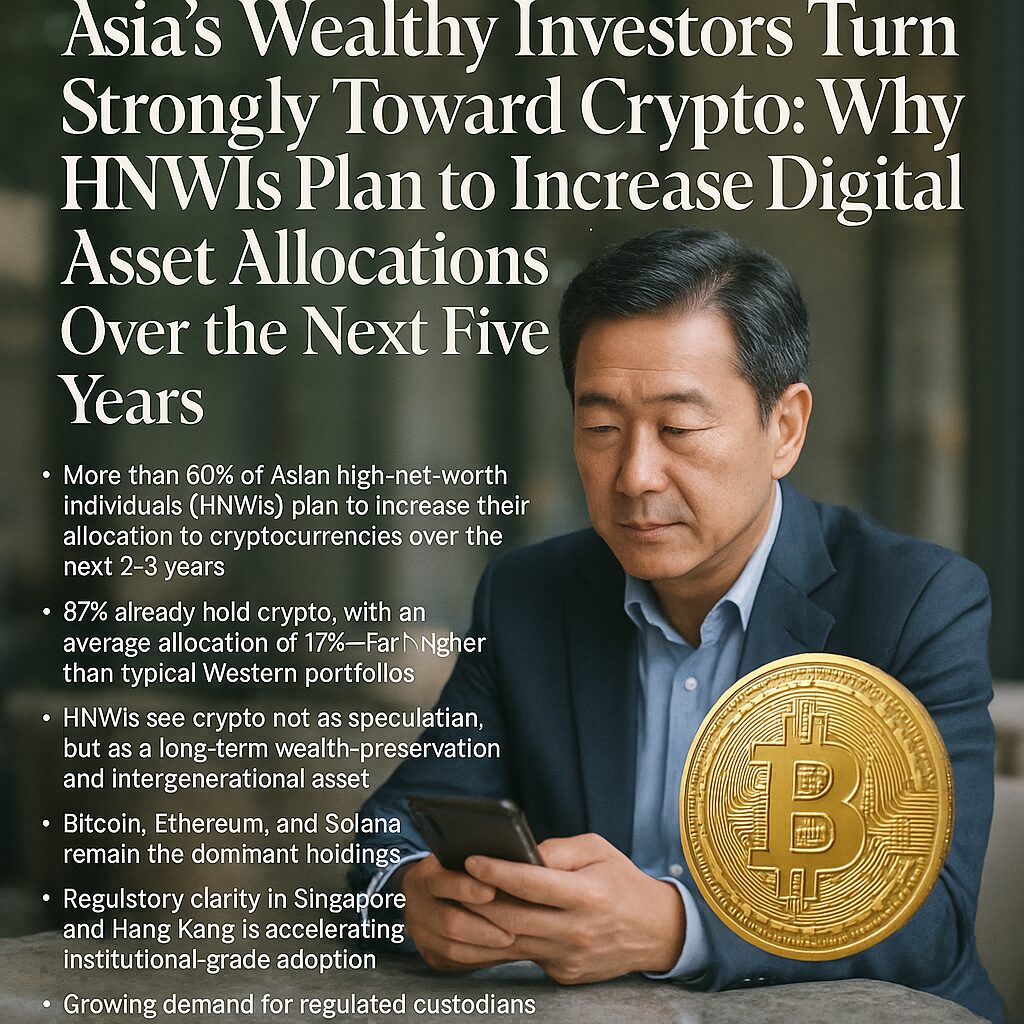
- More than 60% of Asian high-net-worth individuals (HNWIs) plan to increase their allocation to cryptocurrencies over the next 2–5 years.
- 87% already hold crypto, with an average allocation of 17%—far higher than typical Western portfolios.
- HNWIs see crypto not as speculation, but as a long-term wealth-preservation and intergenerational asset.
- Bitcoin, Ethereum, and Solana remain the dominant holdings.
- Regulatory clarity in Singapore and Hong Kong is accelerating institutional-grade adoption.
- Growing demand for regulated custodians, compliance-grade infrastructure, and tokenized assets is reshaping the investment landscape.
- The trend aligns with global macro shifts including Bitcoin ETF inflows, institutional tokenization pilots, and rising adoption across APAC.
1. Introduction: A Structural Shift in Asian Wealth Management
A new report from Sygnum, the APAC HNWI Report 2025, reveals a decisive trend: wealthy investors across Asia are rapidly integrating digital assets into their long-term wealth strategies.
The findings are not about hype or short-term speculation. Rather, they highlight a shift toward professionalized, multi-generational crypto investment, driven by institutional infrastructure and improved regulatory clarity.
Asia is already home to some of the most technologically sophisticated and financially dynamic markets in the world. Combined with a maturing regulatory environment, the region is poised to become a global leader in digital asset adoption among private wealth clients.
2. The Numbers Behind the Trend: Growing Confidence in Crypto
Sygnum’s survey of 270 high-net-worth and professional investors across Singapore, Hong Kong, Indonesia, Korea, and Thailand reveals striking adoption levels:
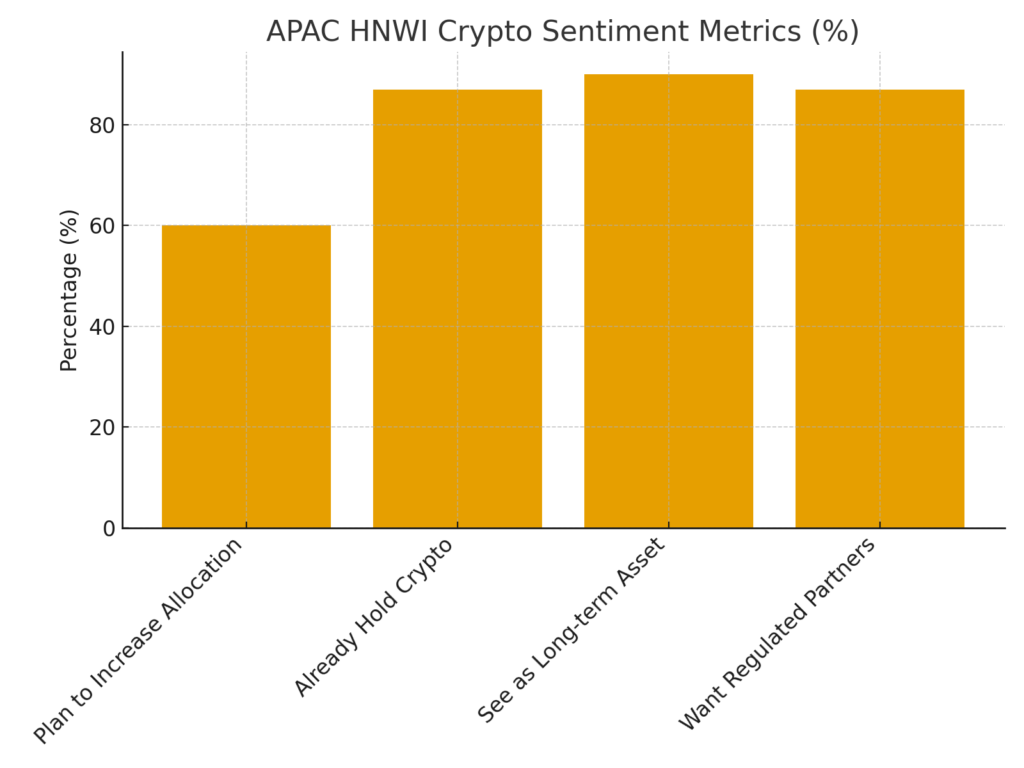
- 87% already own cryptocurrency
- 60% plan to increase holdings over the next 2–5 years
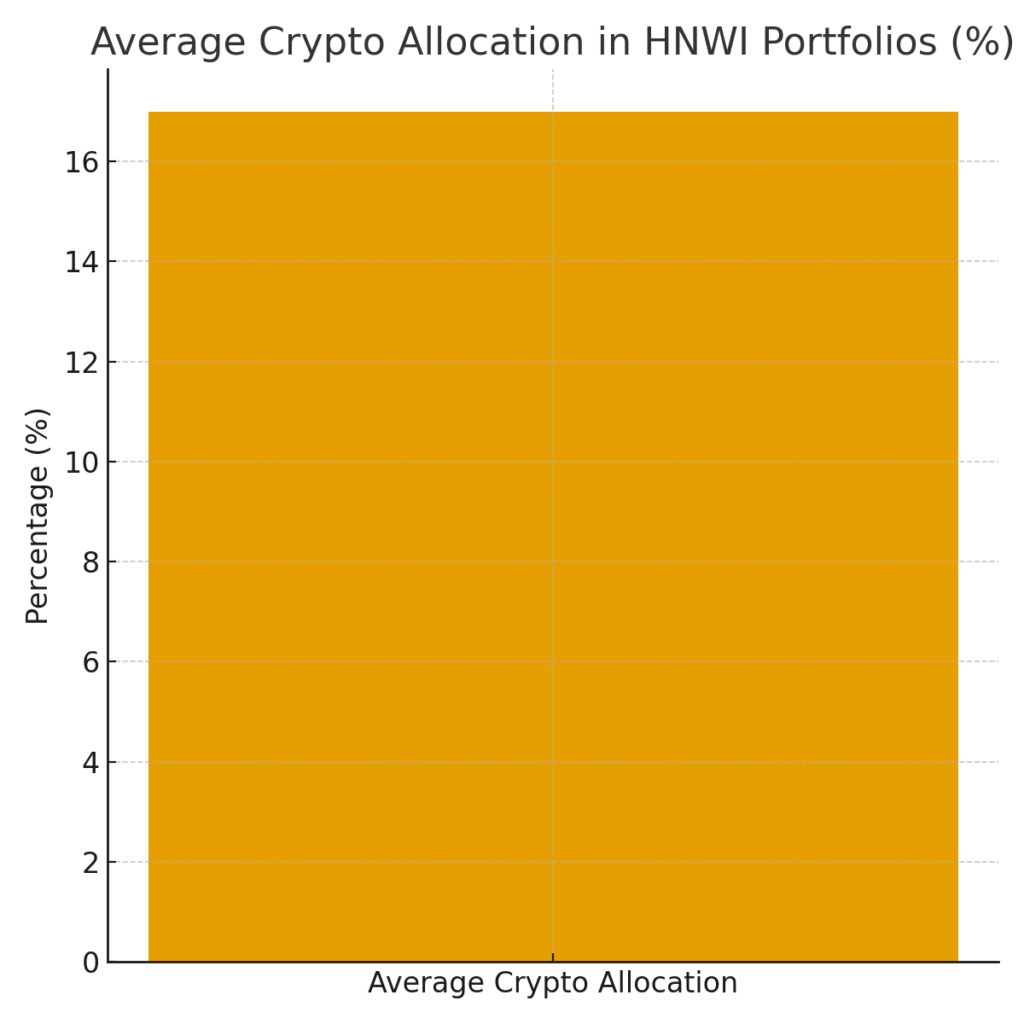
- Average portfolio allocation = 17%
- Nearly 90% consider crypto a long-term asset, not a speculative trade
- 87% want private banks to offer regulated crypto services
These numbers suggest that digital assets are now seen as a core component of modern wealth management, comparable to gold, private equity, or real estate.
3. What Wealthy Investors Are Buying: BTC, ETH, SOL Lead the Pack
Among active investors:
- 80% hold Bitcoin, Ethereum, or Solana
- 56% cite portfolio diversification as their primary motivation
Bitcoin remains the digital equivalent of gold—a hedge against macro uncertainty and monetary debasement. Ethereum continues to dominate institutional discussions around tokenization, staking, and the future of the decentralized internet. Meanwhile, Solana’s performance and network throughput have earned it a strong position among sophisticated investors seeking high-growth blockchain exposure.
This diversification indicates that HNWIs are not merely speculating—they are building structured, multi-asset crypto portfolios, much like institutional funds.
4. Long-Term Perspective: Wealth Preservation and Succession Planning
One of the most transformative findings is how wealthy investors view crypto. Sygnum’s APAC CEO Gerald Goh emphasizes that today’s crypto investors differ sharply from those in 2017:
“They are not speculators. They are thinking about 10–20 year horizons, and planning for intergenerational wealth transfer.”
This shift indicates growing confidence that digital assets will remain a permanent part of global financial infrastructure—especially in Asia, where digital payment adoption, mobile banking penetration, and blockchain innovation are expanding faster than in Europe or North America.
5. Regulation as a Catalyst: Why Asia Leads the Institutional Cycle
A recurring theme in the report is Asia’s regulatory clarity.
While the U.S. struggles with fragmented rules and enforcement-driven policy, regions like Singapore and Hong Kong have instead implemented structured, transparent licensing frameworks, including:
- Capital requirements
- Custody and segregation standards
- Internal controls and risk frameworks
- Investor protection mandates
- Operational compliance guidelines
Gerald Goh explains that although rules may appear strict, they reduce ambiguity, allowing professional investors to enter the market confidently.
Singapore’s MAS provides clear standards for custody, safeguarding, and operational risk, while Hong Kong’s licensing regime has welcomed retail crypto access under tightly regulated conditions.
In wealth management, certainty is more valuable than looseness, making Asia a natural hub for institutional-grade crypto adoption.
6. Broader Market Context: Why This Trend Is Accelerating Now
To strengthen the article beyond the original report, we incorporate recent developments across global markets:
A. Bitcoin and Ethereum ETFs Are Reshaping Institutional Access
- U.S. spot Bitcoin ETFs have drawn tens of billions of dollars since launch.
- Analysts expect Ethereum ETFs to accelerate a similar institutional cycle.
- APAC investors often mirror trends that begin in U.S. capital markets.
B. Tokenization of Real-World Assets (RWA) Gains Traction
Major banks—including HSBC, Standard Chartered, Citi, and DBS—have already launched tokenization pilots for:
- Money market funds
- Government bonds
- Trade finance assets
Tokenization increases liquidity, transparency, and 24/7 accessibility—a perfect match for APAC’s globally distributed investor base.
C. Stablecoin Adoption Surges Across Asia
With growing use in remittances, cross-border settlements, and merchant payments, stablecoins like USDC and USDT serve as the bridge between traditional finance and crypto-native ecosystems.
D. Solana and Layer-2 Networks Multiply Use Cases
From DePIN networks to high-throughput decentralized exchanges, emerging blockchain ecosystems offer real-world commerce applications, appealing to wealthy investors seeking the next frontier.
7. Why Asian HNWIs Are Increasing Allocation: Four Strategic Motivators
(1) Portfolio Diversification
Crypto provides a non-correlated asset class that historically outperforms traditional markets during bull cycles.
(2) Intergenerational Wealth Transfer
Digital assets are easier to store, fractionalize, and transmit across borders—ideal for global families.
(3) Inflation and Currency Risk
As global monetary policy undergoes structural uncertainty, crypto acts as a hedge similar to gold.
(4) Growing Utility and Institutional Infrastructure
Investors now have access to:
- Regulated custodians
- Bank-grade security
- Institutional staking products
- Insured crypto storage
- Tokenized assets
This infrastructure did not exist in 2017, which is why adoption is accelerating today.
8. Risks and Challenges: What Investors Still Worry About
Despite the optimism, wealthy investors recognize key challenges:
- Volatility in token markets
- Regulatory divergence across jurisdictions
- Custody risks for self-managed wallets
- Lack of standardization among exchanges and service providers
- Liquidity fragmentation between blockchains
However, these risks are increasingly mitigated by institutional-grade solutions, and are no longer seen as barriers to long-term allocation.
9. Conclusion: APAC Will Lead the Institutional Crypto Cycle
Based on Sygnum’s findings and broader market context, the next 2–5 years will likely see:
- Expanded institutional product offerings
- Increased tokenization of traditional assets
- Growing private-bank-integrated crypto solutions
- Higher portfolio allocations among HNWIs (possibly reaching 20–25%)
Asia’s regulatory clarity, plus the region’s appetite for innovation, positions it at the forefront of global digital asset adoption.
For investors seeking new opportunities—whether in BTC, ETH, SOL, emerging L2 ecosystems, or tokenized RWAs—the APAC market signals a strong and accelerating demand cycle.
Crypto is no longer the “future of finance.”
For Asia’s wealthy investors, it is already part of their present financial architecture.
