
Main Points :
- Nearly 38% of altcoins are trading near their historical lows, worse than during the FTX collapse.
- Liquidity is shifting away from altcoins toward Bitcoin, equities, and commodities.
- Social sentiment toward altcoins has fallen to two-year lows, reflecting declining investor interest.
- The explosive growth of millions of tokens competing for limited capital has diluted market attention.
- Some analysts believe the downturn could become a strategic accumulation opportunity for long-term investors.
The Altcoin Market Faces Its Deepest Drawdown of the Current Cycle
The cryptocurrency market is once again entering a period of intense stress, but the pain is not evenly distributed across all digital assets. While Bitcoin continues to maintain relative strength compared with the broader market, a large portion of the altcoin sector has entered what analysts describe as one of the most severe downturns in recent years.
According to data analyzed by CryptoQuant analyst Darkfost, approximately 38% of altcoins are currently trading at or very near their all-time lows. This metric has become an important signal for understanding market stress because it reflects the percentage of digital assets that have lost nearly all of their historical value.
What makes this development particularly notable is that the situation is even worse than the market conditions observed after the collapse of FTX in 2022, one of the most catastrophic events in cryptocurrency history. At that time, roughly 37.8% of altcoins were trading near their historical bottoms. Earlier in April 2025, the same metric had reached around 35%.
Today’s data therefore suggests that the altcoin sector is experiencing a structural contraction rather than just a temporary market correction.
Percentage of altcoins trading near all-time lows.
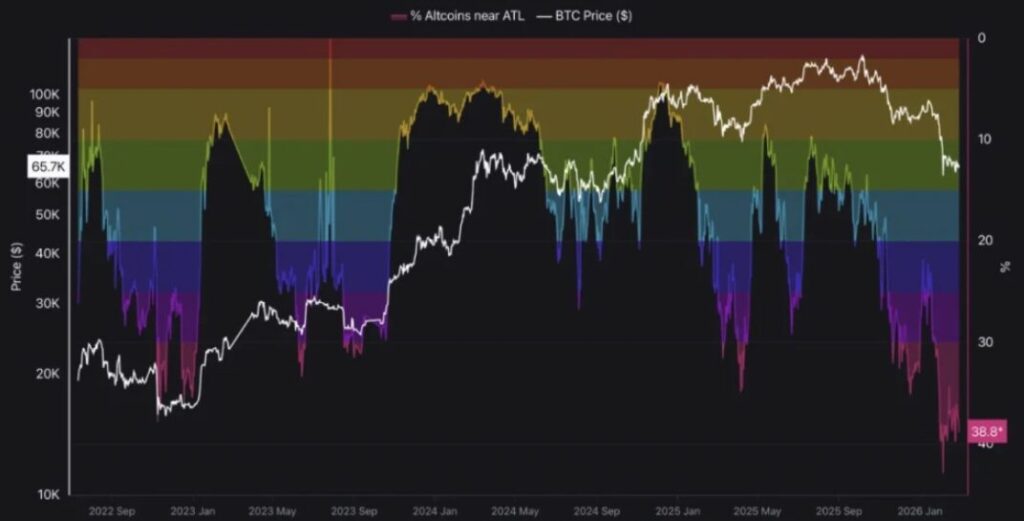
The chart above illustrates the growing share of altcoins trading close to historical lows, highlighting the scale of the current downturn across the broader crypto market.
Liquidity Is Leaving the Altcoin Ecosystem
One of the key drivers behind the ongoing decline in altcoin valuations is the migration of liquidity toward other asset classes.
In previous crypto cycles, capital would typically rotate from Bitcoin into altcoins once the leading cryptocurrency entered a consolidation phase. This phenomenon—often called the “altseason”—created explosive rallies in smaller tokens.
However, the current cycle appears to be unfolding differently.
Instead of flowing into altcoins, liquidity is increasingly moving into:
- Bitcoin, which is increasingly viewed as a macro asset
- U.S. equities, particularly technology stocks
- Commodities such as gold
- Traditional financial products linked to Bitcoin
Data from CoinMarketCap illustrates the contrast clearly. During the dramatic market crash of October 10, 2025, daily trading volume across the cryptocurrency market exceeded $417 billion.
By comparison, between February and March 2026, daily trading volume has fluctuated between approximately $49.4 billion and $268 billion.
Total3 index – cryptocurrency market capitalization excluding Bitcoin and Ethereum.
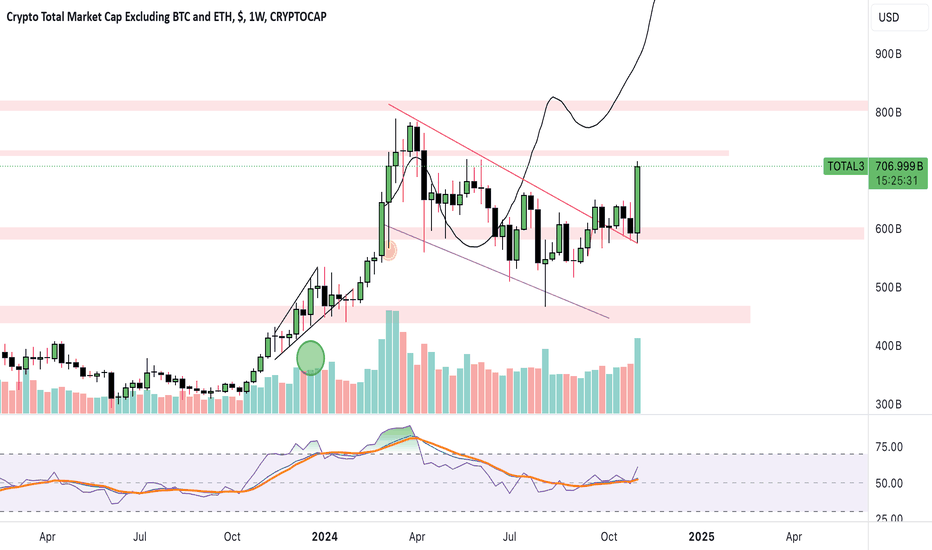
The Total3 metric, which tracks the market capitalization of all cryptocurrencies excluding Bitcoin and Ethereum, has retraced back to levels last seen in November 2024. This indicates that a large amount of capital has effectively exited the altcoin market.
Major Altcoins Hover Near Historical Bottoms
The downturn is not limited to obscure tokens. Even well-known altcoins that once commanded strong market attention are now trading dangerously close to their historical lows.
Examples include:
- Cardano (ADA): currently trading only about $0.10 above its historical low of $0.17.
- Polkadot (DOT): recorded an all-time low of $1.13 earlier this year before recovering about 33%.
- Polygon (POL): trading roughly $0.02 above its historical low of $0.08.
These examples illustrate a broader pattern in which many previously high-profile blockchain ecosystems are struggling to regain investor confidence.
For many retail investors who entered the market during the previous bull cycle, these price levels represent devastating losses.
Yet for long-term investors, such deep drawdowns have historically represented periods of maximum pessimism—often a precursor to major market recoveries.
Social Sentiment Around Altcoins Has Collapsed
Market prices are only part of the story. Equally important is the shift in social sentiment surrounding altcoins.
Blockchain analytics platform Santiment recently reported that social media mentions of altcoins have dropped to their lowest level in two years.
Meanwhile, Google Trends data shows that global searches for the keyword “altcoins” have fallen to a score of 4 out of 100, representing the lowest level of interest over the past year.
Global search interest in the keyword “altcoins.”
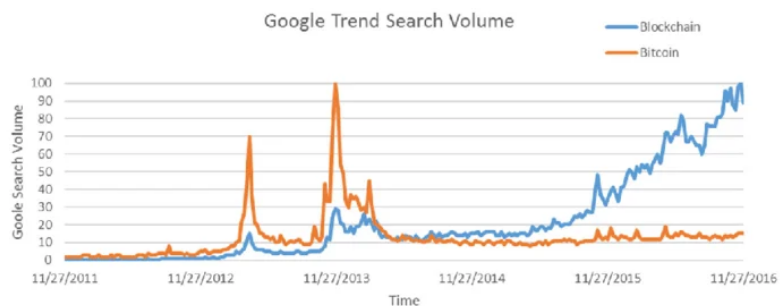
Low search interest typically reflects a broader decline in retail participation in the market.
Historically, cryptocurrency bull markets have been accompanied by massive increases in retail search traffic. The current environment, by contrast, suggests that much of the speculative enthusiasm surrounding altcoins has faded.
Structural Challenges: Too Many Tokens, Too Little Capital
Another major factor contributing to the weakness of the altcoin market is the explosion in the number of available tokens.
At the time of writing, CoinMarketCap lists more than 36.8 million distinct tokens across various blockchains.
This staggering number reflects the rapid growth of token creation platforms, decentralized exchanges, and meme coin ecosystems.
However, it also creates a fundamental economic problem: capital dilution.
Investor capital is finite, but the number of projects competing for attention continues to grow exponentially. As a result:
- Liquidity becomes fragmented.
- Many projects struggle to maintain market relevance.
- Investor attention becomes increasingly short-lived.
Axis co-founder Jimmy Hsu described the situation as a “liquidity drought” affecting the altcoin market.
Because many altcoins lack strong institutional backing or compelling narratives, even small shifts in market sentiment can trigger large and sudden sell-offs.
The Bitcoin ETF Effect
Another structural change influencing the crypto market is the emergence of Bitcoin spot ETFs.
These investment vehicles allow institutional investors to gain exposure to Bitcoin through traditional financial markets without directly holding cryptocurrency.
While ETFs have dramatically increased capital inflows into Bitcoin, they may also have had an unintended consequence: locking liquidity within traditional financial products rather than distributing it across the broader crypto ecosystem.
In previous market cycles, new capital entering the cryptocurrency market often flowed into altcoins after Bitcoin rallies. Today, however, a significant portion of that capital remains concentrated in institutional Bitcoin products.
This shift has fundamentally changed market dynamics.
Bitcoin is increasingly being treated as a macro asset similar to digital gold, while altcoins are increasingly viewed as speculative venture investments.
Could This Be a Historic Buying Opportunity?
Despite the bleak market outlook, some analysts argue that the current downturn may present a rare opportunity for strategic investors.
Historically, the most profitable crypto investments have often occurred during periods of maximum pessimism.
For example:
- After the 2018 crypto winter, many major tokens eventually recovered by more than 10x.
- Following the FTX collapse, several assets later staged significant rebounds once market confidence returned.
The key question is whether the current altcoin market contraction represents a temporary cyclical downturn or a permanent structural shift in the cryptocurrency ecosystem.
If the latter proves true, the future crypto market may become increasingly dominated by a smaller number of high-quality blockchain platforms rather than thousands of speculative tokens.
Conclusion
The current state of the altcoin market reflects a profound transformation in the cryptocurrency ecosystem.
With 38% of altcoins trading near their historical lows, investor sentiment collapsing, and liquidity migrating toward Bitcoin and traditional financial markets, the sector is undergoing one of the most difficult periods in its history.
However, market crises often create the foundations for the next wave of innovation.
For investors, developers, and entrepreneurs interested in the practical applications of blockchain technology, the current environment may serve as a critical filtering process—separating sustainable projects from speculative hype.
Whether this moment represents the end of the altcoin boom or the beginning of a new phase of blockchain innovation remains one of the most important questions facing the cryptocurrency industry today.
