
Main Points :
- A $4 trillion U.S. crypto market faces long-overdue regulatory clarity through a bipartisan push.
- CFTC would have clear jurisdiction over spot markets for non-securities digital commodities.
- SEC would integrate tokenized securities into existing disclosure frameworks.
- New powers, funding, and enforcement for both regulators covering custody, conflicts of interest, DeFi.
- New restrictions on public officials’ involvement and mandatory disclosure of digital holdings.
- DeFi protocols and stablecoins regulated, including ban on interest-bearing stablecoin products.
- Platforms must register under FinCEN; AML/counter-terrorism safeguards required.
- Bipartisan and durable regulatory structure aimed at restoring trust, preventing abuse, and fostering U.S. innovation leadership.
Introduction
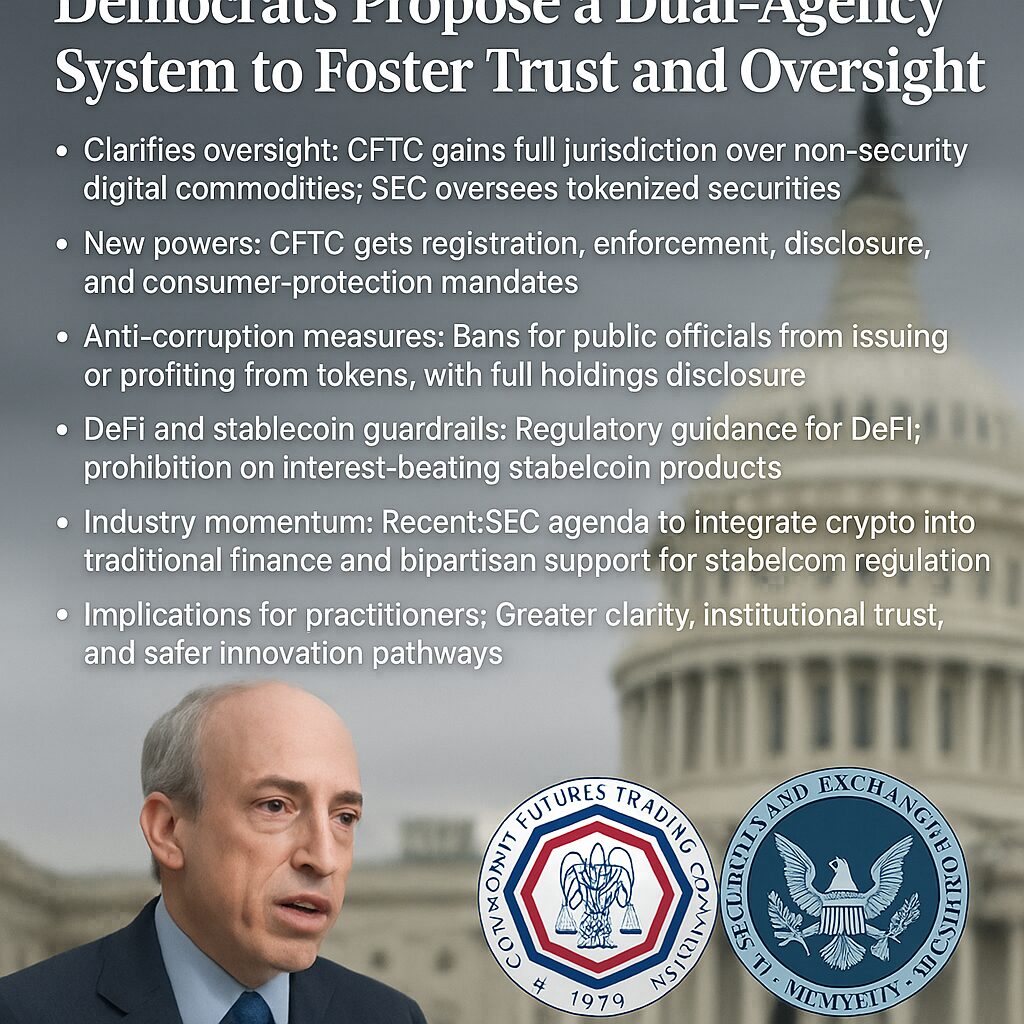
The U.S. crypto industry—now valued at nearly $4 trillion—has long suffered from regulatory ambiguity that has hampered both innovation and investor protection. On September 9, 2025, a group of Senate Democrats unveiled a sweeping regulatory framework aimed at filling these gaps. The proposal lays out a dual-agency model assigning jurisdiction to the Commodity Futures Trading Commission (CFTC) and the Securities and Exchange Commission (SEC), strengthens enforcement and transparency, places checks on public officials, and tightly regulates decentralized finance (DeFi) and stablecoins. This initiative represents a potential inflection point, designed to restore confidence and help America lead the next wave of blockchain innovation. Notably, this framework comes on the heels of the bipartisan GENIUS Act, which established a federal stablecoin regime earlier this year.
1. Regulatory Jurisdiction Clarified: CFTC vs. SEC
At the heart of the Democrats’ proposal is a clear bifurcation of regulatory roles:
- The CFTC would gain full jurisdiction over spot markets for digital commodities that are not securities—including popular tokens like Bitcoin, Ethereum, and DeFi tokens. Importantly, the agency would receive new registration and enforcement powers, along with disclosure and consumer-protection mandates for trading platforms.
- The SEC, in contrast, would be responsible for tokenized securities, integrating them into its existing disclosure and investor-protection infrastructure. This dual-track approach eliminates confusion for businesses and investors by aligning regulation with the asset’s legal character.
2. Empowering Regulators: Funding, Authority, and Enforcement
Both the CFTC and SEC would receive increased funding and expanded authority to supervise modern crypto business models—covering critical areas such as:
- Custody arrangements (how assets are held securely)
- Margin lending practices
- Conflict-of-interest oversight (e.g., exchanges issuing tokens or offering loans)
Moreover, the framework directs these agencies to create and maintain cross-party leadership quorums and rapidly hire staff with crypto expertise, fostering a balanced and capable regulatory structure.
3. Guarding Against Abuse: Public Officials and Transparency
To tackle the risk of political conflicts, the proposal imposes strong ethical constraints:
- Public officials and their families would be barred from issuing tokens or profiting from token sales while in office.
- A new mandate requires full disclosure of all digital asset holdings by public officials.
This directly addresses concerns about political self-enrichment and aims to uphold integrity in governance.
4. DeFi and Stablecoins: Reining In Emerging Risks
The framework tackles two of crypto’s most disruptive sectors:
- DeFi protocols will be subject to new regulatory oversight models, ensuring they meet standards in risk management and consumer protection.
- Stablecoin issuers will be prohibited from offering interest-bearing products, a rule adopted from the 2025 GENIUS Act, which required stablecoins to be backed by liquid assets like U.S. dollars or Treasury bills and mandated transparent reserve disclosures.
5. Intermediary Registration and AML Safeguards
To close financial crime loopholes, the proposal mandates that all digital asset intermediaries, including foreign platforms serving U.S. users, register with FinCEN and adhere to strict anti-money laundering (AML) and sanctions standards.
DeFi protocols are to be scrutinized for compliance vulnerabilities, further strengthening the financial system’s integrity.
6. Political Context and Bipartisan Dynamics
This framework emerges in a highly charged political environment:
- Earlier in 2025, the GENIUS Act established stablecoin regulation via bipartisan cooperation—setting precedent and momentum.
- Democrats earlier blocked a Republican-led stablecoin proposal due to concerns over Trump’s crypto ventures.
- Republicans have introduced the Responsible Financial Innovation Act (RFIA), but Democrats warn it weakens SEC oversight and risks market stability.
- Democrats are also pushing to ensure bipartisan representation within the SEC and CFTC, citing past concerns over politicization of agency seats.
Seen broadly, this framework is a Democratic response to solidify regulation with integrity, protect consumers, and preserve U.S. leadership in crypto.
7. Potential Impact on Investors, Innovators, and the Market
If enacted, this framework is likely to:
- Restore investor confidence by eliminating regulatory ambiguity and enhancing disclosures.
- Facilitate innovation within a clear compliance environment—encouraging institutional and retail participation.
- Mitigate systemic and political risks, by enforcing oversight of DeFi and preventing corrupt influence.
- Boost the U.S.’s position as a global crypto leader, positioning regulation as a strategic advantage.
These advances come at a time when the sector needs credibility, consumer trust, and operational clarity to scale sustainably.
Conclusion
The Senate Democrats’ proposed crypto regulatory framework marks a potential watershed moment for American digital assets. By delineating jurisdiction between the CFTC and SEC, augmenting regulator capacity, imposing safeguards against political abuse, and governing DeFi and stablecoins, the proposal aims to level the playing field—for both protectors and innovators. Paired with prior progress like the GENIUS Act and in contrast to competing bills, this initiative could enable the U.S. to lead responsibly in the next phase of financial innovation. Whether the Senate can translate this blueprint into law will shape the future trajectory of blockchain integration into mainstream markets.
